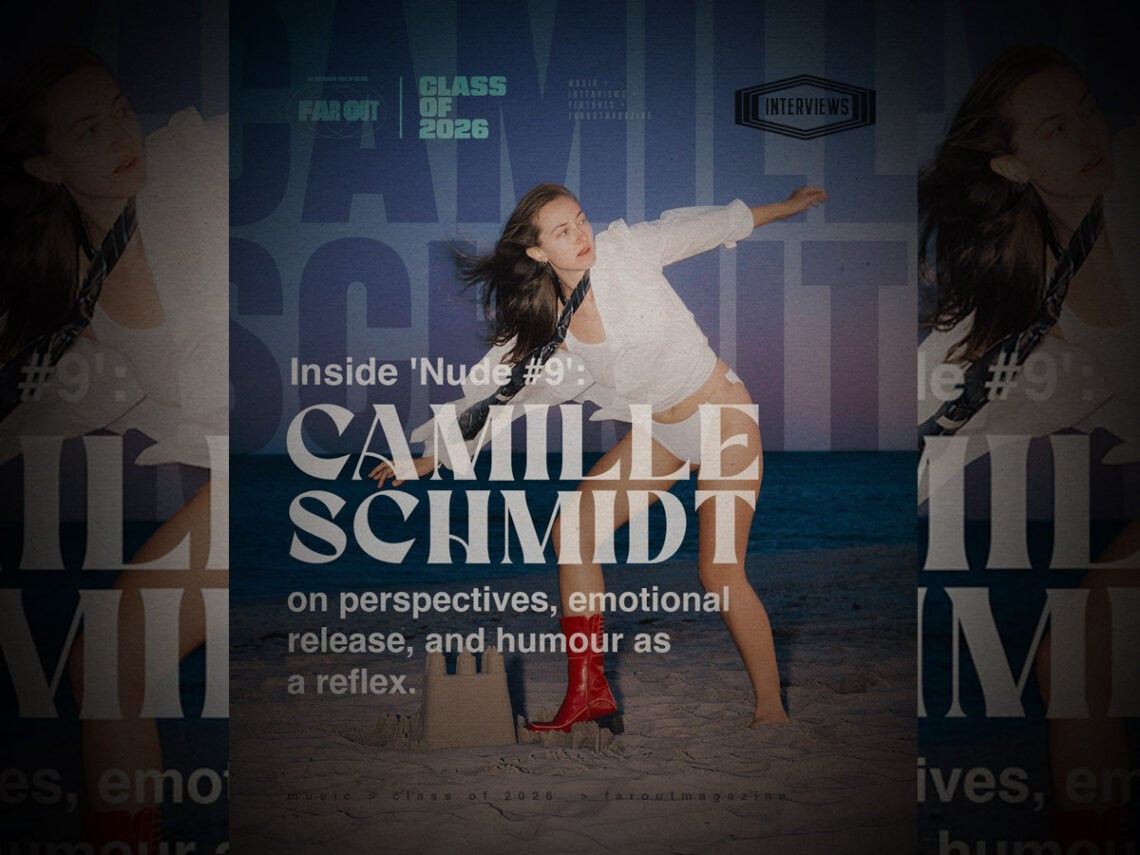
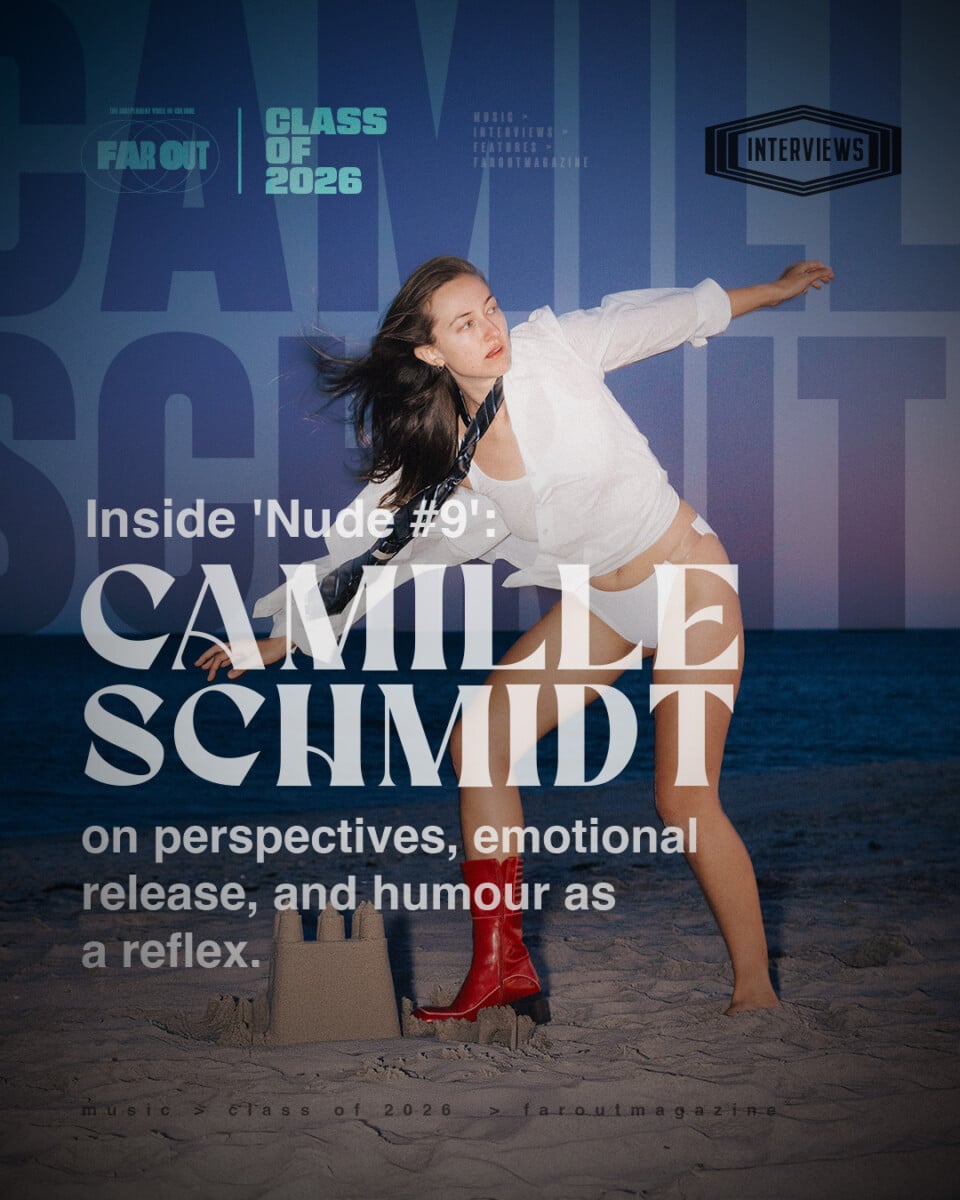
Inside ‘Nude #9’: Camille Schmidt on perspectives, emotional release, and humour as a reflex

Editor’s Note: For 2026, Far Out didn’t just want to recommend ones to watch; we wanted to stick with them. Selecting five artists set for greatness – spotlighting Pem, ELLiS-D, Jeanie and the White Boys, Camille Schmidt and Imogen and the Knife – our Class of 2026 spans genres and countries to back the best of the rising stars. In a series of repeat conversations pairing each act with a writer, we’ll be checking in with them throughout the year, tracking the highs, lows, trials and triumphs of the talent we believe in. For the second check-in, Kelly Murphy spoke with Camille Schmidt about her groundbreaking debut record, Nude #9.
By the end of last year, Camille Schmidt was reflecting a lot on what it meant to hold on. “I often think of life as a cycle of amassing and releasing, building up and letting go,” she told Far Out at the time, as part of the initial Class of 2026 spotlight introduction. “I’ve spent much of my life amassing experiences, feelings, general ‘stuff’, and then holding on to it. This past year has been about release, Nude #9 included.”
Nude #9 was a remarkable debut, one that not only mirrored Schmidt’s approach and attitude as one of New York’s most exciting new artists but also demonstrated the vulnerabilities of her own perils in life and love. Through ten beautifully honest tracks, Schmidt dances between humour, playful self-deprecation, and heartfelt one-liners that’ll most certainly floor you on first listen, and hit even harder when you listen again.
When we think about release in the way Schmidt tackled in year end-of-year reflections, Nude #9 was, as the title itself suggests, a bare soul conversing with its own demons not to make sense of everything that she’s been through but to give it the space and time to figure itself out – to linger on the beauty in between the lines of tragedy and embrace them as integral parts of herself.
While interviewing Schmidt, it became clear that there is no beginning, middle or end when looking at her story so far – it’s all one gloriously kaleidoscopic concoction of emotions and occurrences, some incredibly personal and confrontational for Schmidt to have been through; others joyful and more lighthearted in essence. Perhaps the defining facet, however, the one that gives the entire project context, is that all of it is a matter of perspective.
As she tells me midway through our conversation, “When I’m writing, it feels a little self-centred to not be able to find any humour in it. But at the same time, I think it’s a coping mechanism to laugh about something that feels really hard.”
This comment followed a mention of George Orwell’s A Hanging, a bleak reference to start with, but one that feels especially relevant on the topic of perspective and utilising nuance in ways that make it impossible to categorise as solely dark or solely light. On Nude #9, the songs flourish because they’re a bit of everything, a true picture of what it means to experience things that are often mixed with all the different flavourings of life.
Schmidt uses one part of Orwell’s essay to demonstrate her point – the moment when the prisoner gets hanged, and we’re let in to the bustle around him: the reactions from the prison guards, the nonchalance, the disassociation as the reader, the moral reflection after the fact. All of which is punctuated by a moment Schmidt thinks about a lot: the dog that bounds into the prison yard and licks the prisoner’s face, a moment of clarity that strengthens its broader message.
“It really speaks to me,” Schmidt says. “How the dog comes in, not understanding the gravity of the situation, the way the prisoners do, but also not reacting like the prison guards, who are so used to these hangings that as soon as this one is done, they start thinking about what they’ll eat for lunch. There’s this feeling that, suddenly, amidst the banality and the horror, there is joy. And not just naive joy, but a joy that feels wise and truer than apathy. And I think about that a lot. How often, next to a body decomposing, there is something growing – a flower, a tree, a patch of grass. And that doesn’t take away from the darkness of the thing, rather it adds perspective to it.”
Those flickers of different perspectives, although sometimes heady and tough to swallow, are precisely what give her debut its taste. And the ease with which she threads humour throughout, particularly on tracks like ‘XOXO’, makes the entire experience feel more human and relatable, and like a constant magnet that keeps you coming back.
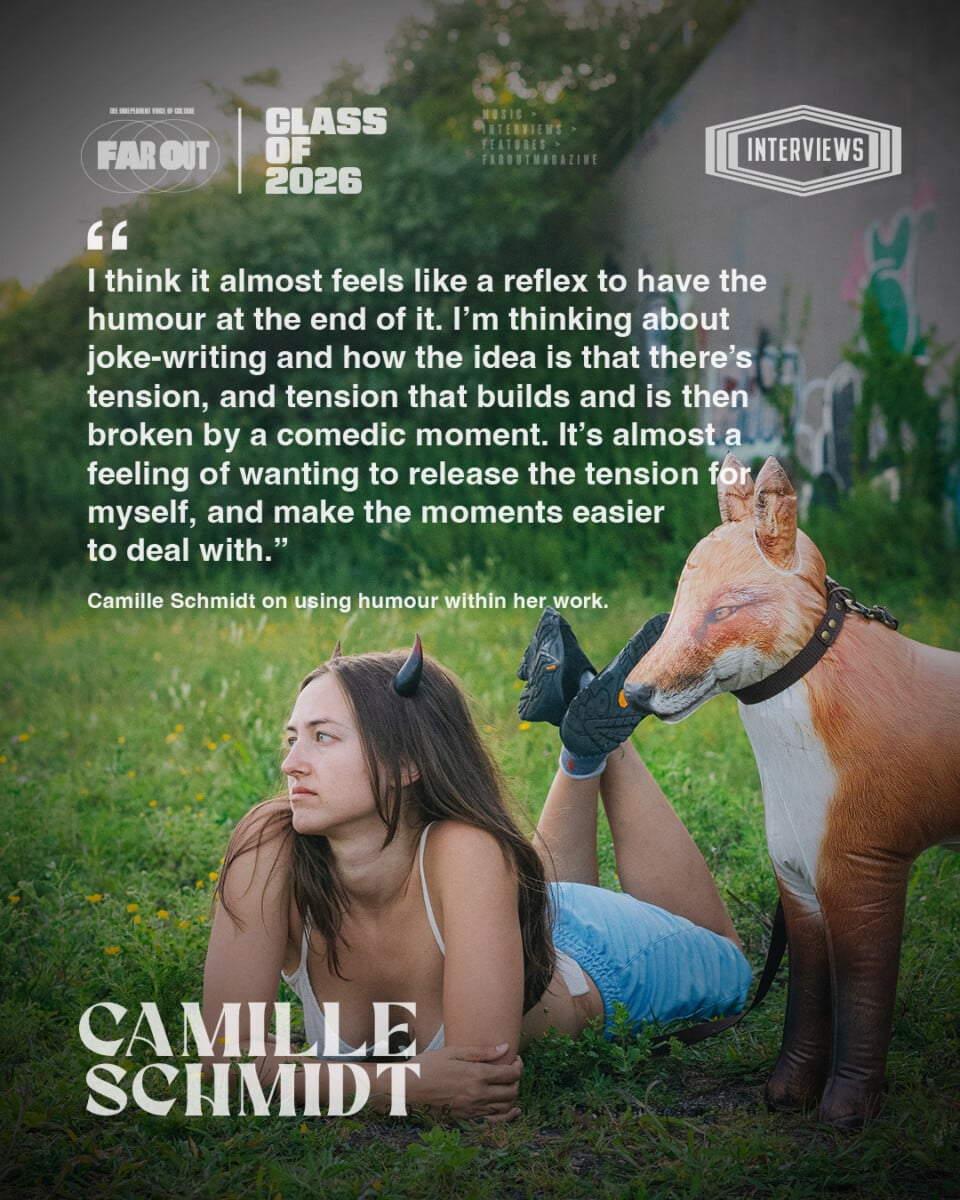
“I think it’s actually harder to stay in the dark part of it,” says Schmidt. “I think it almost feels like a reflex to have the humour at the end of it. I’m thinking about joke-writing and how the idea is that there’s tension, and tension that builds and is then broken by a comedic moment. It’s almost a feeling of wanting to release the tension for myself, [and] make the moments easier to deal with.”
In terms of narrative, Schmidt explains that this naturally formed as she was writing, and the emotional sequencing became the anchor that informed the rest of the journey. “It was kind of this confessional, diaristic style writing that was slightly pop-ish, but also a little bit more abstract in the shapes of the songs. ‘Blood, Love & Blessings’, for instance, is a song that has this repeated motif, as opposed to a direct chorus.”
“When we looked through the forty or so demos, it quickly became clear which songs were favourites and which felt the most emotionally charged,” she continues. “Around 15 were the top contenders. And then once we had those 15, it was about: what’s the specific narrative? Are some of these songs going to want a different sonic world than the album wants? There were songs we tried working on that wanted a country feel, and when we mixed that in with the others, it felt odd, like those two or three songs wanted their own project. In that sense, the narrowing down always gets harder the closer you get.”
The journey had to make sense emotionally for Schmidt, which also means that, when you write from a place that’s as honest as she does, there’s also the risk of revealing too much, especially if the stories you’re writing about concern real events, or perhaps more crucial, real people. On this record, Schmidt encountered moments when people she knew were seeing those experiences from different perspectives for the first time, with varying degrees of understanding.
“I think the most important conversation ended up being one with a friend where we just talked about a story of hers I wanted to include in a verse and why she validly felt that was inappropriate,” says Schmidt. “It was very informative. I learned a lot from hearing her thoughts on that, and it strengthened our friendship.” However, sometimes, she explains, it’s a different response. “You can say something that’s kind of like, ‘Oh, I thought this person might be really offended by this,’ but when they hear it, they’re like, ‘That’s exactly what I did, and I feel totally okay about it.’”
She continues, “So it was a real combination. I think it would be nice to have like, the overarching narrative of, ‘Oh, it turns out, being honest is a way to free yourself of the shackles of polite society, and I don’t know, and free yourself in your relationships. But it didn’t feel necessarily like that. It felt more like a personal freeing for me, and then the world kind of stayed, for the most part, the same around me.”
When each song forms a part of a whole, as we’ve seen, it makes it even more interesting to think about which Schmidt holds the closest to her. There are many major standouts, from navigating confusion in ‘Cult in Denver’ to poignant rumination on loss in ‘Heaven’, but all of these moments are compounded by sharp words and witty wordplay, making it difficult to linger on just one for longer than the others.
“I really, I like them all in different ways,” says Schmidt. “It makes me sad sometimes to play ‘Daddy Long Legs’ live, so I almost never rehearse it beforehand. ‘XOXO’ is so fun to play because of the vocoder. And what’s great is that the vocoder requires hands, and I can’t do it when I’m playing a guitar. So I usually bring someone on stage to play it for me. I love playing ‘XOXO’ and ‘Cult in Denver’. Those are probably my favourites to play.”
She continues, “I also love playing ‘Proton Electron Photon’ live. That might be one of my favourites. And sometimes I really like playing ‘Heaven’ live, because the audience always makes the same noises at the same moments, and they laugh after the blow job [reference], and there’s always uncomfortable laughter coming from whatever size crowd at the exact same moment. I think the only songs I can listen to are ‘Stanley’ and ‘Blood, Love & Blessings’.”
And in terms of what’s to come? Listening to Schmidt discuss how ‘Stanley’ is the closest glimpse, it’s certain that we’re all in for an even bigger treat and an extension into something even more profound – without compromising on the sheer fun and joy Schmidt has cultivated thus far. In fact, that’s bound to be the entire point: to have fun, get on her dancing shoes, and escape for one moment, even if what she’s singing about isn’t all joyful, all the time.
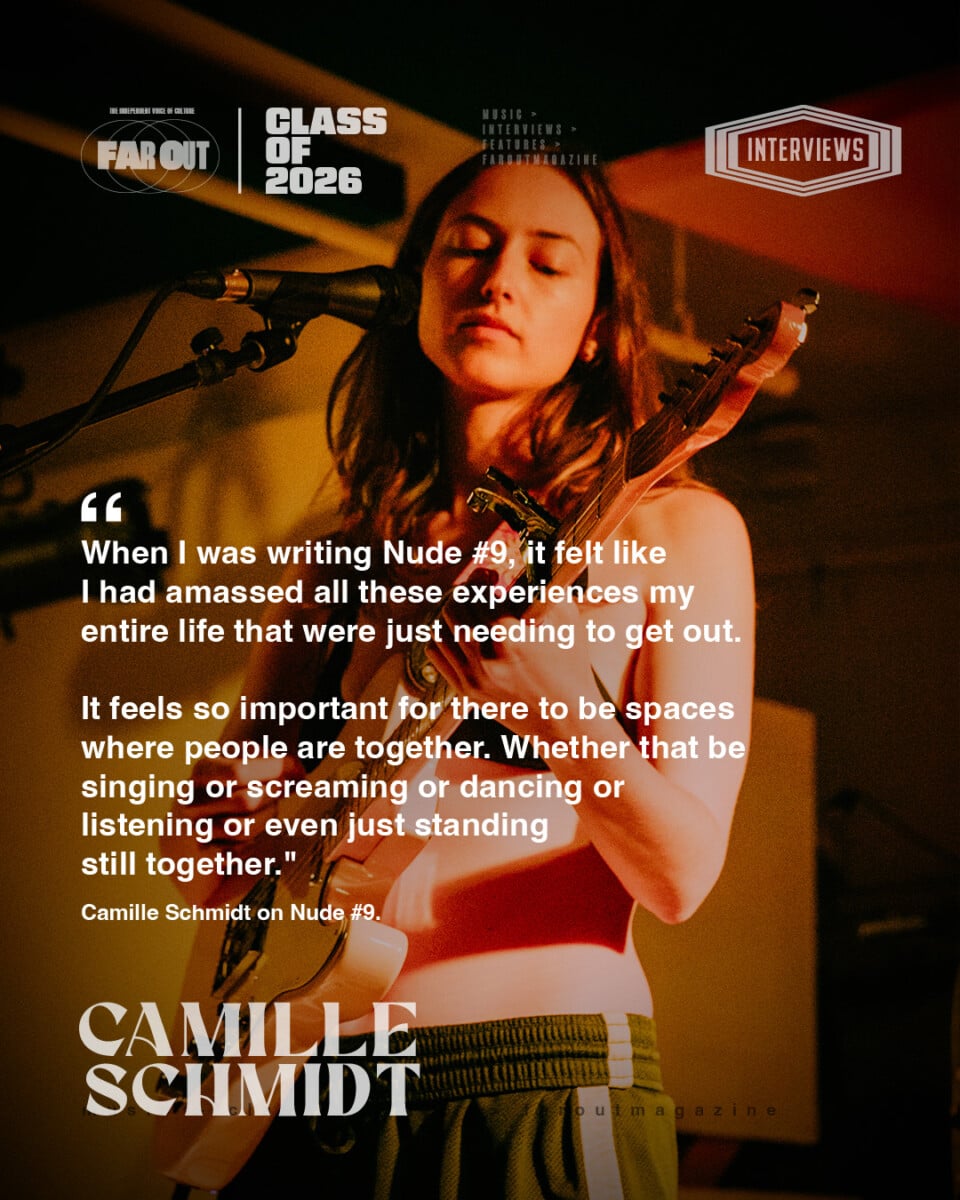
“I want to just have fun, dance around the stage, have a really good time,” says Schmidt. “When I was writing Nude #9, it felt like I had amassed all these experiences my entire life that were just needing to get out.” The next venture, she explains, will focus on the next stage of this process – of feeling and being in the moment. “It feels so important for there to be spaces where people are together. Whether that be singing or screaming or dancing or listening or even just standing still together.”
Release, in this sense, means letting it all go – the emotion, the tension, everything you feel in the moment, a catharsis that relieves you of the energies you’ve been holding onto in normal, everyday life. To demonstrate the significance of this, Schmidt refers to another example: a video, this time, depicting an antelope being chased by a lion. After being in a “short but sustained period” of fight-or-flight, the antelope escapes, then shakes for about 15 seconds before walking away.
“I have kind of been thinking about it constantly since I saw that video about how to process trauma in the body,” says Schmidt. “[About] how to move any emotion through the body. So there’s often a physical component that has nothing to do with just talking about the feeling.”
Earlier, Schmidt had told me how she takes the idea of taking “fun” and “catharsis” very seriously, as something that can be a tool for both mental well-being and real social change. It’s a philosophy that feels especially crucial right now, at a time when live music has become a novelty activity where people are less inclined to be passive or engaged in their own personal problems and more inclined to engage in the serious act of escapism.
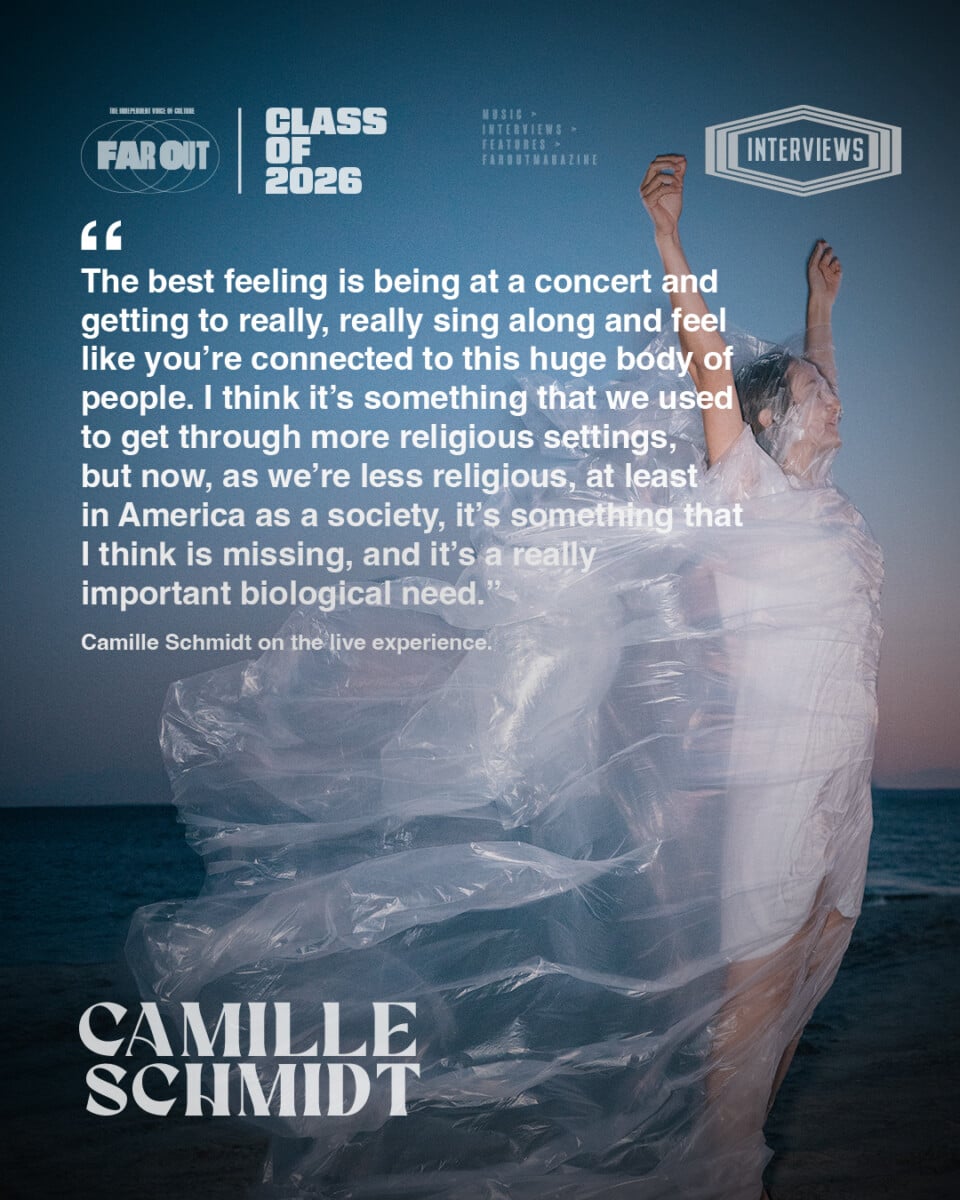
“The best feeling is being at a concert and getting to really, really sing along and feel like you’re connected to this huge body of people,” she says. “I think it’s something that we used to get through more religious settings, but now, as we’re less religious, at least in America as a society, it’s something that I think is missing, and it’s a really important biological need.”