


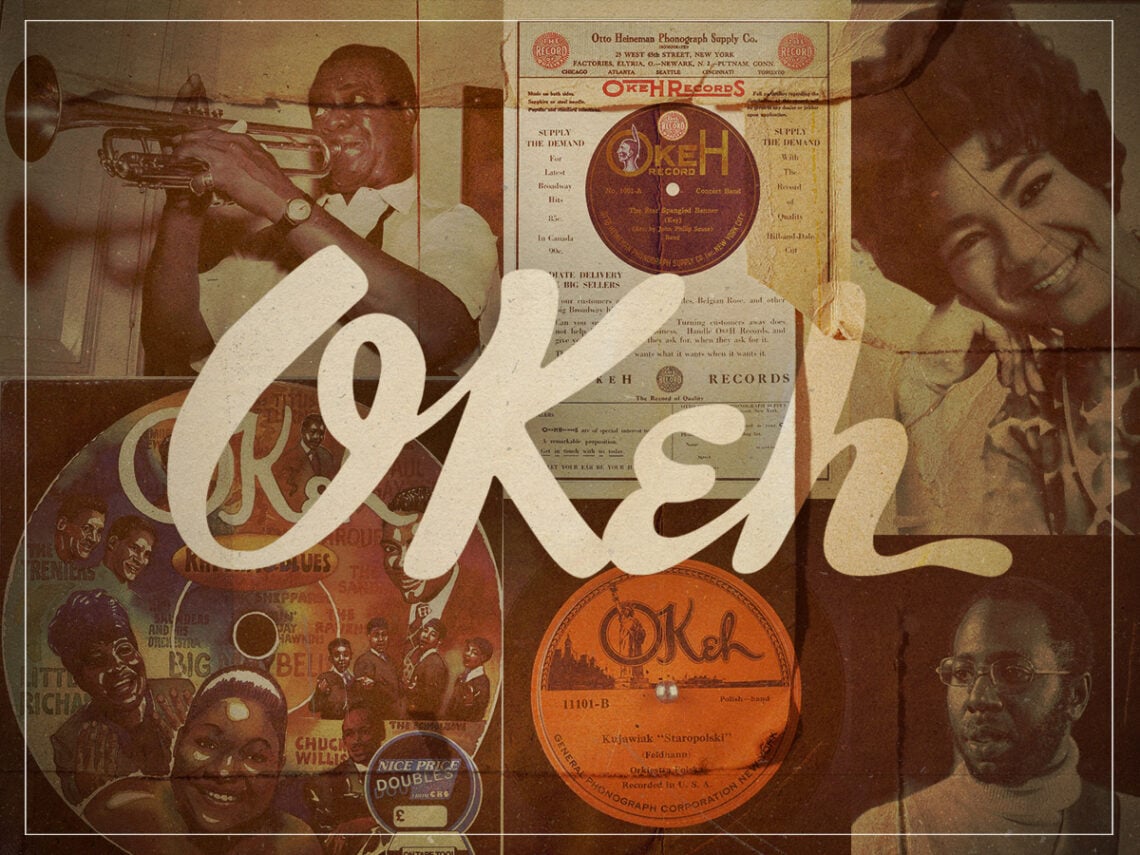
Vaudeville skits to northern soul stompers: the story of Okeh Records

Northern soul is a scene that places almost as much importance on record labels as on artists themselves. For a movement dominated by obscure artists, many of whom only released one or two tracks in total, the sight of a recognisable label like Ric-Tic, Golden World, or even Motown can be an easy way of identifying the sound of an artist you have never heard of before. Chances are, if you have spent enough weekends flicking through boxes of singles at record fairs, you have encountered 45s with bold purple labels emblazoned with the word ‘Okeh’.
Okeh Records is among the defining record labels of northern soul, having released countless iconic floor-fillers, from the elusive mastery of Sandi Sheldon’s ‘You’re Gonna Make Me Love You’ to Billy Butler’s ‘Right Track’. Unlike many of the record labels that came to define northern soul, OKeh boasted a history which extended far before the advent of American soul and R&B music. In fact, the label’s origins date back over a century, to its first foundation in 1918.
Okeh was founded by the German-American businessman and music mogul Otto Karl Erich Heinemann, who had previously worked closely with the American branch of the German label Odeon Records. In stark contrast to the short, sharp 45rpm singles that the label would be synonymous with in later decades, the very first Okeh releases were cut vertically at Heinemann’s pressing plant in New York City, and usually comprised of vaudeville skits, or popular dance songs.
As the label progressed, switching to lateral-cut phonograph records during the 1920s, it became an early support of New York jazz during the 1920s. Representing a bold new era for grassroots music in America, jazz reflected the boom period of the 1920s, and Okeh was essential in getting those revolutionary sounds to mass audiences. What’s more, the label also saw the power in supporting the diverse community of the East Coast city, putting out foreign language records in German, Czech, Polish, Swedish, and Yiddish.
Alongside its support of jazz – issuing early records by artists like Louis Armstrong – Okeh became a key outlet for blues artists during the 1920s. Soon, the New York label had become so influential in the local scene that Columbia Records bought out the label in 1926. After being sold to Columbia, Okeh changed hands various times during the 1930s, during which time its releases became fairly sporadic.
It wasn’t until the early 1950s that Okeh returned in full force, becoming a haven for incredible blues and R&B records, many of which heavily influenced the development of rock and roll towards the end of the decade. However, it was during the 1960s that Okeh really hit its stride, capitalising on the increased relevance of soul music – spurred on by larger labels like Motown, Stax, and Atlantic – the label signed artists like Major Lance, Johnny ‘Guitar’ Watson, and even Little Richard.
If that wasn’t enough, the label also recruited Curtis Mayfield as a primary songwriter for their output. It was during this time that Okeh produced the bulk of soul records that went on to become coveted by northern soul collectors in subsequent years. Although the label never witnessed the same kind of mainstream commercial success as the likes of Motown, it was prolific in its output, putting out some of the most innovative and timeless soul tunes of all time.
As fate would have it, Mayfield left the label towards the end of the 1960s, shifting his focus onto his own incredible solo career. With his departure coupled with declining sales, Columbia shelved the Okeh imprint in 1970. It wasn’t until 1993 that the label was relaunched by Sony Music, this time as a modern blues label, but this resurgence was ultimately short-lived, and Okeh slipped back into obscurity in 2000.
Today, Okeh Records is still in operation, having been relaunched once again by Sony in 2013 as a jazz imprint. Its roster includes the likes of Regina Carter, Bob James, and Dhafer Youssef. For ordinary listeners, Okeh remains a fairly obscure imprint focused on speciality releases from the world of jazz, but the extensive history of the label has had an incredible impact on the history of popular music in America.
So, the next time you are flicking through a box of soul singles and spot that famous purple label, you will know that the foot-stomping northern soul contained within its grooves have their roots in early 20th-century vaudeville skits and vertical-cut phonograph cylinders.
