


The great non-place of Spotify: How music culture was enshitified by streaming

“If creators are using these technologies and are successful, we should let people listen to them.” – Spotify co-president Gustav Söderström
The midday sun shimmers through the stained glass windows, casting a multicoloured spectrum upon the fresh produce as though God himself is trying to aid a sale. A mound of olives has never looked so resplendent. You could walk around Barcelona’s famed Mercat de la Boqueria for hours and never once make a purchase. Imagine doing the same down at your local supermarket?
Mercat de la Boqueria is a temple to the toil of the farmers, seafarers, and anyone else who sells their wares under its ornate roof. It is clearly designed as a passionate celebration of sustenance in the most glorified sense. Plenty of people flock there daily just for the pleasure of being within its decadent confines. If you did the same at an ASDA, it wouldn’t be long before you were escorted from the premises for showing signs of mental instability.
That disparity is because one market is a ‘place’, designed to draw an emotional response, a sense of engagement, a manifested display of local culture. The other is a ‘non-place’ of pure functionality, designed for you to pass through efficiently in order to streamline a commercial interaction. These soulless places of extreme efficiency are the same all over the world.
When Marc Augé coined the term ‘non-place’ in the early 1990s, he had things like supermarkets, airports, and even hotels in mind. They are things that you pass through without realising, barely getting a sense of them beyond a clear knowledge of their purpose. However, the rise of non-places is a sensation that seems to have spread to the internet.
This is bad news for the cyber-sphere as the rise of such vacuums seems to go hand in hand with continual ‘enshitification’ to form a double-pronged downward spiral into the depths of automated mundanity. The latter is another modern philosophical term coined by Corey Doctorow. It essentially explains how online platforms grow their way towards an inevitable decline.
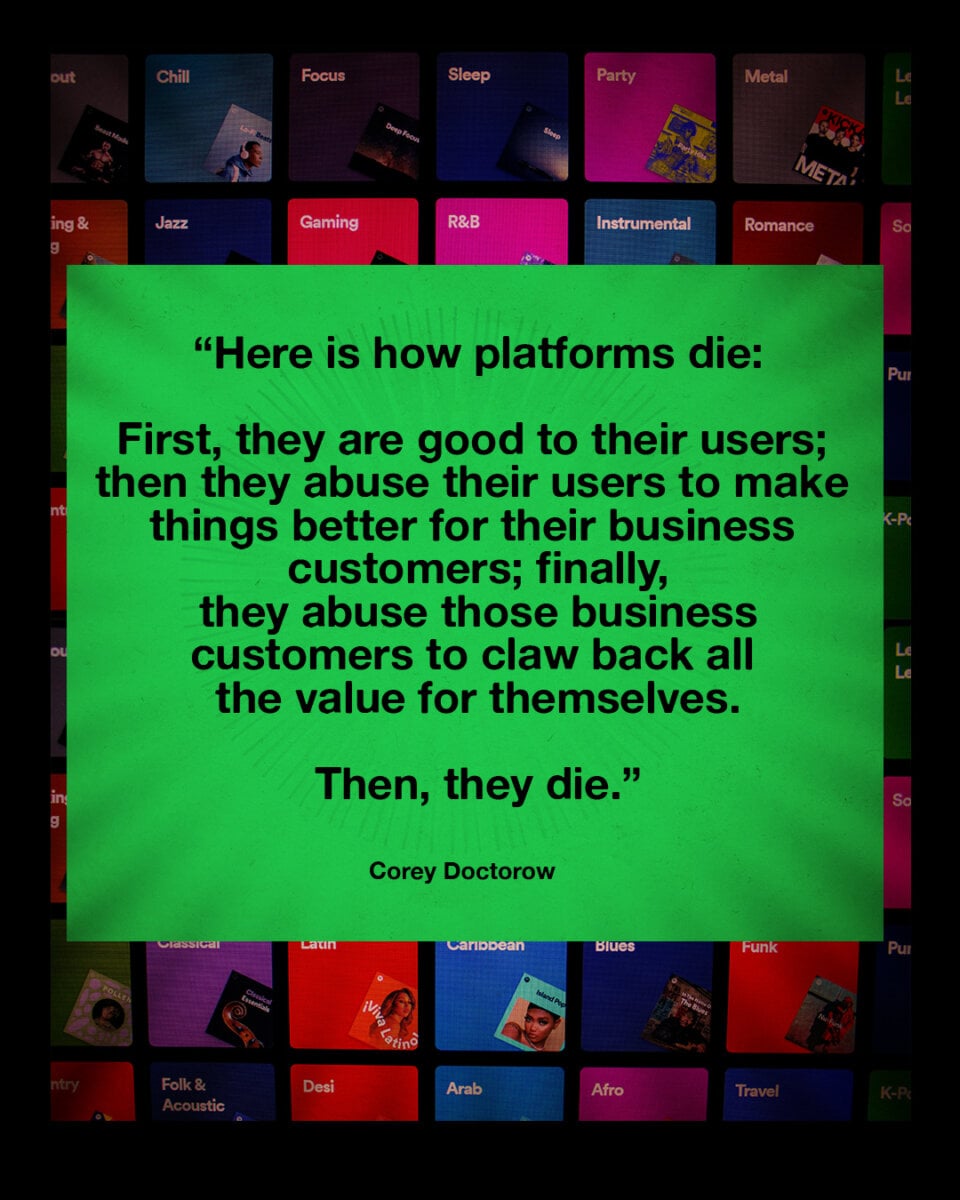
This is how Doctorow defines the mechanics of enshitification: “Here is how platforms die: First, they are good to their users; then they abuse their users to make things better for their business customers; finally, they abuse those business customers to claw back all the value for themselves. Then, they die.”
It’s not hard to see how Spotify falls into that familiar pattern. For a long time, artists have vilified the music streaming service. But even as you morally applauded their efforts back in circa 2015, the elephant in the room sorely hamstrung the potency of their arguments: Spotify was brilliant for users. This was a point proven by the fact that 99.9% of the performers who spoke out against it also happily used it.
It was so good, in fact, that there were legitimate fears of ‘be careful what you wish for’ among the naysayers. Every year, the streaming service would drop you a reminder of how effective a platform it was in an annual ‘Wrapped’ feature that said, ‘Tom, you listened to 23,396 different artists this year’. I’m not sure a more conventional platform, like a radio station, would give quite so many musicians a space to be heard by the global masses.
So, while its royalties might have been rubbish, it racked up millions of new subscribers – even ones who were sympathetic to the plight of the performers riling against it – because of how user-friendly it was. In the midst of an economic permacrisis most people can’t afford to support artists through expensive physical sales, but it was so easy to park that ‘supporting the artists’ concern when every song you ever liked was a click away for a few quid a month.
In short, Spotify became the most secretly beloved app in human history. Its users, no matter how much they publicly stated otherwise, were satisfied. The issue it had was appeasing its business customers. The fundamental flaw in its business model was that it was reliant on the same labels and creators it was looking to undercut.
Bucking the typical trend of enshitification, it seems Spotify had an eye on making things better for its business customers early on. Back in 2008, Swedish news site ComputerSweden reported that major labels were given cheap shares in the platform. “Sony BMG, Universal Music, Warner Music, EMI and Merlin,” they reported, “bought at the time into Spotify – for a pittance. They received 18% of the shares in Spotify for barely 100,000 kronor [about €10,000].”
Thereafter, Spotify founder Daniel Ek continually rolled out the rebuttal that his platform paid as much as they possibly could while staying afloat to the record labels, so if artists weren’t getting their fair share, then the blame lay with whoever they were signed to. In 2021, they even rolled out Loud & Clear reports, transparently displaying the lucrative transactions that surely made them the good guys after all.
Even Magnus Uggla, the first major artist (at least in his native Sweden) to pull his music from Spotify way back in 2009, argued that his label, Sony, were at least as culpable as Spotify when it came to the measly royalties he was receiving from streaming.
He commented that “after suing the shit out of Pirate Bay, they’re acting just like them by not paying the artists,” accusing Sony boss Hasse Breitholtz of figuratively fucking him “up the ass” and that he’d prefer to be symbolically shafted by Pirate Bay instead.
While a swarm of asterisks surround the ‘Spotify being the good guys in the equation’ point, a swarm so vast that it’s nullified as an untruth, they did have to be at least fairly kind to labels. After all, if, for instance, Sony and UMG decided it wasn’t proving profitable enough for them and they pulled all their music from the platform, it would pretty much kill Spotify overnight.
So, Spotify operated at a loss for years. In the meantime, it built up a supremely satisfied user base that its business customers couldn’t ignore, made it clear to said business customers that streaming was the future, and kept them just about sweet enough to ensure continued growth without any nasty label-boycott shaped curveballs.
Ultimately, everyone bar the artists were happy, and even they were wary of going without it. Alas, we have now reached the point where the enshitification long game has come to fruition. And it has come to fruition in the form of the aptly named Velvet Sundown, the soft-rock swansong of the age of premium streaming.
This AI creation has remained online, racking up millions of listens despite being called out months ago as being inhuman in more ways than one. That’s because it is only written into Spotify policy to remove AI content when it imitates a specific artist. Seeing as though The Velvet Sundown imitates thousands of different artists at once to create a form of folk rock tulpa, it is allowed to remain present on the platform.
While the upload source of the mystery band remains unproven, the implications for Spotify and labels are clear. You can make money from music without having to rely on real artists. Thusly, you retain the royalties. By rights, the major labels should’ve released vehement statements condemning The Velvet Sundown by now if they did, indeed, disagree with the principle of a streaming platform promoting them.
But as Uggla argued decades ago, labels have been in bed with Spotify from the very start. This always conjured thorny complications, but barring the artists raising the alarm, it was simply so handy that very few people really seemed to care. Year-on-year, it has attracted users, with 675million monthly users, 276million of which are premium subscribers.
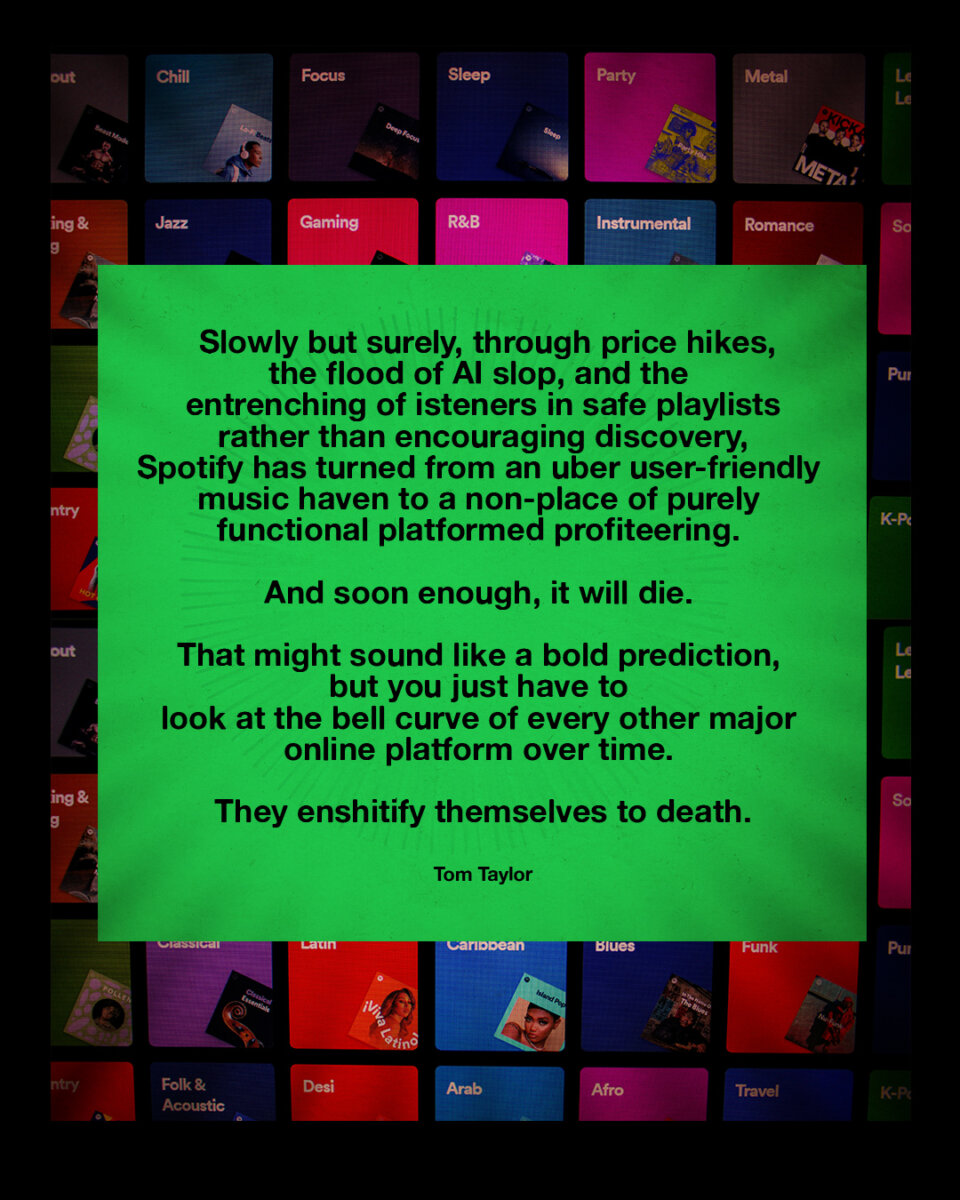
However, slowly but surely, through price hikes, the flood of AI slop, and the entrenching of listeners in safe playlists rather than encouraging discovery, Spotify has turned from an uber user-friendly music haven to a non-place of purely functional platformed profiteering. And soon enough, it will die. That might sound like a bold prediction, but you just have to look at the bell curve of every other major online platform over time. They enshitify themselves to death.
The tragedy in this instance will not necessarily be the loss of Spotify, but how it has made music culture a non-place along the way. Increasingly, there is a distinct lack of humanity on Spotify, and cultures around it have followed suit. What was once an excitable hub is now full of algorithmically-generated playlists promoting artists who don’t even exist for users who hit play at the start of the day.
It has become a tool for passive background functionality. It is the supermarket of music culture, you just glide through for convenience without any real engagement. And sadly, it’s the supermarket that the bulk of the world shops at exclusively.
At its best, music culture is a Mercat de la Boqueria, you peruse the aisles in wonder, recognising the humanity and toil behind the wares on display, and even if it’s not to your palette, a sense of understanding and enrichment has taken place. That enriching engagement has been eroded steadily by increasing commercialism, AI, virality obsession, algorithms, cloaked partnerships, and an arsenal of other onslaughts.
At Far Out Magazine, we are entirely independent and proudly AI-free. We know those choices, ironically, hinder us to some extent, putting us perilously at odds with the ways of the algorithmic age, but they are choices we make because they matter to us. Of course, there are functional trade-offs in our editorial, but these aim to manipulate the capricious hands that the algorithms deal so that we can champion the human side of culture, even when it is inconvenient. Any profit that affords us is a by-product, an essential one, but certainly not the purpose. We feel that’s how it should be. But that’s not often how it is.
Culture should be a proud place of impassioned wares on display for the good of society, not a non-place of passive, background playlist, detached scrolling profit for the good of a few select pockets.
To conclude the potentially clumsy analogy that began this piece: ask a thousand children to design a market, and every submission will be resplendent with quirks and passions as opposed to pure functionality. That’s only natural. Humans want to impart something beyond purpose, the very existence of music implies that.
But more and more, Spotify has made music a supermarket of sound, one infiltrated with sloppy, unregulated junk food. At its best, music culture deserves to be a Mercat de la Boqueria, where the masses wander happily rather than passively, celebrating the proud, unruly ways of human creativity, even if none of us can afford to buy anything as we stroll through.
