


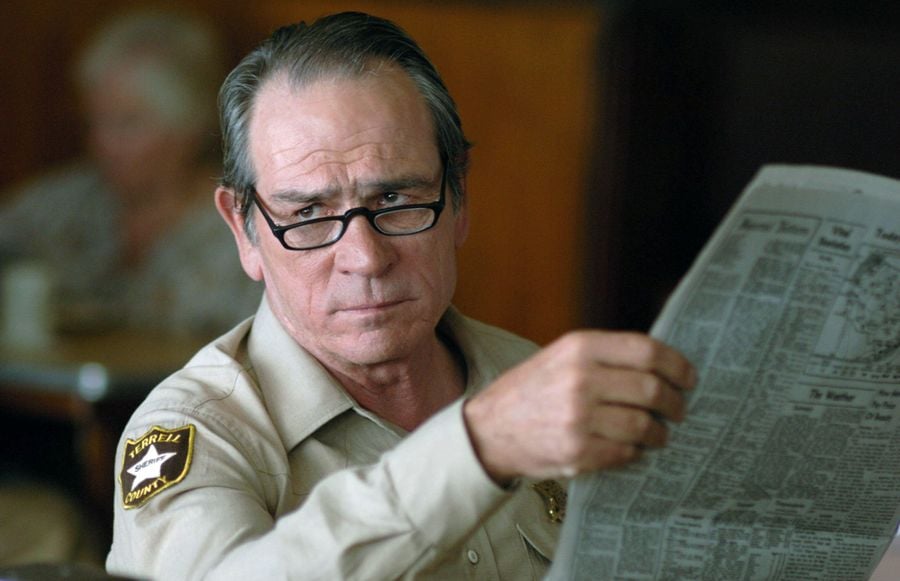
How ‘No Country for Old Men’ subtly paid homage to a classic Coen brothers inspiration

“You never know what worse luck your bad luck has saved you from,” Corman McCarthy writes in the No Country for Old Men novel. While McCarthy’s usual work doesn’t scream the Coen brothers, lines like this one, and others like “The point is there ain’t no point,” formed a perfect touchstone for cinema’s finest purveyors of the absurdism of reality on this occasion. The resulting film was a masterpiece.
Naturally, when you’re dealing with a writer as esteemed as McCarthy and a text as fine-tuned as No Country for Old Men, you don’t want to change things too much. In this regard, the film almost opens up an alternate career course for the brothers where they dropped their cultish muse and went down a more commercial blockbuster route. However, they still found time to drop their hat to an eternal influence that perhaps led them to the bag-of-cash premise of No Country for Old Men in the first place.
In The Big Lebowski, Walter proclaims: “That’s right, Dude. The beauty of this is its simplicity. Once a plan gets too complex, everything can go wrong.” The same can be said for plots. In No Country, a very simple vehicle allows for so much subtextual exploration without ever getting convoluted. This has always been a method that the Coens have supported with the exception of Burn After Reading whereby they brilliantly inversed the whole notion.
This way of looking at things was inspired by noir fiction and early film noir. Thus, it comes as little surprise that during the film a little nod is given to one of their favourites whereby a brief clip is shown on an old TV set of the 1953 film Flight to Tangier—another bag-of-cash film. The old film plays in the background when Llewelyn (Josh Brolin) first returns home to his trailer with an attache full of money, where Carla Jean (Kelly Macdonald) watches the TV.
The synopsis for the Charles Marquis Warren picture reads: “During the Cold War, a mysterious plane carrying $3 million arrives at Tangier airport, and various interested parties try to grab the cash.” Essentially, the plot is the same, it’s the prose that has changed. Whilst it’s the fanfare of thrilling chase in the original, it’s comments like “I tried to put things in perspective but sometimes you’re just too close to it,” that colour the film with depth.
While this nod might not add much, it is a mark of how detail-focussed the Coen brothers are. Aside from what we see on screen, they have stewed over the noir genre for aeons, and this obscure reference is proof. It says nothing about No Country for Old Men, but it is a measure of the myriad subtext swirling beneath the brilliantly shot surface.
