


“You played the wrong song”: the night The Cure were too drunk to perform

It is impossible to imagine anyone singing the tragically romantic goth-pop of The Cure other than Robert Smith, but, for a time, the frontman was merely one of several floating members among a rotation of lead singers, never intending to assume the role he somewhat fell into.
Smith’s introduction to music came as a child, in a moment of competition with his younger sister, Janet. “[Janet] was a piano prodigy, so sibling rivalry made me take up guitar because she couldn’t get her fingers around the neck,” Smith confessed to Guitar Player in 1992.
When he turned seven years old, his older brother, Richard, taught him some basic guitar chords and years later, with a gifted guitar, he began to take his musicianship more seriously. Music became a great passion, but singing was nowhere near the forefront of Smith’s mind.
“For whatever reason, when I sing, people connect with it,” Smith reflected to Tim Burgess on Absolute Radio’s Tim’s Listening Party in 2024. “And it’s one of those things that I have no idea why, and I don’t think any singer does. I was horrified when I ended up as the singer… At school, I never did anything on stage. I was always doing wardrobe stuff.”
In his school days, at age 13, Smith formed one band while at Notre Dame Middle School in Crawley, for a one-off performance: The Obelisk, with Michael Dempsey on guitar, Lol Tolhurst on percussion, Marc Ceccagno on lead guitar and Alan Hill on bass – the initial lineup of what would evolve into The Cure.
Smith still never intended to become the singer, content with being in the background as the band’s lineup and identity continued to shift. The Obelisk became The Group, then Malice, then Easy Cure, cycling through an estimated (by Smith) five different singers before landing on Smith, by default.
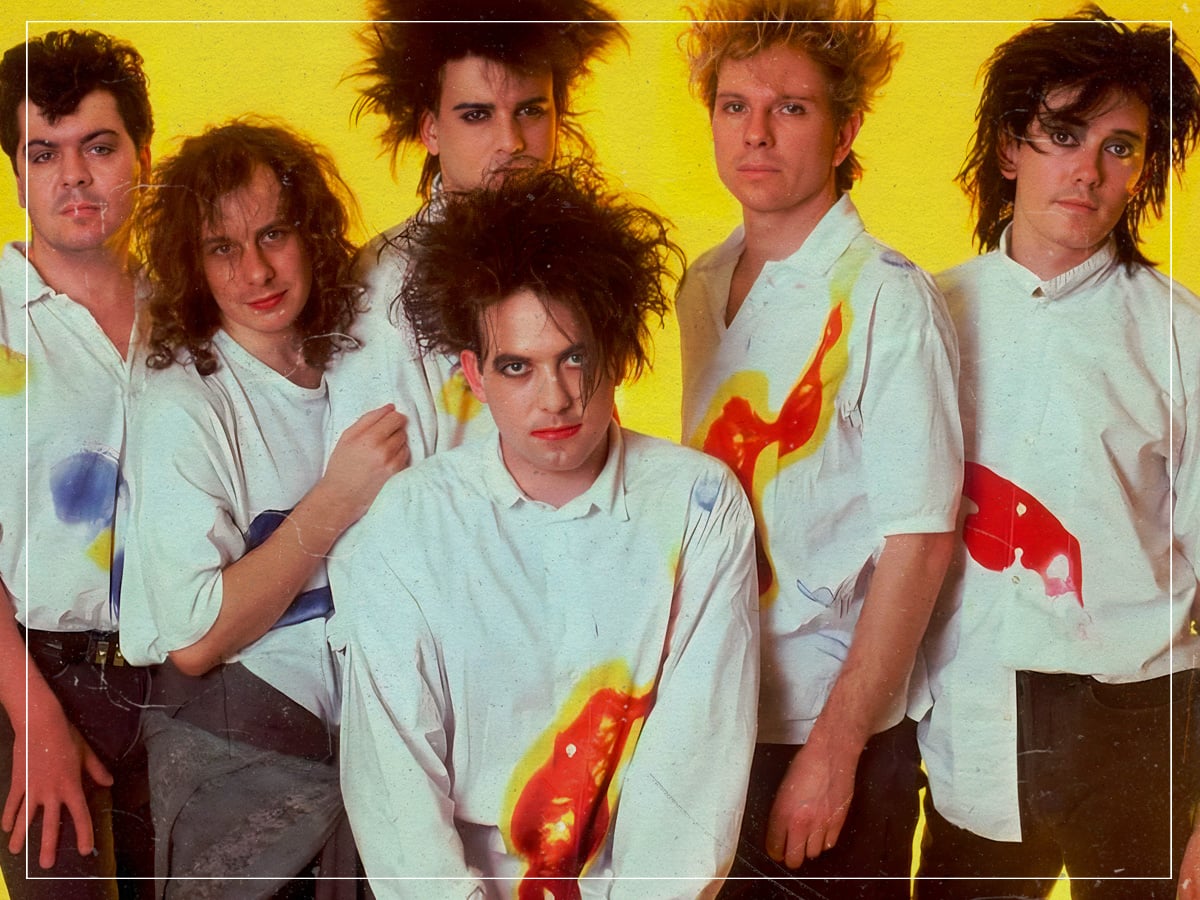
“I always ended up thinking, ‘I could do better than this,” Smith said to Musician magazine in 1989, of the frontmen who came before him. “I mean, I hated my voice, but I didn’t hate it more than I hated everyone else’s voice. So I thought, ‘If I can get away with that, I can be the singer.’ I’ve worked on that basis ever since.”
At one of The Cure’s first shows, Smith would try his hand at singing – with an unfortunately rocky start. He obliged to sing one song, but mistakenly was on another page than his bandmates.
“I sang one song at our first show, just to see what it felt like, and I sang the wrong song,” he revealed to Tim Burgess. “I played and sang ‘Suffragette City’ and everyone else was doing ‘Foxy Lady’, and I was so drunk, I didn’t even know.”
“I thought, ‘That was good!’” Smith continued with a laugh. “And everyone’s like, ‘You played the wrong song!’”
Smith shared that he never felt like he “was cut out to be a singer,” and it became a role that he found comfort in, in time. He revealed that on The Cure’s earliest recordings, his voice is intentionally lower in the mix. Slowly, because of the reception from The Cure’s most ardent fans, Smith’s position at the helm of the band felt more natural.
“When I started singing, I didn’t think that anyone would like what I sounded like,” he admitted. “I didn’t, so I thought, no one else is going to. And so I thought, ‘This is going to be a really short career until we find someone who can sing.’ So I sang the first album and then discovered that people liked what I was doing.”
With a voice truly unlike any other, Smith continues to elevate The Cure onto a pedestal of their own, as their both melancholic and joyous songbook defines a realm of alternative music that will forever resonate.
