


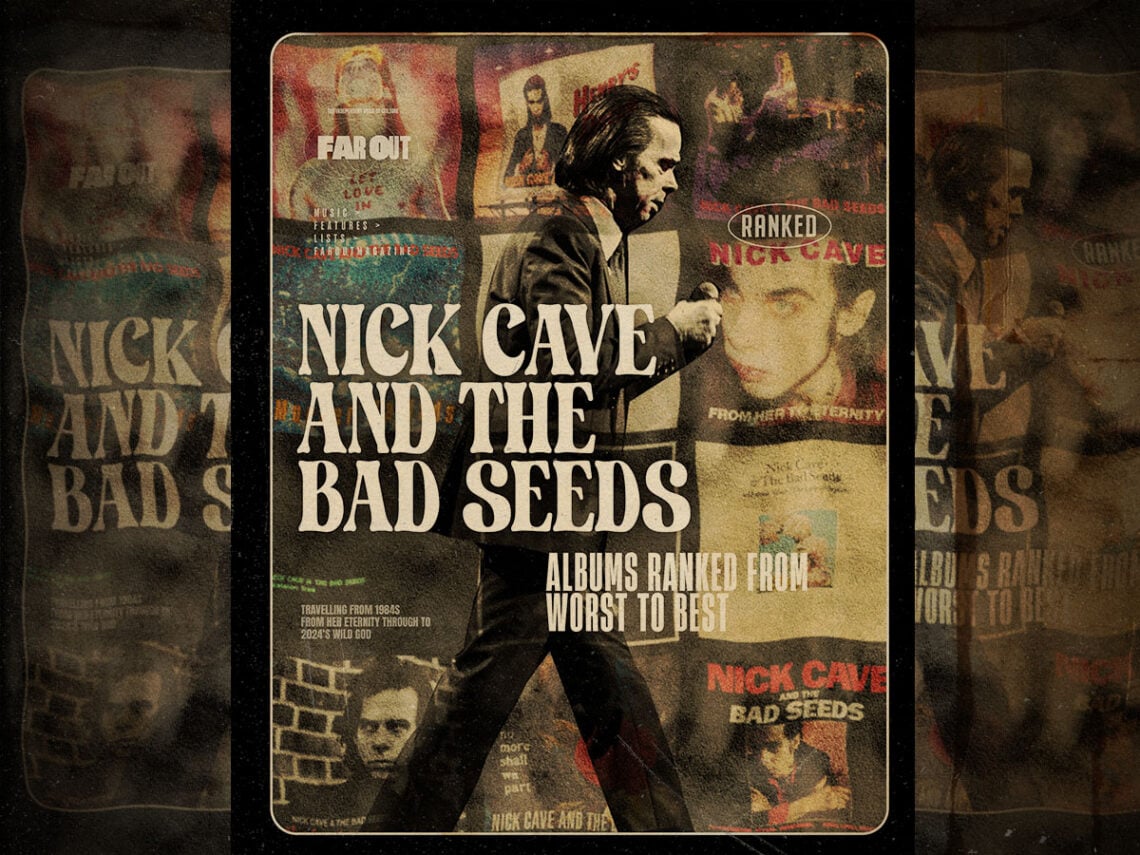
Every Nick Cave and The Bad Seeds album ranked

“I’ve always had an obligation to creation, above all.” ― Nick Cave
Over recent years, the cult of Nick Cave has had to accept a few things: he isn’t quite the spooktacular overlord he once was, and his now far more gentle outlook on life is going to affect his work from hereon in. Cave, through both his music and his Red Hand Files, has softened himself into a sartorial music icon.
That is not to say that his off-stage image changes that of his on-stage persona, Nick Cave has never relented from pursuing his creative vision. In fact, in recent years, the singer has become even more proficient at his craft and welcomed in new aspects of sonic joy to share.
Below, we’re taking a look back at every single one of the great man’s albums with his band The Bad Seeds and ranking his mammoth set of 18 studio records from worst to best. No mean feat considering the high quality of songs on each of his records and the potency with which he has always delivered his work with The Bad Seeds.
Travelling from 1984’s From Her Eternity through to 2024’s effort Wild God, what you’ll find is that Nick Cave is full of nooks and crannies that you’d never really experienced before.
Nick Cave and The Bad Seeds albums ranked from worst to best:
‘The First Born is Dead’ (1985)

The second record from Nick Cave and The Bad Seeds looked to set out their menacing intention as the dirtiest name in post-punk. On the album, Cave continues his obsession with America’s Deep South and also draws inspiration from the city they recorded the album in, Berlin.
Speaking to Rolling Stone Australia, Cave later said of this album: “Berlin gave us the freedom and encouragement to do whatever we wanted.” Adding: “We’d lived in London for three years and it seemed that if you stuck your head out of the box, people were pretty quick to knock it back in. Particularly if you were Australian. When we came to Berlin it was the opposite. People saw us as some kind of force rather than a kind of whacky novelty act.”
‘No More Shall We Part’ (2001)

The first new album of the new millennium for The Bad Seeds came nearly four years after their previous effort. It was always going to struggle following The Boatman’s Call but was given extra weight considering Cave’s struggles prior to recording.
Cave had been struggling with a heavy heroin habit for some time, and in 1999-2000, the singer was determined to get clean. He did, and the rock world was all the better for it. It allowed the Bad Seeds to show off their musical skills and highlighted them all as virtuoso players, but the record, especially in comparison to the rest of the band’s output, was missing more than a few pieces of the previously perfect puzzle.
‘Kicking Against The Pricks’ (1986)

As you might imagine, when Nick Cave and his travelling troubadours The Bad Seeds approached their 1986 covers album, they did it rather differently. Most covers of original songs are filled with a certain degree of respect. But for Cave and co, that kind of pretence was forgotten at the door.
The album is a sinister sneering sign of Cave’s disgust not only for the world around him, as usual, but also for some of the songs on this reworked LP, which, according to him, “weren’t done particularly well in the first place”. The result is certainly an enjoyable piece of work, but considering Cave’s own preference for originality, must be marked down.
‘Your Funeral My Trial’ (1986)

The challenge of ranking Nick Cave and The Bad Seeds albums is that they’re so vast and so complete individually that quite often opinion will change from one person to the next. For example, lower down on our list of favourite Bad Seeds albums may well be Cave’s favourite.
Cave told ABC: “That particular record, which is my favourite of the records we’ve done, is very special to me and a lot of amazing things happened, musically, in the studio.
“There are some songs on that record that, as far as I’m concerned, are just about perfect as we can get, really- songs like ‘The Carny’, ‘Your Funeral, My Trial’, and ‘Stranger Than Kindness’, I think, are really quite brilliant.”
‘Wild God’ (2024)

A new status was awaiting Cave in 2024, and the formerly scary singer was becoming one of the most beloved rockers in the world. Wild God begins with an Elviseque spoken word moment about a beautiful lake, or some shit, that is every bit as pompous, overblown and self-serious as a coronation itself. And that’s fine. You’d expect that from Wild God. In fact, you’d want that from Cave in his current era.
All told, the record is largely a unique and powerful triumph. It boldly reaches for the heavens and often grabs the odd walloping fistful. However, to be entirely truthful, if in two years time the mood for a bit of Nick Cave hits his longstanding fans, the vast majority of people may well bypass Wild God in favour of Push the Sky Away, or have a good cry with Ghosteen instead.
‘The Good Son’ (1980)

After the dark and harrowing work of Your Funeral… My Trial and Tender Prey, this album marked out Cave as a dab hand at reading the room. The 1990 album is far lighter than the aforementioned records and acts as a wonderful reprieve.
The change of pace largely came from Cave settling down in Brazil for a while and finding love, Cave later said: “I guess The Good Son is some kind of reflection of the way I felt early on in Brazil. I was quite happy there. I was in love and the first year or two was good.
“The problem I found was… in order to survive you have to adopt their attitudes towards everything, which are kind of blinkered.”
‘Dig Lazarus Dig!’ (2008)

After Abattoir Blues / The Lyre of Orpheus in 2004, Cave took himself off into the wilderness with Warren Ellis and created their mammoth side project Grinderman. When the band returned in 2008 for Dig, Lazarus, Dig!!! they were pumped up and ready to go.
The album saw Cave take a whole story, this time a biblical one, and make it work and reimagined it as a complete piece of performance art. “Ever since I can remember hearing the Lazarus story, when I was a kid, you know, back in church, I was disturbed and worried by it. Traumatised, actually,” remembers Cave considering the inspiration for the album.
“We are all, of course, in awe of the greatest of Christ’s miracles—raising a man from the dead—but I couldn’t help but wonder how Lazarus felt about it. As a child it gave me the creeps, to be honest. I’ve taken Lazarus and stuck him in New York City, in order to give the song, a hip, contemporary feel. I was also thinking about Harry Houdini who spent a lot of his life trying to debunk the spiritualists who were cashing in on the bereaved. He believed there was nothing going on beyond the grave. He was the second greatest escapologist, Harry was, Lazarus, of course, being the greatest. I wanted to create a kind of vehicle, a medium, for Houdini to speak to us if he so desires, you know, from beyond the grave.”
‘Nocturama’ (2003)

Not many artists are capable of not only stopping the seemingly inevitable haemorrhage of talent and passion one feels with age, but actively working against it. The band’s 12th studio record is more powerful than their first.
The last record to feature Blixa Bargeld before he left for pastures new saw Cave again display his uncanny ability to traverse genres in a single bound. About the recording process, Nick Launay, the producer, remembered: “I’ll never forget the first day recording Nocturama. Blixa swept into SingSing Studio in that hat. Mick Harvey introduces me and Blixa goes, ‘Oh, ja, the engineer.’ Mick says, ‘No, Blixa – the producer.’ Blixa says, ‘Well, we’ll see about that, won’t we?'”
“From a distance, they look like the most chaotic band. From an engineering point of view, it’s just fucking mental – like recording a live gig but you’re capturing this thing for ever. As soon as Nick walks in and sits at the piano, you’re recording. The intensity is unlike any other band.”
‘Henry’s Dream’ (1992)

The first record to feature Bad Seeds stalwarts, Martyn P. Casey, on bass and the late Conway Savage on the piano is often maligned by Cave as being completed badly. In fact, it’s why he and Mick Harvey re-mixed the album and later recorded Live Seeds.
Cave said that he wanted the songs “done justice” and that David Briggs, who preferred a “live-in-the-studio” atmosphere, had missed much of the songs’ power. For this reason alone, the record could be considered one of the worst of his career. Cave’s dedication to his art is, after all, perhaps his most vital talent. However, that doesn’t stop just how brilliant the LP is.
A powerful record with enough menace to make you shudder on cue, the LP is bristling with the kind of malicious intent that would make Cave a household name in the decades that followed.
‘Ghosteen’ (2019)

An album that we called a “masterpiece of human connection” when we first heard it in 2019 quickly became our favourite album of last year. Whereas so many ageing rockers had either given up entirely or created work in the flabby form of their previous success, Cave chose his seventeenth studio record to be his most different.
Moving away from the heavy sounds of old, Cave wrote almost the entirety of the album on piano and used the tragic death of his son Arthur as a way to connect with his fans as he had never done before. During a conversation in his Red Hand Files, Cave answered a fan who suggested they found the album uplifting rather than tragic. Cave’s response was perfect: “This was certainly the Bad Seeds’ objective when we made the record. We wanted each song to feel as if it were climbing toward an exultant and euphoric state, for the record to be a vessel that transported the listener far away from the world and its troubles, and that it lived in the jubilant and hopeful beyond.”
He added: “If there is sadness in Ghosteen, perhaps it is the recognition that we are often blind to the splendour of the world and indifferent to its attendant wonder. Perhaps the sadness is the recognition that the world is indeed beautiful, that it spins within the palm of our own hands and its beauty is available to all, if only we had eyes to see.”
‘Tender Prey’ (1988)

One of the darker moments of Cave’s back catalogue sees the singer sit centre stage and work as our gatekeeper to the pits of his inner sanctum. The album was dedicated to Brazilian actor Fernando Ramos da Silva, an actor who sadly died in a police shoot-out a year prior to release.
The album opens with Cave’s signature track ‘The Mercy Seat’ and is high up on our list largely because of it. The rest of the album can feel a touch jagged but the opener is enough to get your blood pumping.
Cave later said, “It was a nightmare, that record. It is reflective of a group — particularly myself — who was just writing songs and there was no larger idea behind it. Sometimes some of the group was there, sometimes they weren’t. I hear bad production and I hear bad performances as well.”
‘Push The Sky Away’ (2013)

The first record to be put out on the band’s own label Bad Seed Ltd. it was also the first record to not include the founding member Mick Harvey. Describing the record Cave once said, “if I were to use that threadbare metaphor of albums being like children, then Push The Sky Away is the ghost-baby in the incubator and Warren’s loops are its tiny, trembling heart-beat.”
The songs were constructed over the course of 12 months as Cave noted down his new musings “in a modest notebook”. Said book included the song’s which were compiled from “Googling curiosities, being entranced by exotic English Wikipedia entries ‘whether they’re true or not’.”
It makes for not only one of the most engrossing albums in the band’s back-catalogue but easily the most curious and bizarre. It’s a wild ride but one that’s worth staying on.
‘Abbatoir Blues/Lyre of Orpheus’ (2004)

The band’s 13th record was certainly not an unlucky one. It again welcomed Nick Launay behind the mixing desk and saw Cave and the lineup of Mick Harvey, Thomas Wydler, Martyn Casey, Conway Savage, Jim Sclavunos, Warren Ellis, and James Johnston all produce one of their most cherished records.
It’s a “crank the volume” barnstormer of an album and shows that even 20 years into their journey, Cave and co. were still more than capable of taking things off down a dark and dirty road if they needed to.
Even splitting the record in half meant that the group could express themselves as fully as they intended. It was perhaps one of the most interesting records the band had produced up until that point.
‘From Her to Eternity’ (1984)

The band’s debut record was titled as a pun on the James Jones novel From Here To Eternity and suggested that Cave was always making a joke, whether you were listening or not. It shone a light on Cave’s talents as a songwriter.
As well as providing the first real helping of what being a Bad Seed was all about, it also saw Cave pay homage to his hero Leonard Cohen, covering the singer’s song ‘Avalanche’ as the first number on the record. From there on it’s a masterclass in evocative imagery.
It’s difficult sometimes to shake away the shackles of a debut album. And it was likely an issue faced by the band as they delivered such a deeply integral record that so accurately captured their intent as a creative force. Debut LPs are potent for a reason, and this one is like smelling salts in the bath.
‘Let Love In’ (1994)

Of course, it could be easy to let out a small snort of derision when considering the title of Nick Cave and The Bad Seeds’ eighth studio album, Let Love In. But the truth is, in 1994, Cave was pretty swept up in the ultimate governing force in his life: love.
The singer had just spent three-year sin Brazil looking after his new young family and had received success with Henry’s Dream. Things were looking up. That’s not to say that Cave is all light and cheery happiness on the record—there’s still a fair amount of murder.
Musically, it’s the culmination of the preceding records’ sound but is more focused and far less rough and ready. It sees Cave now beginning to find his path and begin to open himself up to his adoring audience. That move would begin to carve out his new career path.
‘Murder Ballads’ (1996)

Chances are if there’s one album you’ve heard about from Nick Cave and The Bad Seeds then it’s this one. Quite right too. The record is easily the most aggressive and affronted as it tells the gruesome stories of true crime villains and despicable deaths.
It wasn’t the only thing that Cave did one the record though. He also managed to rope in Kylie Minogue (one of the biggest pop stars in the world at the time) into dueting with him on the song ‘Where The Wild Roses Grow’. The album also welcomed noted musicians PJ Harvey and Shane MacGowan to try their hand at a Bad Seeds number.
The first track written for the album was the dastardly track ‘O’Malley’s Bar’ which was originally written for Henry’s Dream: “We couldn’t use ‘O’Malley’s Bar’ on any of our other records. So we had to make a record, an environment where the songs could exist,” said Cave of the album. We’re very glad he did.
‘The Skeleton Tree’ (2016)

This album will always act as Nick cave’s most poignant. Not only is the record filled with wrenching and empowering songs but Cave’s son Arthur tragically died during the recording sessions. While most of the album had been written by the time of the accident, several lyrics were amended by Cave during the subsequent recording sessions to shine a light on grief.
The album was a departure from the band’s post-punk sound and was a continuation of Cave and his mate Ellis’ pursuit of their creative vision. Providing a less polished sound, the sonics relied heavily on electronica and ambient music styles.
It proved Cave to be an artist in the truest sense of the word. At his darkest moment, he would rather reflect using his art than anything else. From it, we gained one of the singer’s finest pieces of work.
‘The Boatman’s Call’ (1997)

Sombre, minimalist and dark, this record marked out Nick Cave and The Bad Seeds as more than just another angry punk group. The album acted as a departure from what had gained the band notoriety and saw Cave move away from characters and murder ballads and instead open himself up to his audience.
With a generally slow tempo, Cave realised that he could only gain further menace and intrigue with a well-measured delivery but he also gained more ears to hear him by doing so. The album has become widely recognised as Cave’s best and we find it hard to disagree.
While other records may have slightly more punch or have seemingly wider open arms, The Boatman’s Call manages to strike the perfect balance and offer up the cleanest, most succinct image of Nick Cave and The Bad Seeds that you’ll find.
