


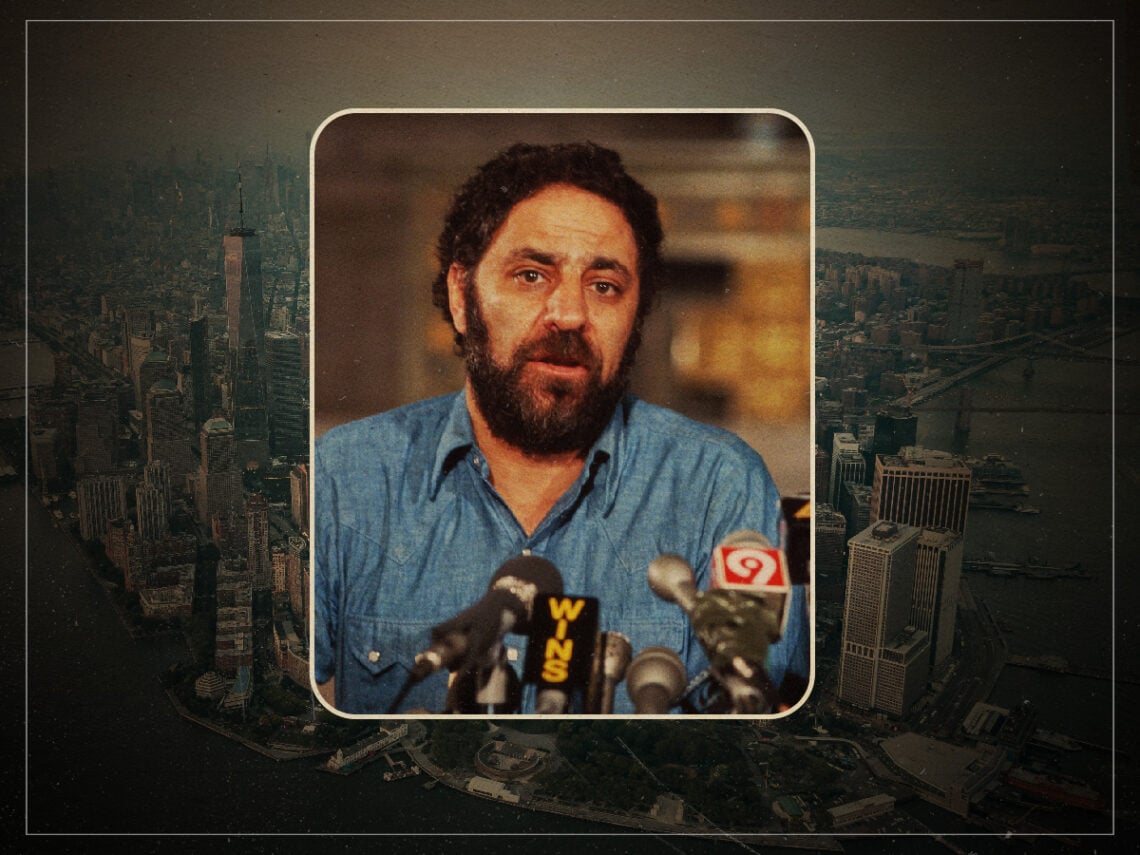
The New York town where Abbie Hoffman lived undercover

When the revolution fails, where do the revolutionaries go?
Execution, forced exile, and imprisonment have been some popular options throughout history, but for Yippie revolution Abbie Hoffman, the post-counterculture years saw him escape to upstate New York.
Once the rebellious harbinger of youth resistance, Hoffman was a key figure within the anti-war movement of the late 1960s. One of the leading faces of the Youth International (Yippie) Party, he tirelessly campaigned for an end to the war in Asia, all the while embarking upon various satirical stunts aimed to criticise the capitalist system of America. For most people, though, it wasn’t until the infamous Chicago riots of 1968 that Hoffman arrived on the mainstream radar.
Charged by the federal government for allegedly inciting a riot outside the Democratic National Convention, Hoffman found himself at the epicentre of the ‘Chicago 7’ trial. Although the charges against the activists were bogus, and their convictions dropped on appeal, the trial created enough attention and media uproar to bring further government attention to Hoffman’s subversive activities.
That attention on the counterculture icon was only extended when Hoffman wrote a handbook for political revolution in the form of Steal This Book – a publication which included, among other things, a guide on how to sneak onto aeroplanes, make explosives, and live outside of the capitalist system. Inevitably, the book caused more of an uproar than Hoffman’s invasion of the stage at Woodstock a few years prior.
Whereas other political revolutionaries of the time aimed to remain as anonymous as possible, for fear of persecution by the US government, Hoffman seemed to revel in his mounting reputation as a leader of the cultural revolution, putting his own name on books like Steal This Book and Revolution for the Hell of It, which were bound to bring some authoritative attention to his activities.
By 1973, that attention caught up with Hoffman, and he was arrested for intent to distribute cocaine, which, he subsequently claimed, was planted on him by undercover police. Rather than embarking on another lengthy trial – particularly one with less chance of public sympathy – Hoffman skipped bail and went on the run. In fact, he went so far as to have cosmetic surgery on his face in order not to be recognised.
During that period of exile, Hoffman could have travelled anywhere; escaping south of the border to Mexico, seeking political asylum in Cuba, or even following his own advice from Steal This Book and sneaking onto a flight bound for Europe. Instead, though, he hid out in Fineview, New York, close to the Canadian border and some 350 miles from Manhattan, operating under the name Barry Freed.
Bizarrely, Hoffman’s period of exile was rather successful for the activist. Not only did he manage to evade capture or suspicion, but he also worked as a travel columnist for Crawdaddy Magazine and even launched a successful environmental campaign to preserve the St Lawrence River.
While Fineview is renowned as a rather picturesque place, near the Thousand Island Park, it seems as though the quiet life was getting to Abbie Hoffman after a while. Seven years after his initial arrest, the activist turned himself in to police in 1980, the same day that a pre-recorded interview with Barbara Walters was broadcast on television.
In the end, Hoffman was handed a one-year prison sentence for his cocaine possession and years spent on the run, of which he served just four months. In the wake of his re-emergence, he returned to the realm of political activism, regularly speaking out against the CIA on topics like the war on drugs and environmental concerns. In fact, he was one of the very few activists of the hippie age who both stuck to their morals and maintained a level of mainstream attention.
Nevertheless, in 1989, amid growing concerns both for the United States and himself on a personal level, an irreversibly disenfranchised Abbie Hoffman committed suicide at the age of just 52, providing a closing chapter for one of the most essential activists in American history.
