


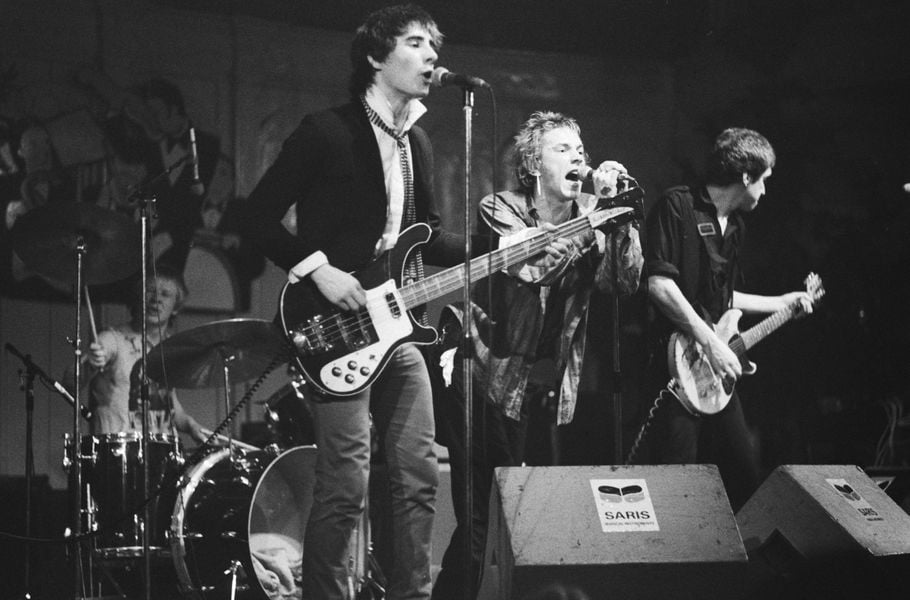
Revisiting ‘Nevermind The Bollocks Here’s The Sex Pistols’

I was a fairly liberal adolescent from a fairly liberal and musically inclined family. I was always encouraged to find my own path, especially when considering the holy sanctity of music. In fact, one of my first memories is of my mum painting the house and singing Nirvana’s ‘Smells Like Teen Spirit’ at me, and I was probably three years old. So when I dabbled with the bubblegum beauty of American pop-punk, my mum was agreeable in her acceptance of my “pogo-ing” and general giggling at dog sex and other such brilliantly informed ideals, which cemented the foundations of the sub-genre. On reflection, she was probably just happy it had a guitar in it.
But as with everything, time eventually turned this bestial boyhood fun into a frivolity a young man of 14 no longer had time for. I was desperate for something more. Something with more grit, with more angst and something decisively more relatable. Like all future-facing teenagers, I turned my back and pushed myself toward the past.
I’d heard of The Sex Pistols before, of course. As aforementioned, my parents were very well versed in the sub-culture of punk and the music that it was born from and continued to rage alongside it. I’d known The Clash, The Damned and X-Ray Spex before I knew how great they were or how ‘cool’ it was to know them. The Sex Pistols were that band on the Thames with Richard Branson. That band that sang ‘God Save The Queen’. That band that swore on the telly. To me, the Sex Pistols had always seemed a bit of a joke.
Until I finally got the punchline.
Punk was a seminal moment for me. It signified a change in my life I would never be able to revert. It held all of the answers I wanted, but most importantly, it asked a whole heap of questions I’d never thought to ask. These previously assumed jovial fellas with the spiky hair suddenly meant more. The tearing of clothes was not merely destruction it was a reconstruction of fashion in their image. It was not purely the fashion, it was a uniform. It was not aggression, it was anarchy. It wasn’t the death of music it was the re-birth of it. It was beautiful, and I didn’t just love it, I fucking needed it.
I held the CD Nevermind The Bollocks, Here’s The Sex Pistols that I’d bought from Woolworths with my unearned pocket money, I put it in the player, pushed down the lid and let the ticking of 2000s modernism fuel this transcendental excitement. Suddenly it all made sense. I can still hear the first notes of ‘Holidays in the Sun’ rattle through my terrible speakers as I, like many before me, actively ‘listened’ to an album that, unbeknownst to me, had launched so many of my future musical icon’s careers.
I needn’t tell you the joy I got from the volume of swearing in ‘Bodies’, the boiling anti-nationalism of ‘God Save The Queen’, and the incredible sense of pride that this band were young, working-class and utterly British in every way. But aside from all of the cultural importance it rightly garners, the record is also a brilliant piece of music, expertly crafted and cultured. The ferocity with which it belts out track after track feels more akin to the punch of a bar-room brawler than a kung-fu maestro, but expert production means it still sounds as measurably vitriolic today as in 1977. Decisive and destructive, it attached to the face with a bleeding menace that had never been heard before and still rings as true today.
NMTB is still just as relevant today as it was 40 years ago. The Sex Pistols may have become a pastiche of sorts – people will always highlight the consumerism they ironically inspired – but what should be remembered is that before the T-shirts, phone cases and other tat, there was the music and the music was everything.
Punk, and with it NMTB, was a complete re-write of musicality. It was a defamation of everything in existence, both sociologically and philosophically, that had made music sacred to so many. Clattering three-chord wonders made the industry scream with desperation. This was a feeling as well as a sound, and it made American punks The Ramones look like schoolchildren hopped up on sherbert. The record possesses a snarl which made tigers wince with fear and a vocal which made Johnny Rotten the voice of a disenfranchised generation.
So, what’s the point now? Well, if you hadn’t noticed, the world is very damn similar to the world the Sex Pistols were so keen to burn down. The threat of nuclear war? Check. An idiot in power on both sides of the pond? Check. A severe reduction in welfare? Check. An economic downturn that is likely to affect young people the worst? Check. Heightened racial tensions? A big fat check. This was the album in the ’70s that many turned to find solace in solidarity, to spark the volcanic outpouring of creativity, the album to understand that everyone was in the same shit-heap boat and that mutiny was always an option.
I’d encourage you to do what The Sex Pistols encouraged me to do, what they encouraged my mother before me to do. Question everything, never settle for ‘your lot’ and always, always fight against injustice. It’s a message we need to remember in 2017, perhaps even more than they did in 1977.
