


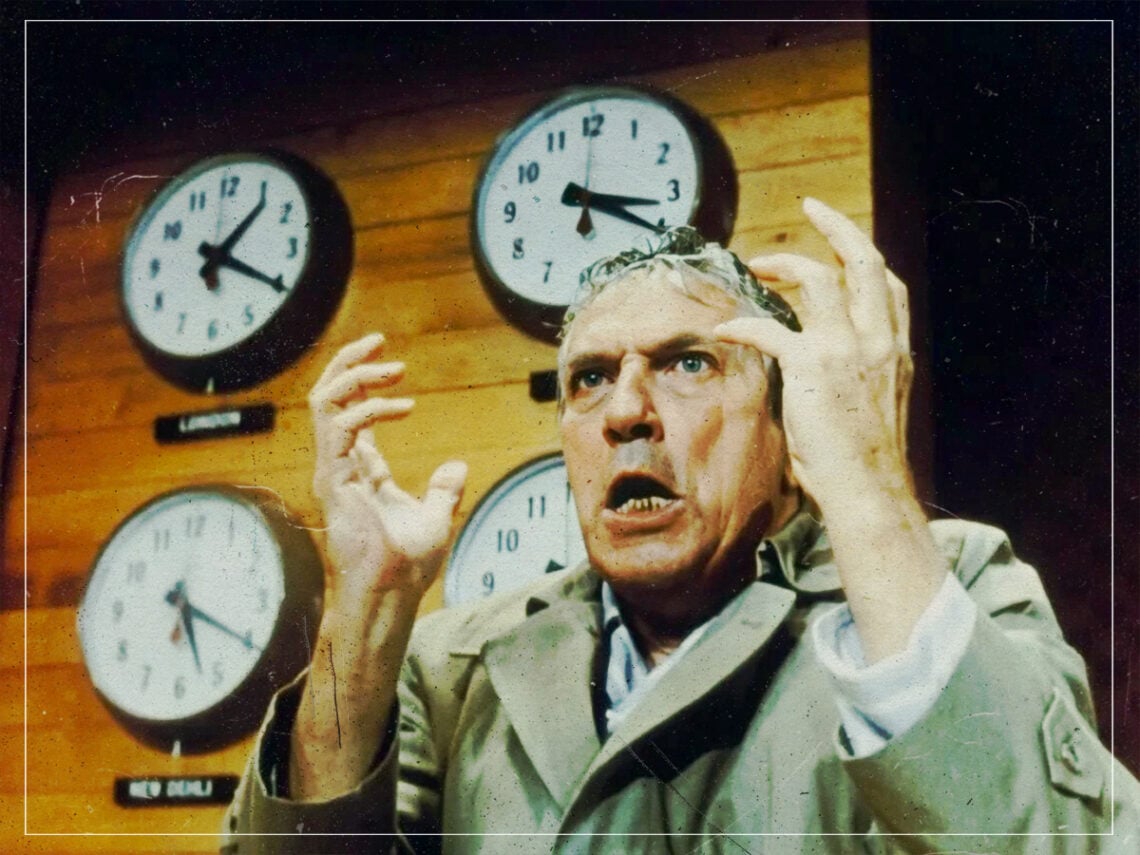
‘Network’ ending explained: Who killed Howard Beale?

Network is the satire to end all cinematic satires, holding up a mirror to the screen that transfixes us day after day with shows and movies and revealing the cynical calculations of big-money interests that stay just out of view behind the screen. Sidney Lumet’s masterpiece seems to resonate even more today than it did upon its release in 1976.
The overwhelming majority of the English-speaking world’s film and television has been monopolised by three giant conglomerates, while social media is beholden to a couple of mega-billionaires. And, even more than they were back in the 1970s, people are “mad as hell” and “not going to take it anymore”. Yet they keep on watching in their billions, placing their faith in one false prophet or another speaking to them from across the airwaves.
Lumet’s movie centres on one such prophet, who actually does speak the truth for much of the time we see him on air. Howard Beale is a network news anchor on the brink of losing his job, whose desperate personal situation compels him to reveal the real state of society to his viewers.
What follows is an extraordinary turn of events that sees Beale’s outwardly lunatic but profoundly lucid ravings against corporate America, not least his own employer, make him the most popular star on television. His network cynically exploits the situation in its obsessive drive for viewing figures, even though Beale spends a lot of air time attacking the material interests of those who control the network.
Beale’s show becomes a network TV staple, with its own studio and spin-off segments. He preaches his credo nightly to rapt audiences across the United States. That is until he suddenly finds himself gunned down live on air by two unnamed assassins from the Ecumenical Liberation Army (ELA), a terrorist organisation which carries out indiscriminate acts of violence in the name of Maoist ideology.

But why is Beale assassinated?
In reality, the ELA has opportunistically done a deal with Beale’s network to have a documentary made about them. They’re very happy to carry out the news anchor’s assassination as a stunt to spread awareness of their organisation. But it’s the network management themselves who have ordered the killing. As programming chief Diana Christensen explains during a previous scene, “I think I can get Mao Tse-Tung people to kill Beale for us, as one of their shows.” Christiansen pitches the idea as a crossover event to promote the network’s “Mao Tse-Tung Hour” featuring the ELA, which could bring “a fantastic looking audience” to the channel.
So Beale’s assassination is designed to boost the ratings of another show, an incredibly dark satirical twist with a ring of truth to the Machiavellian sentiments behind it. But that’s not the only reason he’s killed.
Several scenes before his premature death, Beale is confronted by the chairman of the Communications Corporation of America, Arthur Jensen, because of his show’s role in stopping the conglomerate’s buyout of his network. Jenson threatens Beale in pseudo-religious terms, explaining that he has “meddled with the primal forces”, namely the “dominion of dollars”, and that he “will atone” for what he has done.
Yet Jenson’s threat doesn’t directly lead to the assassination. In fact, Beale does atone, telling the millions of viewers watching his show the very next night, “It’s every single one of you out there that’s finished.” Having roused them into making a democratic intervention to stop a multinational business deal from going through, he pacifies them into passivity with a despondent message of pessimism, just as Jenson had asked of him.
It’s this message that, ironically, seals Beale’s fate. As the film’s voiceover explains to us, “Nobody particularly cared to hear his life was utterly valueless.” And so, for the first time since Beale became the “mad prophet of the airwaves”, people began to switch off from his show.
In the end, Beale’s network was only interested in the ratings he could bring in. Once he was unable to do that, he was finished. That’s why he became, according to the movie’s final line, “the first known instance of a man who was killed because he had lousy ratings.”
Sadly, life imitated art in a way even Lumet or Network screenwriter Paddy Chayefsky couldn’t have predicted. Peter Finch, the actor who played Howard Beale, died just weeks after his greatest performance was made accessible to cinema-goers. To this day, he remains the only posthumous winner of an Oscar for Best Actor in a Leading Role.
If Finch had lived to see the world today, he would have probably found that his character’s prophecies didn’t go far enough. Another reason, perhaps, is that Beale had to be struck down in his prime, on prime time.
