


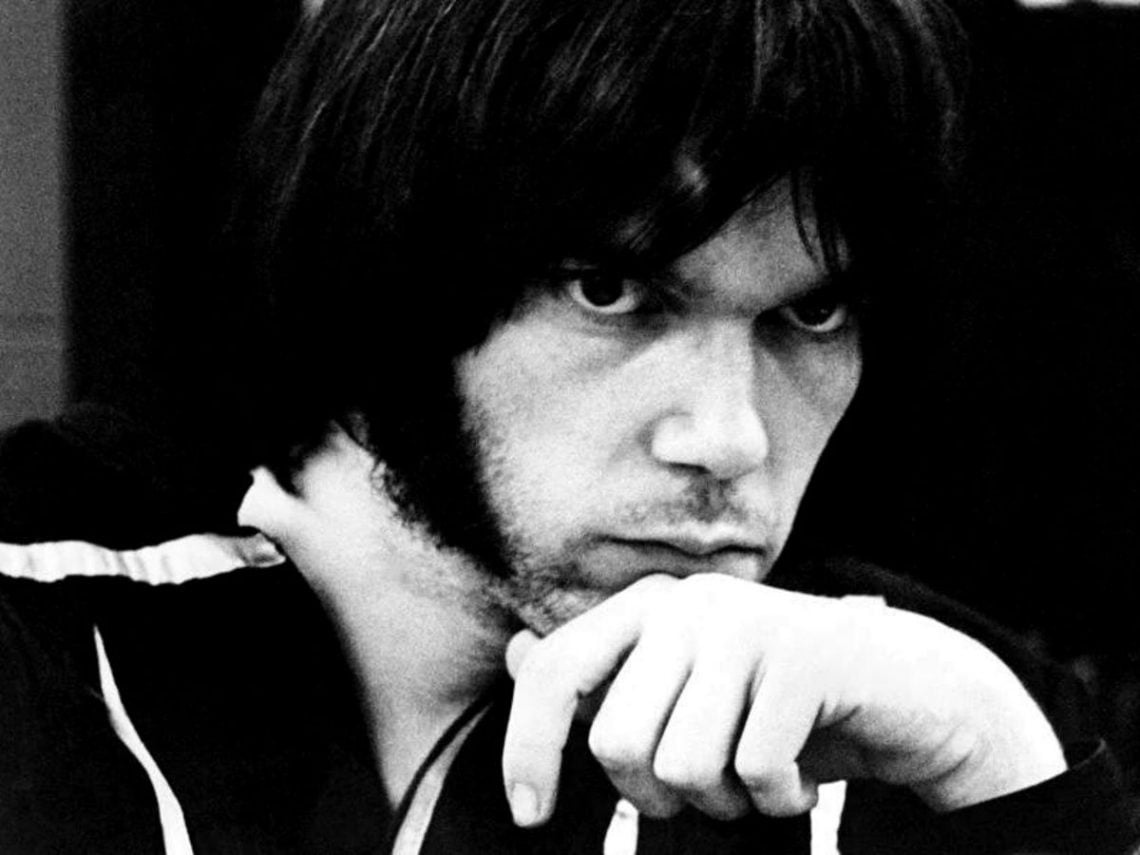
“I was making all these changes”: Neil Young names the key to his classic sound

The Canadian singer-songwriter Neil Young is a man of many voices, yet one can always tell when they’re listening to one of his records. No matter what instrumental design Young uses to frame his voice, one can always discern that trademark high tenor vocal. Above all else, this vocal binds an eclectic and influential catalogue from the gentle banjos of Harvest to the proto-grunge rasps of Rust Never Sleeps.
Young grew up on a diet rich in country and folk music and began learning his craft using a ukulele in his childhood. Over time, a “better ukulele” led to “a banjo ukulele to a baritone ukulele” and eventually the guitar. When he reached his teens, Young became enamoured with early rock ‘n’ roll and artists like Elvis Presley, Jerry Lee Lewis, Chuck Berry and Little Richard as his dream was further elucidated.
The artist’s diverse taste in music opened him up to several songwriting mediums as he began a musical career in the 1960s. With his first successful band after relocating to California, Buffalo Springfield, Young satiated his passion for a fuller folk-rock sound. Meanwhile, he worked on solo singer-songwriter material that would arrive on his eponymous solo debut LP of 1968.
Subsequently, whether working with Crosby Stills & Nash, his band Crazy Horse or as a solo artist, Young maintained a healthy balance between raw rock ‘n’ roll sounds and delicate acoustic work. Since the acoustic textures of Harvest and the blues-derived instrumentals of On the Beach are not uncommon elsewhere, Young doesn’t consider these songs as his characteristic sound. His most original sound arrived in his work with Crazy Horse.
Those who have only heard Young’s ballads and softer singer-songwriter material might find his title as ‘Godfather of Grunge’ difficult to comprehend. However, the 1979 live recording ‘Hey Hey, My My (Into the Black)’ with Crazy Horse is commonly regarded as the progenitor product of the genre.
Although this pioneering guitar sound of fuzzy rhythms and overdriven lead reached a pinnacle of refinement (or lack thereof) in 1979, it had been latent in Young’s output since the late 1960s. As far as Young is concerned, his most associative sound began to emerge in the 1969 album Everybody Knows This Is Nowhere courtesy of Crazy Horse guitarist Danny Whitten.
Speaking to Jonathan Cape for his biography, Shakey, Young commended Whitten’s contributions, which paved the way towards that classic Crazy Horse sound. “That’s what was so great about Crazy Horse in those days: Danny understood my music, and everyone listened to Danny,” Young beamed. “He understood what we were doing. A really great second guitar player, the perfect counterpoint to everything else that was happening. His style of playing was so adventuresome. So sympathetic. So unthoughtful. And just so natural.”
Picking out ‘Cowgirl in the Sand’ and ‘Down by the River’ as two prominent examples of Whitten’s talent as a tesselating guitarist, Young said that few guitarists could match that sense of rhythm. “When you listen to ‘Cowgirl in the Sand’, he keeps changing: plays something one and a half, maybe two, times, and he’s on to the next thing,” Young noted. “Billy [Talbot] and Ralph [Molina] will get into a groove, and everything will be goin’ along, and all of a sudden, Danny’ll start doin’ somethin’ else. He just led those guys from one groove to another, all within the same groove.”
Tragically, Whitten passed away in 1972 following an alcohol and diazepam overdose. As Young persevered with Crazy Horse, he often tried to replicate the same style, which can be heard especially in the 1975 album Zuma. “When I played these long guitar solos, it seemed like they weren’t all that long, that I was making all these changes, when in reality what was changing was not one thing, but the whole band. Danny was the key,” Young concluded in his praise for Whitten.
