


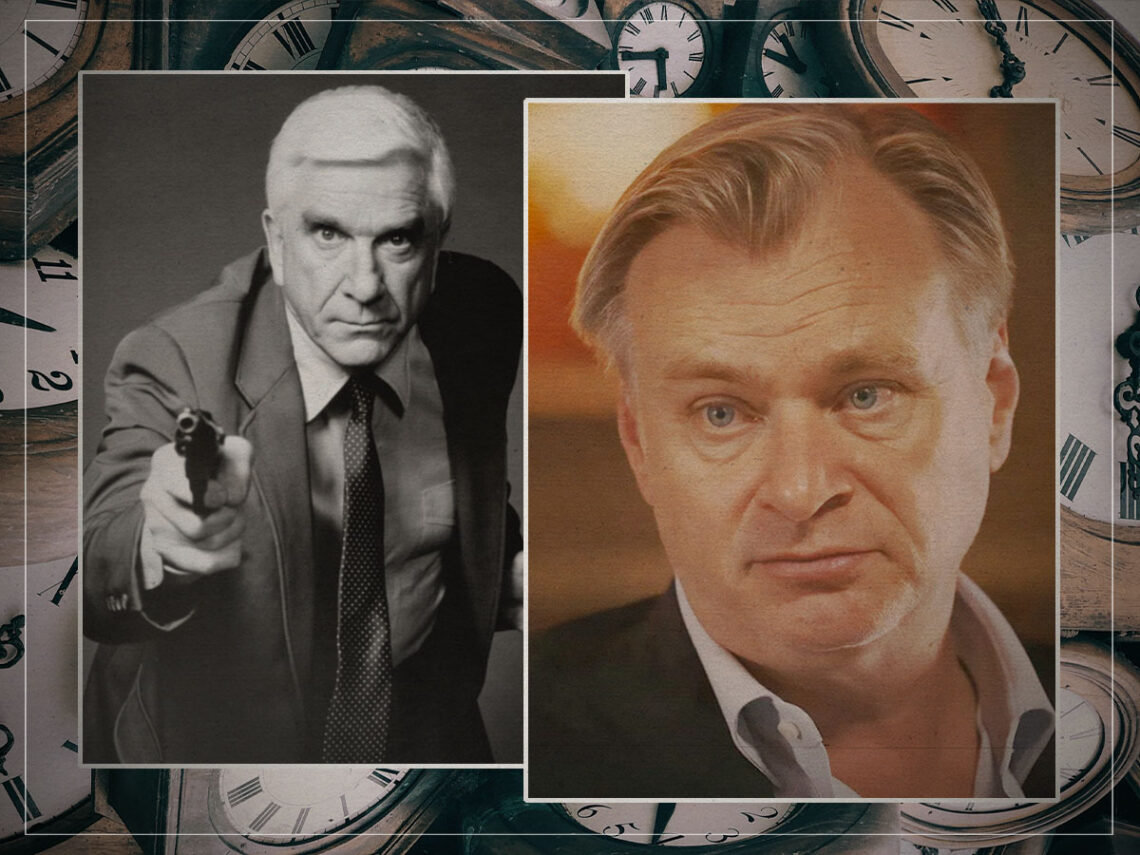
How ‘The Naked Gun’ inspired Christopher Nolan’s fixation with time: “It’s very nicely done”

Countless superlatives have been launched at Christopher Nolan as he gradually ascended to his current status as one of modern cinema’s most acclaimed and influential auteurs, but few have gone out on a limb and praised him for being hilarious.
While there are certain moments of levity littered throughout his filmography, and nobody was upset that Oppenheimer wasn’t overflowing with quips, one-liners, and zingers, a regular criticism of the Academy Award winner’s back catalogue is that it’s often po-faced to the point of portentousness.
Of course, directors aren’t obligated to write gags for the sake of gags, but Nolan’s undying love for preposterous comedies like MacGruber and Talladega Nights underlines that he doesn’t spend his free time watching relentlessly serious films and needs to plumb the depths of his soul to find the funny bone.
Among his favourite recurring themes is the notion of time. In its many different guises, the concept has been present in everything from Memento and Interstellar to Tenet and Inception, factoring into his narratives internally, externally, and even existentially. It’s one of the go-to options in his filmic playbook, and it turns out that The Naked Gun had a huge impact.
One of the funniest Hollywood comedies ever made, Leslie Nielsen’s hapless Frank Drebin spent the entirety of David Zucker’s 1988 classic lurching from one self-inflicted crisis to the next, becoming the onscreen embodiment of falling upwards as he somehow conspired to thwart a mind control conspiracy.
On the surface, there’s absolutely no common ground between The Naked Gun and Nolan’s back catalogue, but one scene was instrumental in informing one of his most notable preoccupations. “The Naked Gun has this wonderful bit where Leslie Nielsen gets together with Priscilla Presley and then they go into this very MTV montage where they’re at the beach,” he explained per Tom Shone’s The Nolan Variations.
“They’re riding horses, and at the end, he goes up to the door, and it’s like, ‘I had a wonderful day, Frank, I can’t believe we met just yesterday,'” Nolan continued. “And you’re like, ‘Oh, that was all in one day?’ It’s very nicely done.” Sure, it’s a great sequence, but how did that become cinematic muscle memory?
The Oppenheimer architect elaborated that if someone were to pick “just some random film” and ask the audience how much time elapsed over the course of the story, “you’ll never get a simple answer.” It could be days, weeks, months, or even years, but unless it’s explained, “it’s really tough to figure out time because time is so elastic.”
The Naked Gun achieved it with a single line of dialogue, and years later, it became integral to Nolan’s approach to cinema. “The way that time is dealt with in regular films is incredibly sophisticated,” he offered. “I take the mechanism and make it visible, like making the watch transparent in the back or something. So suddenly, people are going, ‘Oh, there’s all this going on with time’. I actually make it simpler.”
Thanks to his obsession, audiences are rarely in the dark about how much time has passed in a Nolan film, and it’s always clear why he’s made those narrative choices. And to think, it can all be traced back to The Naked Gun.
