


Uncovering the mysterious history of Kiyoshi Kurosawa’s ‘Cure’

The magical world of horror cinema is infinitely nuanced, allowing filmmakers to approach the frameworks of the genre in so many innovative ways. While it’s only natural for artists to draw inspiration from each other, nobody does horror quite like Japanese auteur Kiyoshi Kurosawa. Lovingly dubbed the “David Cronenberg of Japan”, Kurosawa has impacted the genre in numerous ways through masterpieces such as Pulse.
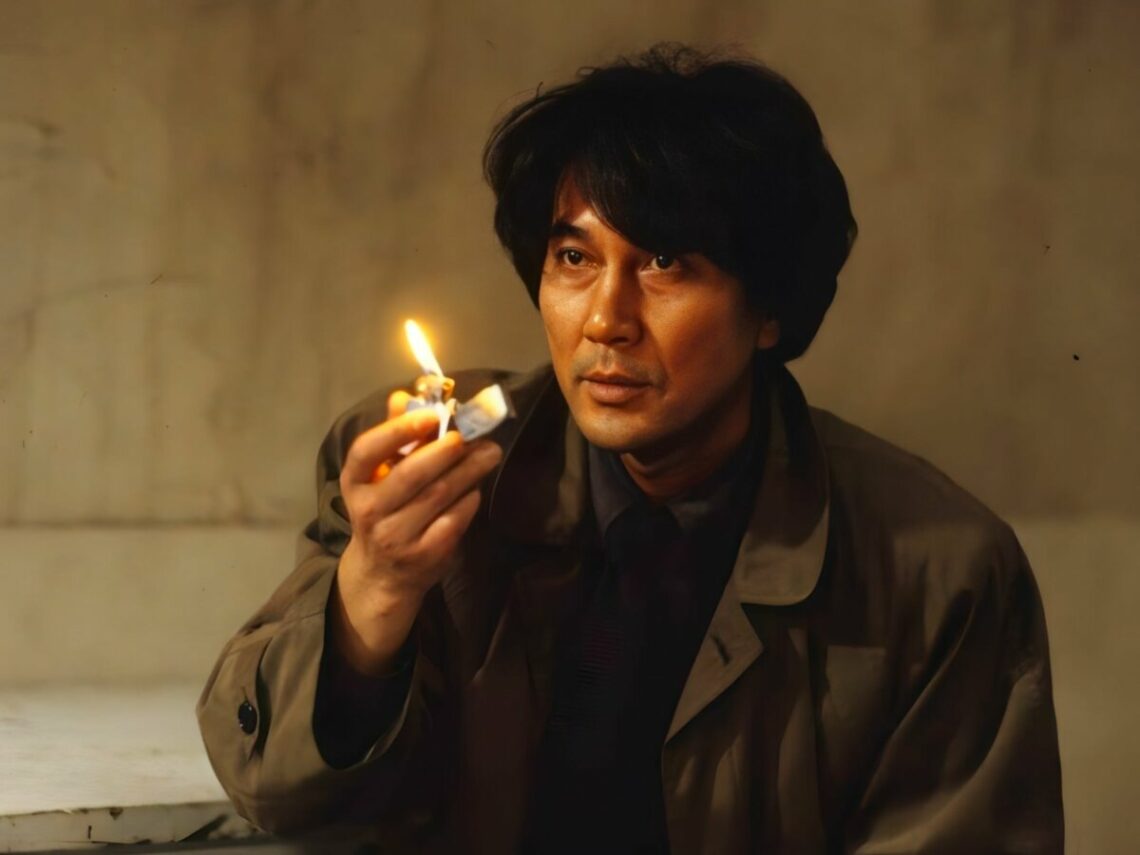
One of Kurosawa’s most interesting works is the 1997 thriller Cure, starring his frequent collaborator Kōji Yakusho as Takabe – an emotionally burdened detective who gets sucked into an ominous case. Creating an atmosphere of palpable paranoia, Cure is set in a Tokyo that is plagued by gruesome murders that are only connected by one element. All the bodies have an ‘X’ carved into their necks, even though none of the murderers has any recollection of committing the crimes.
Cure is a fascinating effort due to a number of reasons, ranging from Kurosawa’s deviations from the horror-thriller conventions to the film’s unique interpretation of the serial killer archetype. The latter is a particularly compelling element, featuring Masato Hagiwara as Mamiya – a disillusioned psychology student who delved too deep into hypnosis and forgot who he was. Mamiya’s amnesia sweeps over the rapidly decaying city, wrapping it like an impenetrable fog.
At the core of Cure’s sociological investigations is the work of Franz Mesmer, the German physician who tried his best to popularise the pseudo-scientific concept of “animal magnetism” or “mesmerism”. Often referred to as one of the first practitioners of hypnosis, Mesmer claimed he could heal people by using alternative methods, but it wasn’t long before all of his theories were debunked by scientists. While Mesmer’s medical beliefs were demonstrably false, his exploitations of human psychology (especially group psychology) continued to pique the curiosity of scholars.
During a conversation with IGN, Kurosawa revealed that he was scared of trying hypnosis even though he didn’t believe in it. The director admitted: “I had the chance a couple of times, but to be honest, I was scared. I did have the utter confidence that I would never be susceptible to being hypnotised, but I was told by several people that those people, those that are the most confident, are the ones who are most vulnerable to this type of thing. When the chance arose I basically said, ‘No, let’s not do this!'”
While talking about the idea of transformation that occurs throughout Cure, he added: “Terror, I think, has many different levels. Changing into something different isn’t that scary. Well, maybe a little bit. But I think what’s scarier than that is not changing at all. Becoming the same forever, without any transformation whatsoever, I think that is truly terrifying. And if you add to that, the condition in which you are the same forever without any alteration, I think the condition that most clearly embodies that is death itself.”
In the film, we discover that Mamiya might have been influenced by the history of Japanese mesmerism. The detective and his friend stumble across the rare footage of a late 19th-century hypnotist in Japan who reportedly used his techniques on women, drawing an ‘X’ with his hand to initiate the process. It’s easy to dismiss that footage as something that Kurosawa added to the narrative to intensify the intrigue, but it actually goes beyond that.
Fukurai Tomokichi, born in 1869, was a psychologist at Tokyo Imperial University who actually majored in abnormal psychology. Not just that, the subject for his PhD thesis was “the psychological study of mesmerism”. According to historical records, mesmerism came to Japan in the early Meiji era and was initially seen as a way to boost cognitive abilities. However, it was soon outlawed by the government because it was seen as a social problem.
After he joined the university as an assistant professor, Fukurai conducted several parapsychological experiments on subjects such as clairvoyance and “thoughtography”. The latter term refers to the belief that some people possess the ability to burn their thoughts onto mediums such as celluloid. Fukurai published reports on both subjects, which were dismantled by other researchers who criticised him for his unscientific methods.
In Cure, the female subject who was hypnotised by the Japanese practitioner mysteriously died, and the same thing happened to Fukurai’s subjects as well. Chizuko Mifune committed suicide by ingesting poison, while Ikuko Nagao apparently died due to complications caused by the flu. Fukurai was forced to resign from the University, and he eventually died of pneumonia in 1952 after spending some of his later years trying to generate psychic abilities in himself.
Fukurai might not have influenced any serious contributions to the field of psychology, but he did end up inspiring one of the greatest Japanese horror films of the 1990s – Kiyoshi Kurosawa’s Cure.
