


Music Venue Trust announces ownership of first venue as part of ‘Own Our Venues’ scheme

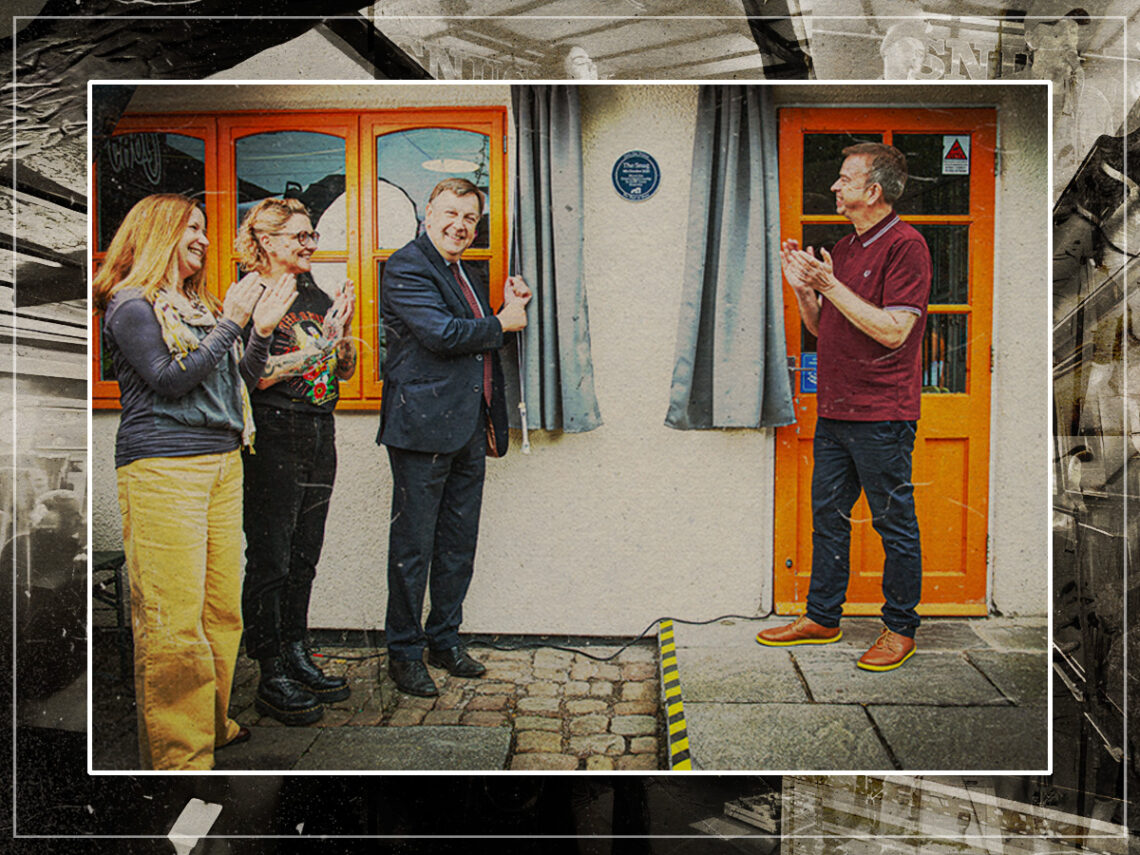
The National Trust of Music Venues, a charitable coalition conceived by the Music Venue Trust, has announced the purchase of their first venue, The Snug in Atherton, Greater Manchester.
The 100-capacity venue opened its doors in 2015 and has been bought through the ‘Own Our Venues’ scheme by Music Venue Properties. The Music Venue Trust encouraged music fans to buy shares at 3% APR, raising almost £2.5million in the process. Arts Council England and Arts & Culture Finance contributed £500,000 to the fund alongside 1,200 independent investors. Another eight venues across the United Kingdom are being earmarked for ownership.
While The Snug is the first venue under their ownership, Mark Davyd, the CEO of Music Venue Trust, told press at the unveiling this was only the beginning, and they had grand plans to change the landscape of grassroots venues. Currently, 93% are tenants, which threatens their long-term futures.
Rhoda Dakar, the former singer with The Bodysnatchers, made her career thanks to similar independent venues and is now a board member for Music Venue Properties. Speaking exclusively to Far Out at The Snug, Dakar revealed they came forward with a proposition to ask her to be a patron and explained how her role primarily focuses on providing a musician’s perspective.
She explained: “I know what would be nice to have and what would make venues better. If you give people an environment that makes them comfortable, they will include you on their tour. It can be mad stuff, like ‘Why don’t you have a washer and dryer?’ because if people are touring, they don’t get a chance to clean their clothes. It’s a very small outlay but a massive benefit to the musicians.”
The process of saving independent venues has been many years in the making, according to Claire Mera-Nelson from Arts Council England. She exclusively told Far Out: “For as long as I’ve known Mark, which is nearly six years now, we’ve been talking about this. First of all, it’s like a dream, and I think the really impressive thing is how, over the pandemic period, it began to consolidate as an active idea.”
“Arts Council has been right behind this from the start because we completely agree with the principle that these are important cultural spaces and really important places for the community,” she added.
Outside of this initiative, Arts Council England also has a fund which has been running since 2019 which offers grants of up to £40,000 to independent venues and promoters. Mera-Nelson added: “We’ve seen venues around the country be able to renew their sound and lighting equipment, improve their changing facilities and toilets. We’ve also seen them being able to take some risks on the artists that they’re promoting so they can appeal to a different kind of audience.”
Independent venues are not only at the heart of communities but also the places where artists learn their craft and how to perform. In recent years, many artists such as Sam Fender and Lewis Capaldi have gone from playing rooms like The Snug to selling-out arenas, but if these venues are closed down, that pathway to superstardom is closed.
On that topic, Mera-Nelson added: “We’ve got a responsibility to make sure the pathway is there, but I don’t for one minute think that it isn’t a complicated one. It’s true to say that the kind of artists who perform in arenas these days have done a lot to prove that they’ve got the kind of audience that justifies an arena performance. The question we have to ask ourselves is how to get there, and although this is a very small venue, this is a small part of the solution, and helps artists build that patchwork of networks and connections which take them on that journey.”
Jamie Lawson, who had a number one with his self-titled album in 2015, is an example of an artist who rose through the ranks playing independent venues to touring the world as a professional musician. Lawson was at The Snug to perform at the celebratory event in honour of The National Trust of Music Venues taking ownership of the venue.
Before his performance, he explained how playing at grassroots venues changed his life: “I did the grassroots venue circuit in London when I moved there, and that’s where I met my wife, and at another, I met Ed Sheeran. Had I not made those connections, I’d be a very different person today.”
On his relationship with Sheeran, who famously started in these same rooms, Lawson added: “Ed signed me to his record label, and I made three records with him and got to open for him doing arenas and stadiums.”
By the time it was Lawson’s chance to play these spacious venues, his years spent grafting away in sweatboxes and on the open-mic circuit had prepared him for the eventuality. However, he does acknowledge social media has altered the pathway, and emerging artists are losing sight of independent venues.
Lawson recalls: “A decade ago, we weren’t doing TikTok and social media reels. It seems people are being discovered via that rather than music venues, which is how Ed and I were discovered. I would argue that even if you’re discovered via TikTok, at some point, you’re going to have to go and do it in front of people, and you’re going to need places to learn that craft. If you’re going to start learning in front of 10,000 people, that’s a hard lesson, and I would argue it’s better to be doing both at the same time.”
While the pathway to arenas is a significant reason why venues like The Snug need to be cherished, more importantly, they act as hubs in local communities nationwide. Many artists who play these rooms weekly have no desire to become the next Ed Sheeran. Instead, they simply want a communal space to meet like-minded people who become friends and play music.
James Grundy MP, who represents the Leigh constituency, told Far Out: “It’s all too easy for small towns like Atherton to become cultural deserts, and I think there was a real worry during Covid that many smaller venues would close and just wouldn’t come back again.” He added: “Greater Manchester isn’t just the city centre. It’s important that the Red Wall towns like Leigh and Atherton have thriving cultural hubs where people can go and enjoy live music.”
Although news regarding other venues in the ‘Own Our Venues’ scheme are yet to be confirmed, The Bunkhouse in Swansea, Hull’s Polar Bear Music Club and The Hairy Dog in Derby have been identified by the Music Venue Trust.

Never Miss A Beat
The Far Out Music Newsletter
All the latest music news from the independent voice of culture.
Straight to your inbox.