


‘Blow Up’: The erotic movie that inspired Nan Goldin to become a photographer

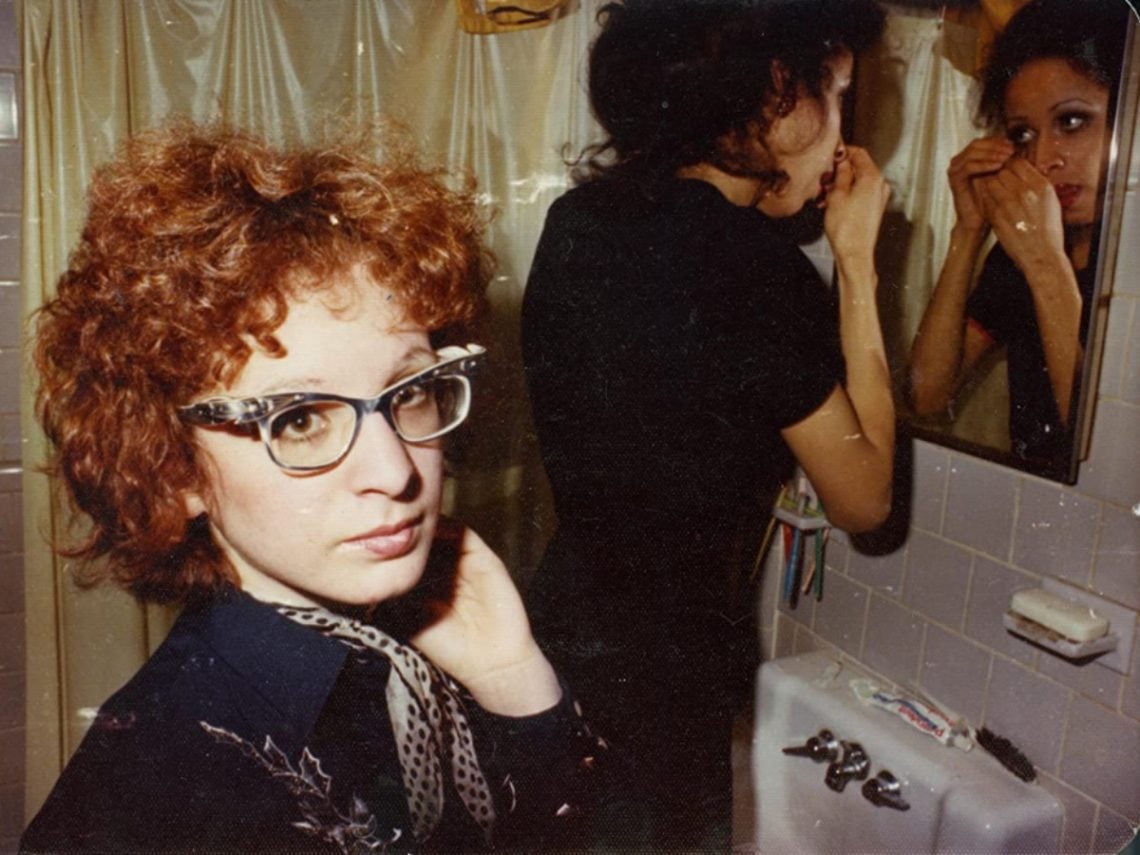
Since the early 1970s, Nan Goldin has chronicled her life through images, pioneering a new genre of documentary photography defined by richly-saturated photos of herself and her friends. She captured New York’s underground figures and outsiders like no one else, enthralled and involved with those on the margins of society. Goldin’s seminal work, The Ballad of Sexual Dependency, intimately depicts the lives of Goldin and the LGBT community she associated with. The images show love, pain, innocence and violence, all presented with extreme vulnerability and honesty.
The photographs were often shown as slideshows at underground bars, with Goldin playing music by The Velvet Underground or Maria Callas over the top. Goldin’s eye for poignantly capturing specific moments frozen in time, such as ‘Nan after being battered, 1984’ or ‘Couple in Bed, 1977’, reflect her interest in cinema – one of her first loves. During an interview with Criterion, Goldin explained: “I think of my slideshows as films made of stills”.
Later, she explained how cinema shaped her interest in photography when she was growing up, and as a child, she “lived in a hippie commune and went to a free school,” Goldin explained. “Basically, we didn’t have classes, and we went to the cinema almost every day. I grew up on double features—I’m still not used to the single feature. We would also go to all-night screenings. Cinema was the major art form in my life, and at that age, I wanted to be a filmmaker when I grew up. I ended up doing photography because it was easier.”
There was one specific film that greatly inspired Goldin to pick up a camera – Michelangelo Antonioni’s Blow-Up. She recalled: “I saw Blow-Up for the first time when I was fifteen, and it’s why I decided to become a photographer. I have scenes from that movie embedded in my brain forever, especially the one with David Hemmings and Veruschka. Years later, I photographed her, but it didn’t come close to that scene! I saw it with my father, who didn’t get it.”
The 1966 film follows Hemmings’ character Thomas, a photographer, as he becomes obsessed with the idea that he has captured a murder in one of his images. The sexually explicit film won the Palme d’Or, and its success led the United States to reconsider the strict Hollywood Production Code, whose standards Blow-Up did not meet. Antonioni’s film – his first in English – captured the essence of London’s swinging ’60s in the same way Goldin effortlessly captured New York’s marginalised communities and her personal relationships.
Growing up, Goldin was also inspired by other European directors, such as Francois Truffaut and Federico Fellini, alongside experimental and underground American artists like John Waters and Jack Smith. She told Criterion: “We would go to the Harvard Film Archive and see all of the films with Marlene and Marilyn, all of Douglas Sirk’s films, all of Joan Crawford and Bette Davis—all of the Hollywood goddesses we were obsessed with. I saw a lot of European cinema: Antonioni, Robbe-Grillet, and Jacques Rivette. I’ve also been very influenced by Andy Warhol’s films since I was a teenager.”
Goldin has recently been the subject of a beautiful new documentary, All The Beauty and the Bloodshed, directed by Laura Poitras, which details Goldin’s life as a photographer and an activist.
