


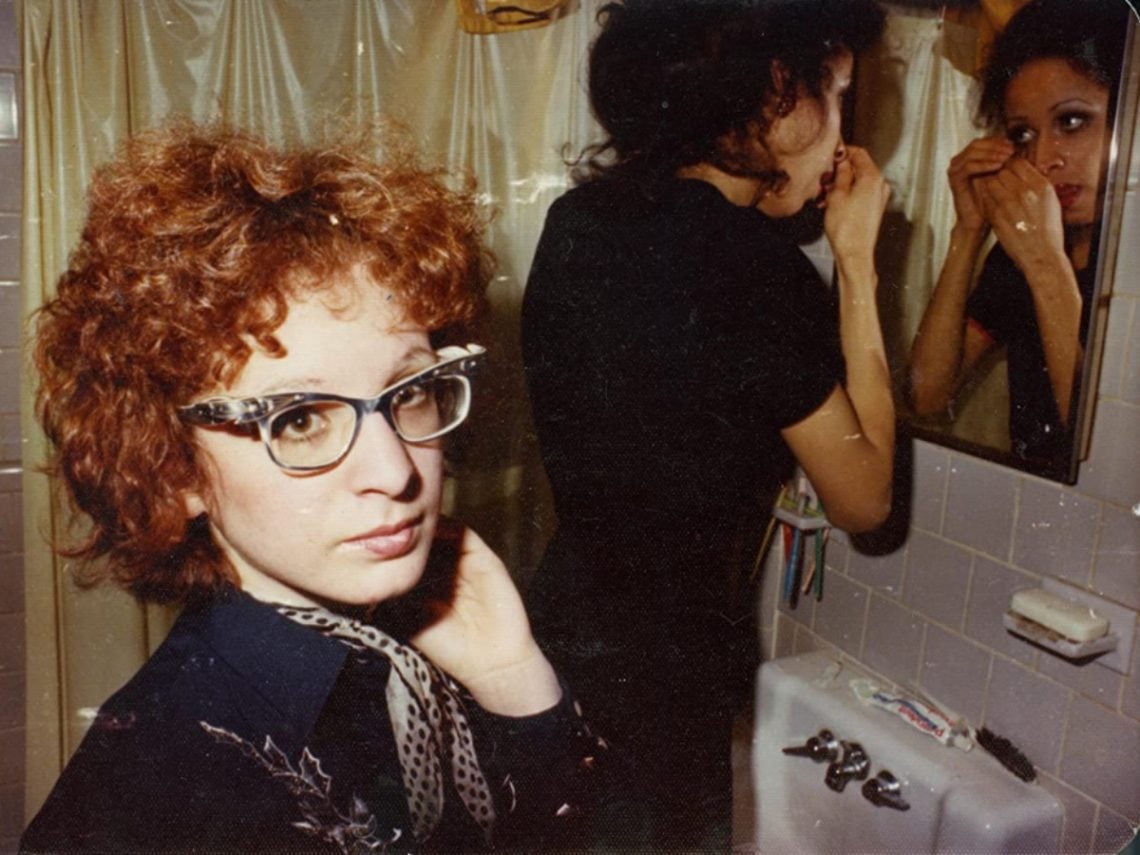
‘All the Beauty and the Bloodshed’ Review: Nan Goldin as the ultimate artist-activist

Every once in a while, you come across a film that shakes you to your very core and leaves you in a state of quiet devastation. You need to gather your thoughts to make sense of what you have just witnessed, thoughts that you know will continue to haunt you for months afterwards. All the Beauty and the Bloodshed, Laura Poitras’ latest documentary about photographer Nan Goldin, washed over me in the same way, and I haven’t been able to stop thinking about it since.
To those who are familiar with the history of queer art and the evolution of American photography, Nan Goldin requires no introduction. One of the first photographers to document the LGBTQ+ subcultures without otherising them, Goldin’s radically autobiographical art paved the way for multiple generations. Not only did she change the landscape of American photography, but Goldin also influenced the cinematic medium in more ways than one.
All the Beauty and the Bloodshed oscillates between the personal and the political, following Goldin’s campaign against the Sackler family and their direct contribution to the opioid crisis in the US, which has already claimed more than 500,000 lives. For Poitras, the idea for the documentary came about when she became obsessed with Goldin’s work with her advocacy group P.A.I.N. (Prescription Addiction Intervention Now).
Just after All the Beauty and the Bloodshed received an Oscar nomination for Best Documentary Feature, Poitras hopped on a call with me to discuss her work. She explains: “I had been following the news of the actions that Nan and P.A.I.N. had done in the museum. At the Met and at the Guggenheim, it was on the front page of the news. I mean, it was getting a lot of attention. And I thought, ‘Wow, this is really great!’ You know, this is really amazing that somebody with so much power in the art world is calling for a reckoning and to take down the Sackler name and not accepting business as usual.”
The term “reputation laundering” has been used to describe the operations of the Sackler family, who have made obscene donations to cultural institutions to steer the conversation away from their wrongdoings. Often called “the most evil family in America”, the Sacklers effectively manipulated the exploitable structures of American healthcare to ensure that addictive drugs such as OxyContin became unimaginably overprescribed.
For survivors of opioid addiction and the grieving families of the countless lives lost, seeing major museums honour the Sacklers for their donations has been deeply painful. Goldin and P.A.I.N. took it upon themselves to bring about real change within the hegemonic spaces of museums, protesting the glorification of the Sackler name until museums around the world stopped taking donations from the family and removed their name from the buildings.
Although the central hypocrisy of the co-existence of the Sacklers’ former presence in the art world and their bloodthirsty reign over the opioid market is not lost on me, it’s strange that it existed in the first place. Arthur Sackler, the family patriarch who became renowned as an art collector, had a disturbing obsession with Orientalism and went out of his way to amass large collections of Asian art, which he ended up donating to Western art institutions to build his reputation. While the irreparable damage done by Purdue Pharma is undeniable, the Sacklers’ impact on the art world is also questionable, to say the least.
Just like Poitras’ other films, such as Citizenfour and My Country, My Country, All the Beauty and the Bloodshed, is a stunning portrait of an individual confronting the structures of power that maintain the unacceptable status quo. The filmmaker tells me: “I like these kinds of narratives. I like… the story of an individual who’s kind of at the cusp of some historical moment and is creating change.”
However, All the Beauty and the Bloodshed stands out because of its unique structure, which is one of the reasons why I found it so fascinating. Alongside the vérité footage of Goldin’s protests, we see extended slideshows of her photography accompanied by incredibly intimate audio interviews about life, death and everything in between. Goldin has always thought of her slideshow presentations as “visceral experiences” that are fundamentally cinematic, but the documentary transforms these slideshows into something more.
Still images in films have always come across as somewhat paradoxical, but masterpieces always transcend the limitations of their medium. If you haven’t seen the documentary and are wondering how slideshows of Goldin’s photography can ever be compatible with the dynamism of the cinematic medium, trust me. It just works. Just like in Chris Marker’s La Jetée, there isn’t just an overwhelming sense of movement between the images, but each individual photograph is in motion as well.
While talking about the narrative structure of the film and the editor Joe Bini’s conceptualisation, Poitras elaborates: “The language that Joe Bini used, he described it as the inner world and the outer world. And the inner world is the story of the past, and that the outer world was a contemporary story. So that, you know, it did take time but… we did build an outline around these chapters, and that were thematically organised, which helped us to sort of focus on different parts of Nan’s life, or different slideshows. And those kinds of became organising principles.”
All the Beauty and the Bloodshed is much more than its individual parts. It’s obviously a portrait of Goldin, but it’s also a vision of America that looks back on the painful decades, stretching from the HIV crisis to the opioid epidemic, to examine the country’s problematic relationship with healthcare. The documentary criticises the American government’s continuous marginalisation of those who are suffering the most. It draws parallels between the government’s treatment of the LGBTQ+ community during the AIDS epidemic and the blaming and shaming of addicts instead of the Sackler family.
Due to the current sociopolitical climate, Goldin’s protests within museum spaces have inevitably reminded viewers of the environmental protests conducted by organisations such as Just Stop Oil who have been routinely demonised by the media. However, Poitras maintains that such comparisons only serve to detract from the individual causes because they fail to address the systemic problems that continue to pose serious threats to modern societies.
“I’m fully in support of people who are taking action to respond to existential threats,” Poitras insists. “I think it’s the wrong set of questions. I think we have to ask ourselves, what are the failures of society that people are having to resort to going to cultural spaces to try to get accountability. Let’s face it, there’s never going to be real accountability or change in those cultural spaces. It can only raise awareness about them. It doesn’t create [any] structural change to the problems.”
There is no sense of closure in All the Beauty and the Bloodshed because the Sacklers were never held accountable. Due to the expertise of the expensive legal teams they hired, the wealthy family managed to declare bankruptcy and escape any real consequences. Not just that, they put activists such as Goldin and journalists like Patrick Radden Keefe under surveillance to intimidate them. When Poitras was making the documentary, she never expected it to receive such a spotlight, but the Oscar nomination changes a lot of things – for the filmmaking team as well as the Sacklers.
The director, however, has only one thing on her mind. “In terms of the additional attention that the nomination brings, I’m just hopefully gonna use the platform to call for some justice. I believe that the Justice Department in the US should indict Richard Sackler. There’s still time, they can still do it, and they should, and maybe that message will be heard more. I also wanted to acknowledge that it’s not just about my work or this film. Jafar Panahi, the renowned Iranian filmmaker, is currently incarcerated. He needs to be released. The nomination can help bring a platform to talk about those kinds of issues that I care deeply about.”
The Justice Department might not have indicted Richard Sackler yet, but All the Beauty and the Bloodshed is a scathing indictment of the systems built by people like the Sacklers to preserve power. Its central thesis about the inseparable nature of art and activism is an essential blueprint for all artists who want to create meaningful change in a society that is designed to self-perpetuate its flaws as long as the profit margins are satisfactory.
All the Beauty and the Bloodshed is out in cinemas today. Watch the trailer below.
