


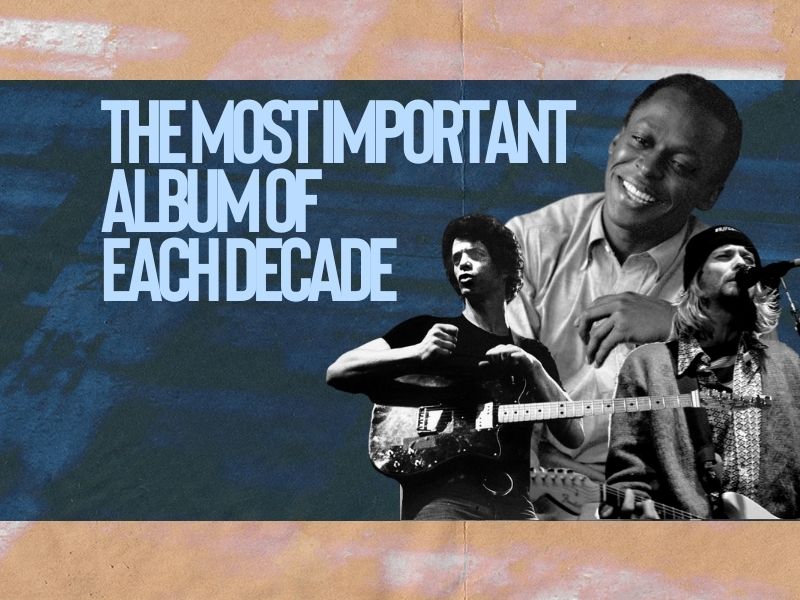
The most important album of each decade from the 1950s to the 1990s

Today, I’ve given myself the difficult task of selecting just one album from each decade between the 1950s and ‘90s as the most important of its time. This means cutting out hundreds of highly influential artists to reach just the one album in the given decade that would have the biggest butterfly effect had we zoomed back in time in a DeLorean and deleted it from existence.
So with importance, I’m not looking at album sales or radio air-time; nor am I picking out my favourites (although I do enjoy all of the selections). These selections are based on their creative influence on subsequent popular music and so may not even have been particularly popular in their time.
I understand that I’ll have an angry hoard of Michael Jackson or Madonna fans wondering why Thriller or True Blue weren’t on the list for the 1980s, but I am selecting artists based on their originality as well as their influence. If I feel a candidate album or artist was influential yet derivative in sound, then I may decide that a different artist, who may have been less influential but more of a trailblazer, is more appropriate.
So without further ado, let’s have a look back at the most important fifty years in musical history and pluck out some of the most critical milestone albums, decade by decade.
The most important album of each decade…
1950s: Miles Davis – Kind of Blue
In jazz music, there is a lot to explore, but the gateway album is almost always Miles Davis’ Kind of Blue. For the groundbreaking project, Davis enlisted some of the greatest jazz musicians among his peers, including John Coltrane and Julian ‘Cannonball’ Adderley, Bill Evans, Paul Chambers, and Jimmy Cobb. The album is a staple of any discerning record collection and is often referenced by rock and pop musicians when the word “jazz” comes up.
While it’s a prominent milestone in the world of jazz, Kind of Blue has had the added effect of influencing pop music during its continuous genre-blending over the years. So while you might not be too keen on jazz, you might like Roxy Music, Steely Dan, David Bowie or The Velvet Underground, and if so, you might just have Miles Davis to thank.
Honourable mentions: Elvis Presley – Elvis Presley, Frank Sinatra – Come Fly With Me, Little Richard – Here’s Little Richard, Chuck Berry – Chuck Berry Is On Top.
1960s: The Velvet Underground – The Velvet Underground and Nico
As a package, The Velvet Underground’s debut album has to go down in history as one of the most iconic and influential records of all time. Sure, the 1960s had a host of exceedingly vital bands and musicians – especially in the British invasion cohort (The Beatles, The Rolling Stones et al.). However, for a singular album, this progressive masterpiece takes the lead. The music wasn’t a great success in its time, but it has since inspired more musicians than one would care to list. This is before we even mention the iconic sleeve design created by Andy Warhol.
Brian Eno once described the ongoing impact of The Velvet Underground and Nico perfectly: “I was talking to Lou Reed the other day, and he said that the first Velvet Underground record sold only 30,000 copies in its first five years. Yet, that was an enormously important record for so many people. I think everyone who bought one of those 30,000 copies started a band!”
Honourable mentions: The Beatles – Revolver, The Beach Boys – Pet Sounds, Bob Dylan – Blonde On Blonde, The Rolling Stones – Let It Bleed.
1970s: Sex Pistols – Never Mind The Bollocks, Here’s The Sex Pistols
While the Sex Pistols didn’t invent punk music, they undoubtedly brought the genre to the fore in the UK with an attitude of anarchy that seemingly countered everything, from the monarchy to learning to play instruments properly. While the group weren’t the most talented of their time, their demeanour and style inspired a cultural revolution, with most subsequent punk and post-punk groups citing them as a crucial influence. The Sex Pistols had a particular impact following a famous performance at the Manchester Free Trade Hall, where future members of Joy Division, Morrisey, Mark E. Smith, Mick Hucknall and John Cooper Clarke were all allegedly in attendance.
“It was just about the attitude,” Peter Hook of Joy Division said, discussing the famous Sex Pistols gig in a recent Far Out interview. “The fact that what they were doing was so different. The week before, I’d been to see Led Zeppelin, and that was great; they played fantastically, but they weren’t inspiring – as in, come along and change your life, inspiring. So, yeah, the Sex Pistols spoke to me and said, ‘pack it in’, okay, ‘give up your job, and get out and join the circus’.”
Honourable mentions: Kraftwerk – Trans Europe Express, David Bowie – The Rise and Fall of Ziggy Stardust and The Spiders From Mars, Pink Floyd – The Dark Side of the Moon, Marvin Gaye – What’s Going On.
1980s: The Smiths – The Queen Is Dead
The selection for the 1980s was the most challenging. While there were plenty of exceedingly important and influential artists and a host of fantastic albums, the decade lacks albums on the iconic level of some of the others mentioned in this article. At first, I thought of some of the classic synth-heavy albums from earlier on in the decade, but I then felt the music created by these artists was often too derivative for any of the albums to be singled out as historically significant.
For that reason, my attention fell to The Smiths. At a time when every band in pop music seemed familiar with a worn-out synth element, The Smiths hit the scene with a guitar-driven sound that would burgeon through the 1990s in the so-called Britpop era. The Smiths were effectively the godfathers of indie music as we know it today. Of their four albums, The Queen Is Dead is widely regarded as the most important and influential.
Honourable mentions: Joy Division – Closer, Pixies – Doolittle, Talking Heads – Remain In Light, Sonic Youth – Daydream Nation, Prince – Purple Rain.
1990s: Nirvana – Nevermind
When thinking about the most important album of the 1990s, several great albums came to mind that have been influential for countless subsequent artists over the past three decades. But I feel that few of you will be able to contend with this selection; Nirvana brought grunge music to the masses with their unique and innovative style helmed by the late iconic frontman Kurt Cobain.
The 1991 masterpiece, Nevermind, is the jewel in Nirvana’s crown and has had an influential presence in rock music to this day – there’s a reason why every teenager today still seems to be wearing the classic Nirvana smiley tee shirt. Jared Leto, actor and lead singer of 30 Seconds to Mars, once said, Nirvana gave him and countless other musicians “permission to pick up an instrument and create,” and without their influence, he “would not be here.”
Honourable mentions: Radiohead – OK Computer, Portishead – Dummy, Spiritualized – Ladies and Gentlemen We Are Floating In Space, Aphex Twin – Selected Ambient Works 85-92, My Bloody Valentine – Loveless.

Never Miss A Beat
The Far Out Beatles Newsletter
All the latest stories about The Beatles from the independent voice of culture.
Straight to your inbox.