


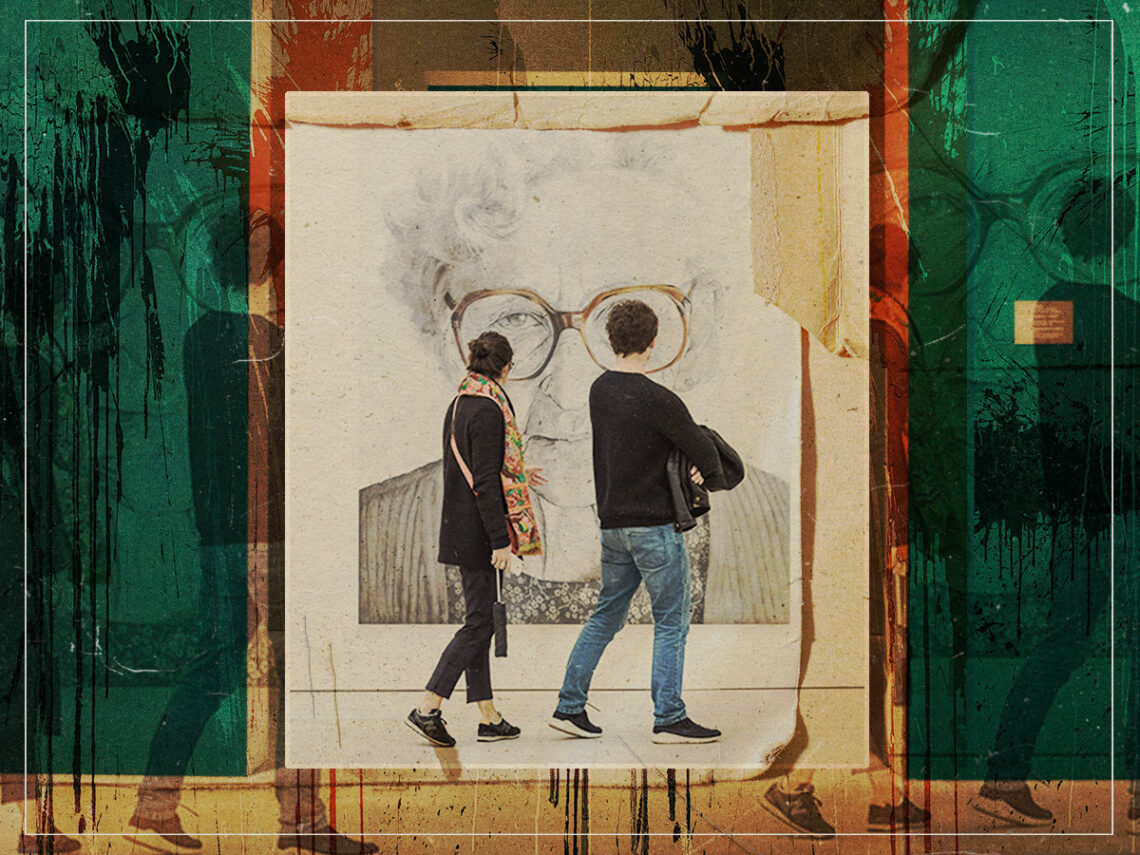
Why are art galleries so triggering to the working classes?

This past Sunday, I found myself hostage to the unwritten construct that there’s a minimum time you should spend in an art gallery. You can’t just find yourself in front of a painting you don’t like, not feeling anything, and then move on. You have to endure this dull malaise for upwards of 20 seconds at a time. This wouldn’t be so bad if it weren’t for the fact that I am often stood there with beads of anxiety-sweat dribbling from my brow and an overwhelming sense of dread induced by the gallery itself.
My local one in Newcastle, one so near to me that I’m actually looking at it now, has an infinity staircase, whereby you peer over the bannister, and thanks to a clever mirrored illusion, you see a bottomless plummet of stairs. Most Sundays, I’m glancing down into this stainless-steel abyss, hungover, pondering upon the clever yet truly evil mind behind it, as a panic attack rears its ugly head from within. Only this weekend it was worse.
One of the current exhibitions features a darkened room where a surrealist reel of video footage plays while eerie ambient sounds, like whale noises if the whale in question was being subjected to water torture, blare out bleakly. The inability to concentrate or read anything into this perverse oddness is underpinned by the fact I am silently standing in a dark room with strangers, perfectly capturing the awkwardness of an elevator and amplifying it by removing both the point and sense of imminent release.
I can’t move, I can’t snigger, or even say anything to my other half, who stands mere feet away, a barely detectable aura about her frame indicative that she is surely experiencing the same doom-laden inertia as me. It’s like being trapped in some strange coma, my own psyche intact but subject to the unfeeling analysis of the thoughts of someone else. Then, the mind inevitably drifts towards class disparities.
Most galleries these days champion the plights of the world’s poorest, and yet the actual exhibitions always feel as though someone middle class has taken up the mantle of a cause that isn’t truly their own. It’s not that I’m not pleased to see the fight of Amazonian tribes beset by logging firms taken up and exhibited on my own doorstep via the medium of art. It’s just that the art in question is more often than not an assortment of strange nonsense by someone called Suki, who flew first class to Peru, got dysentery, and recovered in a private hospital before embodying the experience by using twill to tie a stone to a twig and then figuratively screaming at me in scary tones, ‘You’d think this was good if you weren’t such a poor, thick piece of shit’.
Meanwhile, the call to watch Super Sunday with a pint of Fosters knocks on the door of my subconscious, like the prodigal son of my true self asking to take over the day’s proceedings. But this happier side of my identity is barred for now. In its place is a mature imposter who says things like, ‘It’s amazing that such a resource is free to everybody. If anything, it just needs more funding’, and, ‘I don’t even mind that you’re not allowed to carry a coffee around with you’ while knowing full well that my favourite pieces in here are the cool posters that you can buy in the gift shop. The true art of my crowd is scribbled onto the back of the door in the Crown Posada across the road.
But I’m not in the pub. I was there last night, and now I’m shuffling awkwardly from piece to piece in designated 20-second intervals, occasionally daring to whisper the typical working-class questions: ‘Which is your favourite piece in here?’ and ‘Would you have any of these in the living room?’. Despite this sacred space being free, there is a palpable, inherent sense that I don’t quite belong here—the product of Britain’s perennial class bludgeoning. And it immediately spikes anxiety within me as soon as I set foot in the hushed halls. It’s no fault of the gallery. It’s just the manifestation of the make-up of our society.
So, in part, the reason I keep going is not just because there are often some truly interesting pieces that I’ve negated to mention so as not to skew the narrative of these pieces but also, strangely, to battle this embittered disposition that I feel as I stride around, a recurring attempt to genuinely try and enjoy elevated culture without feeling like a liar on the brink of a breakdown—a breakdown often conjured by stark art so humourless, highfalutin and nonsensical that it seems to say: ‘You don’t get this? Well, you wouldn’t’, while ramming home a triggering dread of calm, hushed horror, thanks to the strange mix of staggeringly bleak works about the end of the world via climate catastrophe or knife crime in an otherwise very pleasant and welcoming building.

