


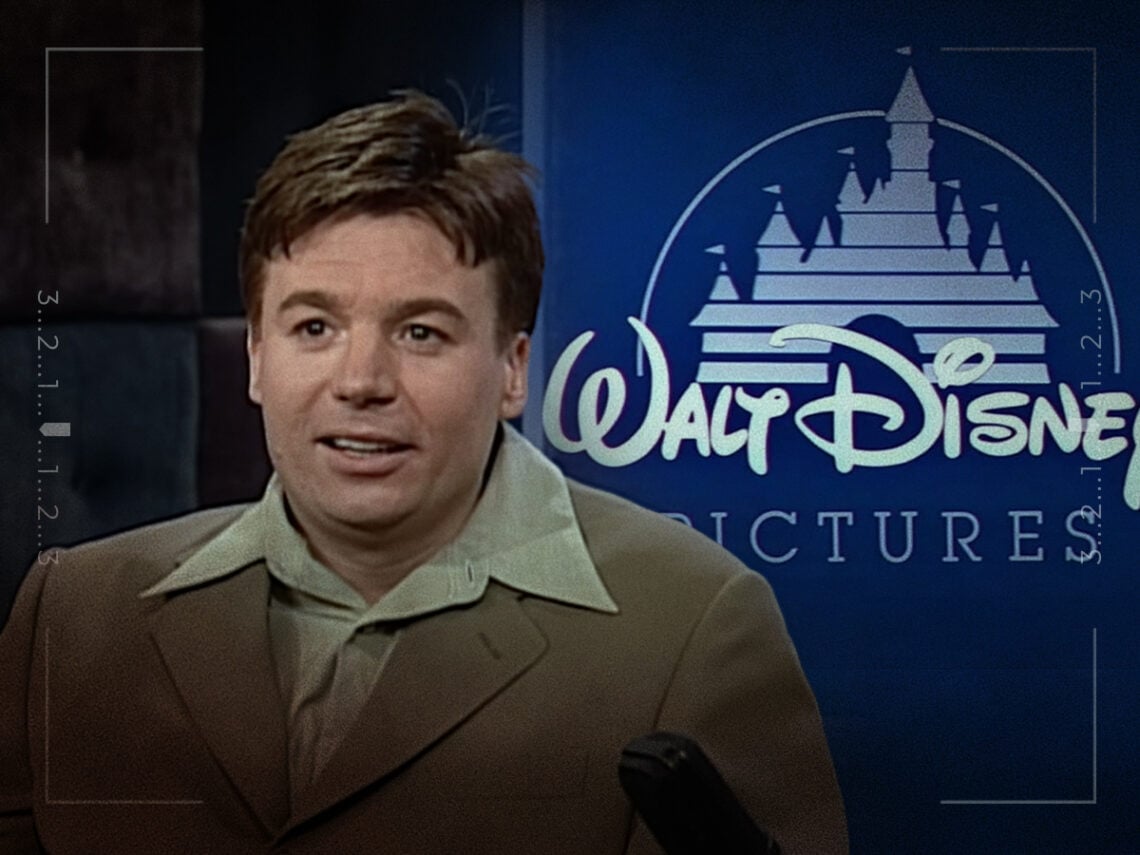
The 1998 Mike Myers movie too gay for Disney: “The characters were fundamentally changed”

Now that he seems settled into his groove as a semi-retired former movie star, a pattern has been emerging in Mike Myers‘ recent work, and it’s already starting to border on self-parody.
In 2018, he appeared in the musical biopic Bohemian Rhapsody as a bearded and bewigged record company executive, and in 2026, he appeared in the musical biopic Michael as a bearded and bewigged record company executive, which is about as uninspired as returning to the well can possibly get.
Despite making his living and name as a comedian, Myers always had loftier ambitions of being taken more seriously as an actor and filmmaker. They didn’t come to pass since every time he tried it, the results were dire, but the first time he sought to branch out to no avail in writer and director Mark Christopher’s 1998 drama 54, it wasn’t his fault, or the filmmaker’s, for that matter.
Playing Studio 54 co-owner Steve Rubell, the picture was intended to be a complex, hard-edged drama. When it was released in cinemas, it died a death, suffering from anaemic box office and vitriolic reviews, with Disney largely to blame, after the studio interfered on behalf of its then-subsidiary, the Weinstein-backed Miramax, to turn Christopher’s passion project into something it was never meant to be.
Ryan Phillipe’s Shane O’Shea gets a job in the titular club, drawing him into a world of hedonism, drugs, romance, disco, and sexuality. When the director provided his initial cut of 54, he was ordered to remove 40 minutes from its 106-minute running time, leading to extensive reshoots that completely changed the tone of the movie. “I’ve never seen this kind of editing and reshooting on another film I’ve done,” Phillippe recalled. “The characters were fundamentally changed in a way that wasn’t true to the original script. Not even close.”
When Christopher showed Miramax an early scene, “The studio went bananas,” but that enthusiasm was short-lived. At Miramax’s insistence, a kiss between Phillipe and co-star Breckin Meyer was cut, a rough cut was screened for the boardroom in February 1998, and a test screening at a Long Island mall was an unmitigated disaster, with words like “irredeemable” and “loathed” being thrown around by those in attendance.
“This was a dark movie,” Christopher explained, “And it shouldn’t have been tested in those places. Audience test screenings are blunt instruments.” Disney was leaning on Miramax to water down the homosexual elements of the story and depictions of drug use, with an outside editor hired to re-edit the film and add new scenes, leaving Phillipe to lament that “the ambition changed behind the scenes without us being included.”
In the theatrical version, O’Shea’s bisexuality is completely absent, among other sweeping changes, leading Christopher to assemble his own cut. “I wanted to make sure that I had it,” he explained. “Even if it was for myself.” Fortunately, it wasn’t, but it took a long time. A bootleg version of his two-hour 54 made the rounds for years, culminating in a screening at the 2015 Berlin Film Festival, with 44 minutes of reintegrated footage that wasn’t present in the version sent out to die on the big screen.
It was a vindication, with Christopher’s original vision receiving a rapturous reception and becoming something of a cult favourite, especially among the gay community. “I still can’t believe it,” the writer and director acknowledged. “Usually, director’s cuts come from Orson Welles or famous movies like Blade Runner. That this happened is kind of amazing.”
