


What is regarded as the first-ever “needle drop” in a movie?

Movies and music – the two are inseparable from each other.
They go together like peas and carrots. Like Harry and Sally. Like Butch Cassidy and the Sundance Kid. Bogart and Bacall. One of the highest compliments you can give to a particularly great piece of songwriting – think here of Marty Robbins’ ‘El Paso’ or perhaps Warren Zevon’s ‘Desperados Under the Eaves’ – is to call it cinematic. And what would cinema be without music?
What would Casablanca be without ‘As Time Goes By’? The Big Lebowski without ‘The Man in Me’? Reservoir Dogs without ‘Stuck in the Middle With You’ or any movie about Vietnam without ‘Sympathy for the Devil’ or something by The Doors?
Even way back in what is now known as ‘The Silent Era’, the movies might not have been able to speak for themselves, but they’d always have some sort of musical accompaniment. Though usually in the form of a live pianist playing along and reacting in real time as the events onscreen unfolded, some showings were more elaborate and would feature a full orchestra playing to the picture. The first true film score arrived in 1908, when French composer Camille Saint-Saëns wrote a piece of music to accompany the short film L’Assassinat du Duc de Guise.
Once sound and colour could finally be brought together in one neat production, those full orchestras began to score each scene with music synchronised to picture and meant that you didn’t need to hire a full orchestra to play in your cinema screening anymore to give an audience all the emotion that comes from such a beautiful musical collective. In 1926, Don Juan became the first film to be released with a synchronised score, and then in 1933, King Kong was the first feature film to comprise a fully original score.
Max Steiner wrote the music for King Kong, just like he wrote the music for things like the original A Star is Born, Gone With the Wind, and Casablanca, among hundreds of others – he was probably the most well-known and most sought-after composer in all of Hollywood until John Williams came along and rewrote the songbook.
And speaking of songbooks, so many of the songs that make up our everyday lives were written in the Brill Building (or, at least, on Tin Pan Alley) for the pictures, from ‘The Way You Look Tonight’ to ‘Moon River’, and thousands more were written specifically to be used in films – even Elvis’ horrible run of movies in the late 1950s and early ’60s yielded some stone cold classic songs, including ‘Love Me Tender’ and ‘Can’t Help Falling in Love’.
What was the first-ever “needle drop” in a movie?
Then there were the musical numbers that made their way into the movies. The first such instance came in 1927 when Al Jolson sang the 1922 Gus Kahn, Ernie Erdman and Danny Russo composition ‘Toot, Toot, Tootsie (Goo’ Bye!)’ in The Jazz Singer (a movie much more famous for his version of the Irving Berlin classic ‘Blue Skies’ and also for Jolson’s trademark blackface). Again, more famously, Jolson performed the 1919 George Gershwin and Irving Caesar song ‘Swanee’ in no less than three movies, The Jolson Story, Rhapsody in Blue and Jolson Sings Again.
But those were all songs written for the movies, or sung on-screen by the singers. It wasn’t really until the 1950s and ’60s when directors really started to experiment with their use of music, and when songs started to feature on a film’s soundtrack to help to set a scene, grab an audience’s attention, establish a mood or even in cases become a character themselves.
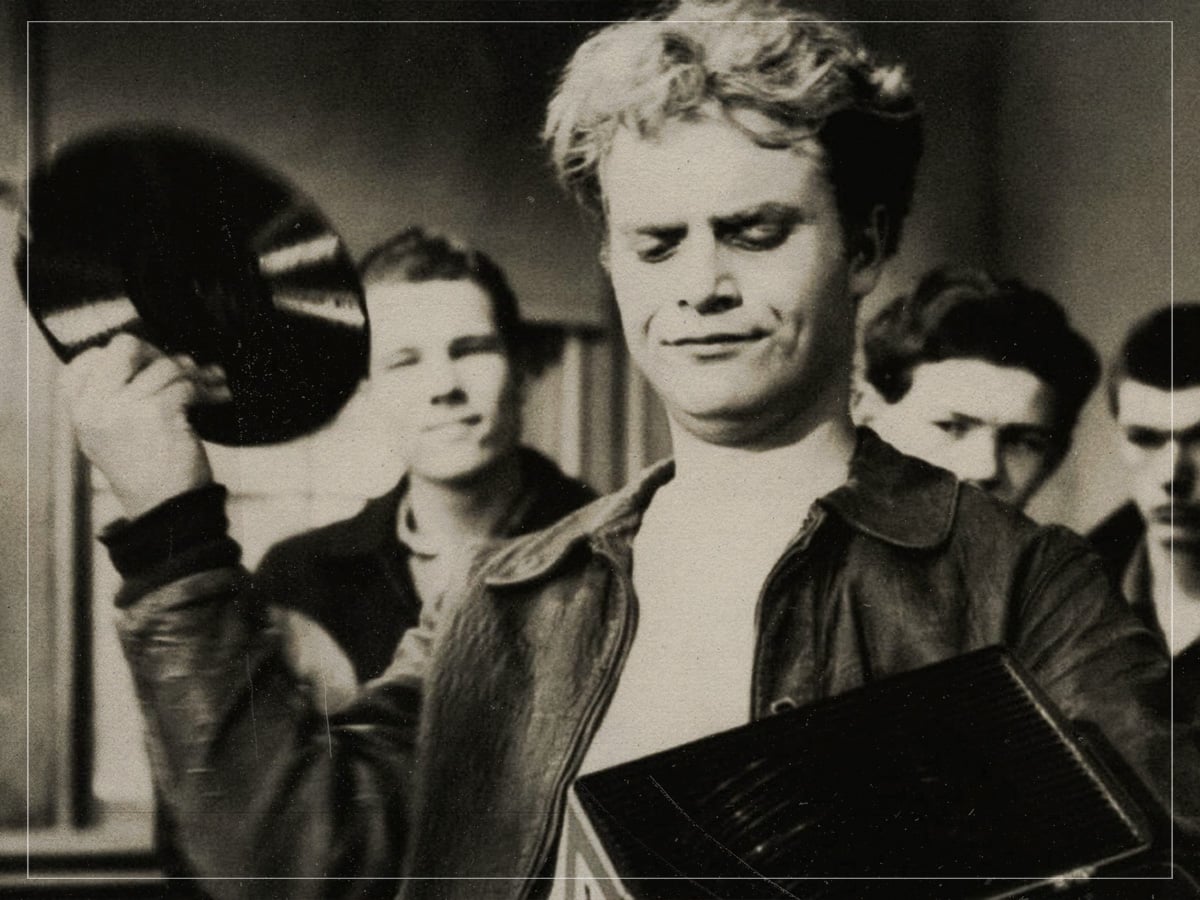
In 1955, Richard Brooks’ Blackboard Jungle caused a stir everywhere it was screened, not least of all for its use of the Bill Haley & His Comets track ‘Rock Around the Clock’. The movie sparked riots in certain circles and helped cement rock and roll’s rebellious image in the minds of many of society’s stuffier citizens. The use of ‘Rock Around the Clock’ in the movie is regarded as what people now refer to as “needle drops”, the use of a piece of music in a film outside the scene, in a way that the characters can’t hear, to help move the movie along. It might have been the first, but it wasn’t really until the next decade that the phenomenon really took off and became the massive talking point that it remains to this day.
Andy Warhol had featured music in the background during scenes in his movies through the 1960s, including his 1965 Edie Sedgwick picture Poor Little Rich Girl, but in 1968, Mike Nichols set a new precedent for the use of non-diegetic music when he set several scenes of his seminal The Graduate, which had five songs from Simon and Garfunkel, including ‘Mrs Robinson’, a previously unfinished song that Simon re-worked for inclusion in the movie.
In 1969, Dennis Hopper wrote, directed and starred in Easy Rider, alongside Peter Fonda and Jack Nicholson, a road-trip movie set in the American South, which set a further precedent for the use of music in film to help carry, continue and cradle a story – songs such as ‘Born to Be Wild’ do as much for the movie as any of the writing, cinematography, acting or directing did.
Of course, now, practically every movie that is made comes with at least one needle drop. Some movies even feel like nothing more than an excuse for the director, and the attached music supervisors, to show off just how brilliant their taste is (here’s looking at you, Watchmen, Guardians of the Galaxy, Suicide Squad, Saltburn and the excruciating 2000 High Fidelity adaptation), while at other times, the use of music can even salvage an otherwise middling scene or movie (for instance, every use of Leonard Cohen songs in Natural Born Killers).
Some needle drops are better than and more natural than others; more memorable and worthy of the heavy history that comes with the pairing of movies and music. Those films are usually directed by people like Nora Ephron, Sofia Coppola, Paul Thomas Anderson, and widely regarded as the king of the needle drop, Martin Scorsese.
