


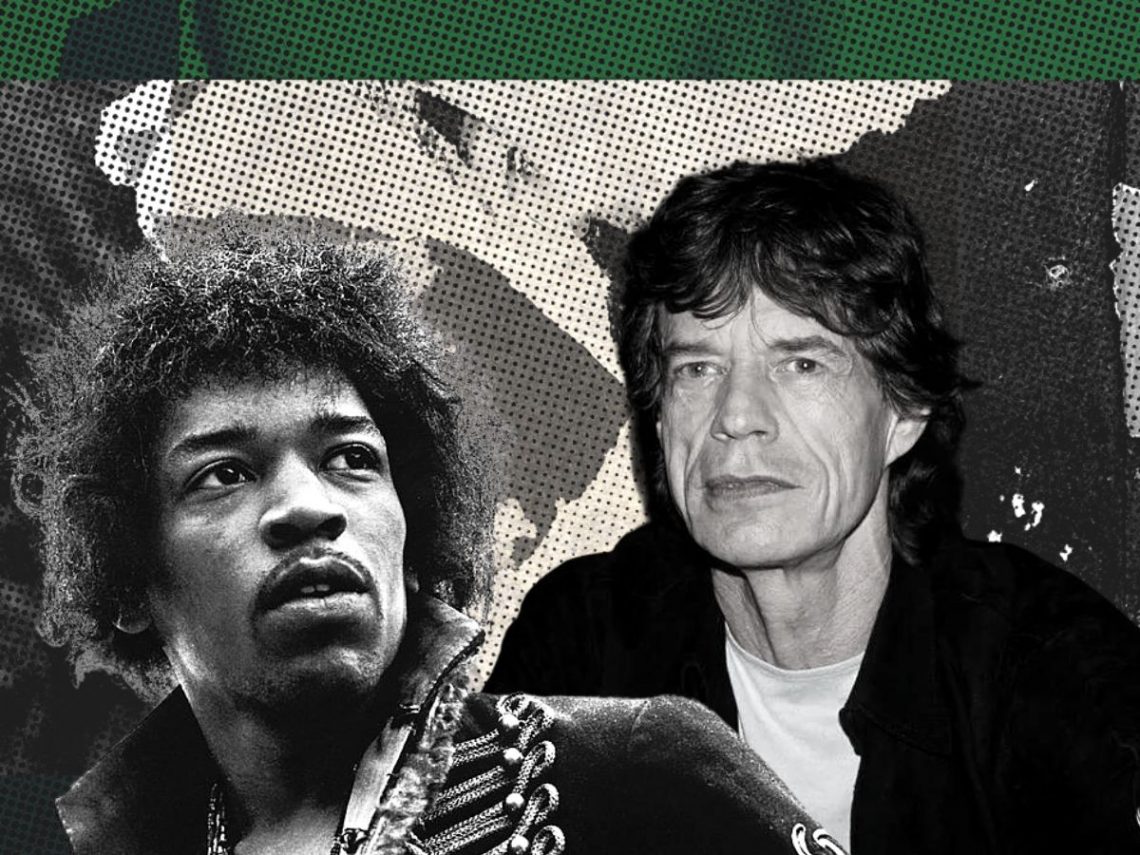
Mick Jagger reveals his theory on Jimi Hendrix’s downfall

Jimi Hendrix first trampled his path to success in 1965 when he met The Animals’ former bassist and aspiring band manager Chas Chandler in the US. Chandler encouraged the guitar virtuoso to travel to London, where he was introduced to bassist Noel Redding and drummer Mitch Mitchell, with whom he duly formed the Jimi Hendrix Experience. Within weeks, the band joined the top-flight British rock scene alongside The Rolling Stones, The Beatles and Eric Clapton.
Hendrix’s live shows left audiences with slackened jaws in the run-up to his band’s 1967 debut album, Are You Experienced. He successfully translated the complex psychedelic guitar voicings of his live shows onto vinyl and saw his fame and fortune proliferate exponentially.
Over the late ’60s, Hendrix became one of rock music’s hottest talents and most alluring performers. His intense performances were as passionate as they were chaotic. Taking a leaf from The Who’s book, Hendrix would occasionally set fire to his guitar as an added infernal touch.
Despite this wild, seemingly gregarious onstage persona, Hendrix was reportedly a distinctly reserved and timid man. “In real life, Jimi Hendrix was nothing like the wild guy that he portrayed on stage,” The Kinks’ guitarist Dave Davies once told Louder Sound. “He was a quiet, introverted guy like Ray [Davies] was. He was explosive on stage but very softly spoken off it. I’d see him from time to time at the Scotch of St James or at parties. We used to exchange the odd word to each other, but it was never like we were close.”
This apparent double life undoubtedly brought a great deal of stress to Hendrix’s daily routine. His dream was to be a rock star soaking the limelight centre stage, but his true demeanour leant towards a quieter, more introverted Hendrix. In an interview with Rolling Stone in 1995, Mick Jagger appeared to suggest that this internal conflict led to Hendrix’s demise.
Reflecting on the first time he saw Hendrix perform in the mid-60s, Jagger recalled that the American guitar hero was “exciting, sexy, [and] interesting”. Despite not being the biggest fan of Hendrix’s vocal capabilities, Jagger could see he was a uniquely gifted guitarist.
“He was a really sweet guy,” Jagger told Rolling Stone. “A bit confused. It’s the same old story: Jimi Hendrix played all over the place with all these bands. He’d been a background guitar player for donkey’s years.”
“And suddenly he gets what he wants, then has to play ‘Purple Haze’ every night,” he continued. “He goes, ‘Uh, I don’t want to play ‘Purple Haze’ every night. I don’t want to burn the guitar.’ And then, when everyone went off the deep end, he had to go off the deep end. He became a heroin addict.”
Sadly, like many before and many after him, Hendrix turned to drugs and alcohol to help him cope with the pressures of rock ‘n’ roll performance. On September 17th, 1970, he spent the evening out with some friends in London before heading home with his girlfriend, Monika Dannemann. According to Dannemann, the pair enjoyed the rest of the night together, drinking more red wine before Hendrix decided to take some sleeping pills.
The next morning, Dannemann found Hendrix unresponsive, covered in his own vomit. The young rock star had died from asphyxiation, and the autopsy found that he had taken nine sleeping tablets, around 20 times the recommended dosage.
“Jimi Hendrix, bless his heart — how I wish he was still around — almost inadvertently ruined guitar,” the Rolling Stones guitarist Keith Richards told the San Diego Union-Tribune 40 years later. “Because he was the only cat who could do it like that. Everybody else just screwed it up and thought wailing away (on the guitar) is the answer. But it ain’t; you’ve got to be a Jimi to do that; you’ve got to be one of the special cats.”
Watch Jimi Hendrix perform his cover of Bob Dylan’s ‘All Along the Watchtower’ below.
