


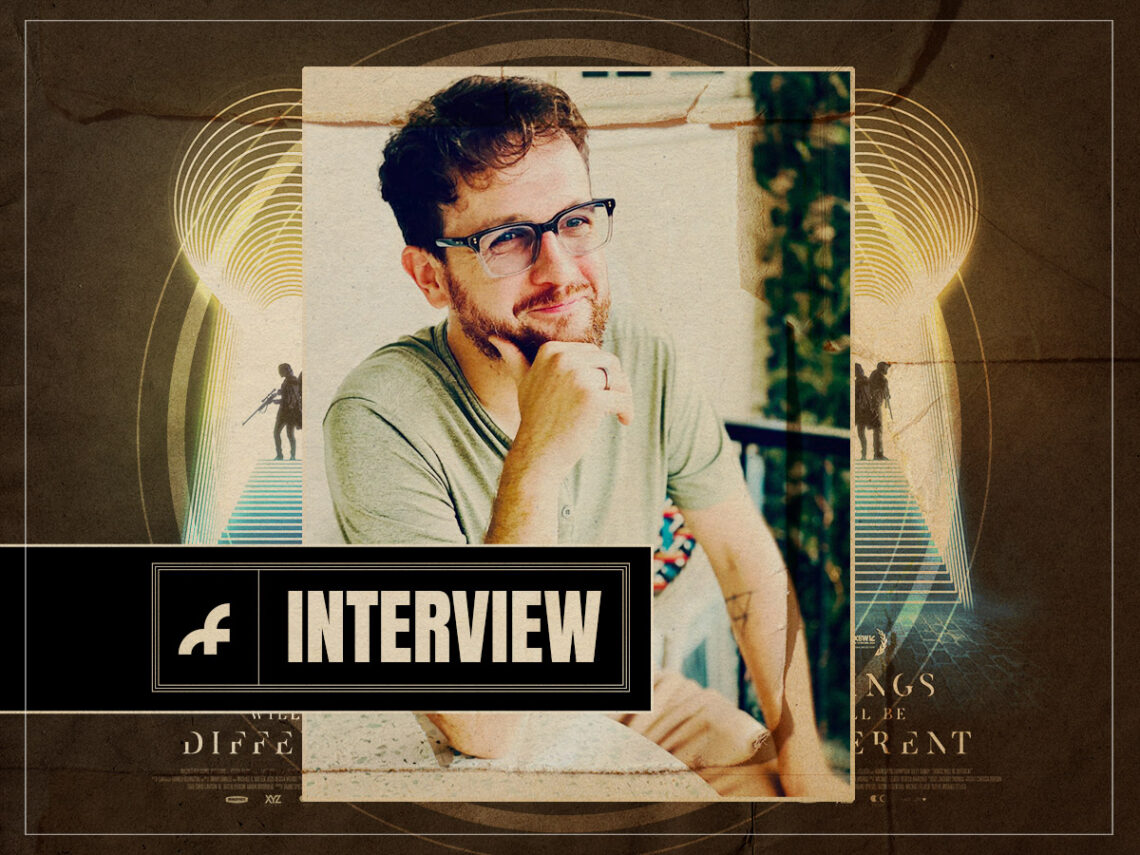
“It’s like ‘Reservoir Dogs’, with time travel”: writer and director Michael Felker on sci-fi thriller ‘Things Will Be Different’

Diving headfirst into his feature-length directorial debut with ambition to spare, writer and director Michael Felker tells an intimate family drama laced with genre trappings and no small amount of temporal tampering in Things Will Be Different, a story that’s equal parts existential and intimate.
Adam David Thompson and Riley Dandy play siblings Joseph and Sidney, who reunite at a remote diner after committing a robbery. Seeking a place to hole up and wait for the heat to die down, they relocate to an abandoned farmhouse, which introduces the film’s key mechanic: to escape the law and stay one step ahead, they can use the technology left behind by its mysterious originators to travel through time.
It would be an understatement to say time travel is well-covered ground in cinema, but Felker has found a new way in. That’s not easy to achieve, with the director revealing how his background and upbringing saw him develop the premise that sets Things Will Be Different apart from a crowded pack.
“I had the world of the movie for a while now, just because I come from a science-based family, so we kind of just talk about time travel sometimes just over coffee, casually,” he tells Far Out. “We watch a lot of science fiction movies, so we’re well-versed in the time travel movie classics, and which ones are doing different rules and which ones obey different logic for their stories.”
The concept originated from conversations with his nearest and dearest, a love of cinema, and also the limitations of independent cinema. Felker admits, “I know how to make a movie in a very cheap way that you could do it with just household objects and a few friends and colleagues,” a process that’s “been really exciting to find a new way in, that felt fresh and exciting.”
One thing that time travel movies always do is cause the audience to try and poke holes in the logic, something Felker was also keenly aware of as a fan of the medium. It’s even referenced in Things Will Be Different, where Joseph’s response to a question on how it all worked is basically, ‘I don’t know’. No time travel film is airtight, and the filmmaker has the perfect explanation that came from his father as to why.

“When I was stuck writing a time travel movie about ten years ago, I was talking to him about, like, ‘I can’t quite explain this rule, and I need to do this and this, and none of this is connected together’. And what he told me was, ‘Michael, if you would have invented time travel, you would have invented time travel, you wouldn’t be writing a screenplay,” he says. “You wouldn’t be trying to make it work in a movie; you would be changing the world with quantum mechanics.'”
An entirely fair point, and one that inspired the script. “I think that stuck with me more than anything,” Felker reflected. “You know, you could have movies like Primer where they tried to really solve time travel with like an 80-minute runtime in a movie, or you can have the people that you’re following.”
That being said, Things Will Be Different still needs to establish the ground rules of its world. Exposition can often be the death of sci-fi, with Felker’s preference for appreciating the unspoken and unsaid feeding directly into his decision-making about how much information to give to the viewer.
“My favourite type of science fiction is the ones that leave you with more questions than answers,” he explained. “I think the reach for the answering of the unknown is more fascinating than getting the answer of the unknown because we have so many possibilities of how a movie can work or how some certain things in the universe behave and work.”
“For me, I want the audience to engage and ask and pose these questions as much as they can, knowing there will be some answers, but then, there’s just going to be more questions that are beyond the scope of the characters we live with.” It’s an admirable mission statement and one that bleeds into every frame of Things Will Be Different, mirroring its universe’s unanswered questions with the ones the audience will be left with.
“I love when a movie, especially in a science fiction movie, explains enough for me to explore in the playground, but it doesn’t give me everything so I know where the universe ends and where the walls begin,” Felker mused on his conscious choice not to spell it all out. “I feel like there’s a balance between this large universe, but then to still have fog in the distance where you think things are, and you’re not sure where other things are as well.”
Many of the best time travel movies are the ones that lead to intense debate and conversation once the credits have rolled, and it’s key to Things Will Be Different. Generating discussion isn’t something a filmmaker can solicit intentionally, but Felker nonetheless used post-production as the barometer.
“I think I learned while we were still editing it,” he confirmed. “So one of the biggest things was, when we do cuts, we kind of gauge whether somebody’s confused in a good way or confused in a bad way, and so we kind of try to find the middle ground of if they are leaving with the right questions. That’s good confusion. Confusion by design is what I like to call it.”

As for bad confusion? “Bad confusion is, like, ‘I don’t understand why characters do certain things, or I just don’t understand the heart of them’. Which is what should be very clear, at least as clear as you possibly want it to be, for the audience to emotionally engage and have a reason why these questions need to be asked after the end of the movie.”
When fine-tuning the final cut, Felker did what he calls “foolproof testing,” where people – “especially people who work within sci-fi or engage with sci-fi lore and books” – came in to help him figure out “what is a playground they can play in, or a swamp they can sink in,” a methodology that helped him bring Things Will Be Different “as close as you can to that sweet spot between knowing and not knowing.”
There were other touchstones, too, with Felker citing the Coen brothers’ Blood Simple and Rian Johnson’s Looper as influences. Nacho Vigalondo’s Timecrimes, which he called “the ultimate indie time travel movie,” was also a reference.
Shane Carruth’s aforementioned mind-bender Primer was acknowledged, too, but the third isn’t even a sci-fi story at all, with Andrew Dominik’s The Assassination of Jesse James by the Coward Robert Ford key to Felker’s visual aesthetic.
“Just in terms of how to shoot a rustic noir like that, using the lens as a foggy dreamscape, you could kind of idolise or romanticise stuff that happens in the past,” he elaborated on the style developed alongside cinematographer Carissa Dorson. “That was really interesting for us to have that as a reference, knowing that was our way to kind of make it feel a lot different from your typical time travel or indie crime movie.”
However, as a movie that opens with the aftermath of a robbery that’s never shown but kicks the plot into high gear before the bulk of the narrative unfolds in an isolated location where the story is pushed forward by the characters and not the inciting incident that brought them there in the first place, it could be said Things Will Be Different has subtle shades of Reservoir Dogs, too.
“That’s a really, really good pull,” Felker confessed, despite it being unintentional. “I didn’t even think about that context because you’re right. All we know is just references to what happened, just based off what the characters say. And we take their word for it or don’t take their word for it. It’s a really, really good reference for this type of movie. It’s like Reservoir Dogs, with time travel.”
Snappy marketing hooks coined by this writer aside, the point stays the same; it might have a high concept, but at the end of the day, Things Will Be Different is a story about a brother and a sister. The dynamic between Thompson and Dandy feels real, relatable, and authentic, especially when the spaces between conversations become more important than the dialogue to relay their feelings.

“Absolutely, yes, that’s a really good insight,” Felker agreed. “I base a lot of my writing and directing on my own relationship with my sister, which, a lot of the regret of not seeing each other and being closer came from my own relationship with my sister.” To solidify the bond between the two stars, they were encouraged to form a relationship outside of the writer and director’s prying eyes.
“I feel like in order to get a brother and sister relationship, you kind of just have to know each other when you’re most relaxed,” which in this case involved Felker leaving Thompson and Dandy to their own devices so they could “develop their own language, like their own secret set between each other that even I don’t know.”
It’s the crux of the film on every level, with Things Will Be Different never losing sight of the two-hander that anchors everything from the first to the last scene. That familiarity between the two leads, and the story itself being so indebted to his own sibling relationship, allowed Felker to refine the shorthand that serves the characters and their overarching arc so well.
“It allowed me to trust them a lot with any of their insight, especially if they had some ideas about how to tweak some dialogue in the moment out there in the set or try some new blocking decisions,” he offered. Referring to himself as “the encyclopaedia of the world,” Felker encouraged his actors to seek clarification but stopped short of treading on their toes.
“If they needed to know information, or if they needed to know enough to be able to get through the scene, they can go to me, and I can just go through my binder in my head and go like, ‘This is what this is. This is what this is.’ And it allowed me to then shape their relationship based off what they know and don’t know,” he explained. For the most part, the director of any time travel movie needs to know more about the inner workings of the world than the characters and the audience, and Things Will Be Different carried on in that tradition.
Although Felker would rather his movie “lives on its own for a little bit just to see what the engagement is and what people bring to it,” he’d nonetheless “love to revisit this world with these characters and fill in even more blanks, but also leave even more questions.” The door for sequels and prequels remains open, then, but outside of a potential Things Will Be Different franchise, what would the first-time feature director’s dream project be if he was given free rein to make whatever he wanted?
“Legend of Zelda is definitely one; it’s the reason why I got into moviemaking outside of the movies that inspired me,” he said of his dream directorial outing. “Just the atmosphere and the progression of being safe in a world, like growing up in the forest that you came from and then going down to the deepest, darkest depths of hell and finding the horrors that come from it.”
The downside is that Wes Ball is currently developing that exact movie, but should it live up to its potential and make a killing at the box office, who’s to say Felker can’t helm a Zelda sequel? “Oh my god, that would be the dream,” he agreed. “I hope it becomes a reality for sure. Just got to keep thinking about it. Just got to keep the target going.”
With Things Will Be Different releasing on digital and in select cinemas from October 4, Felker’s dream is only just beginning.
