


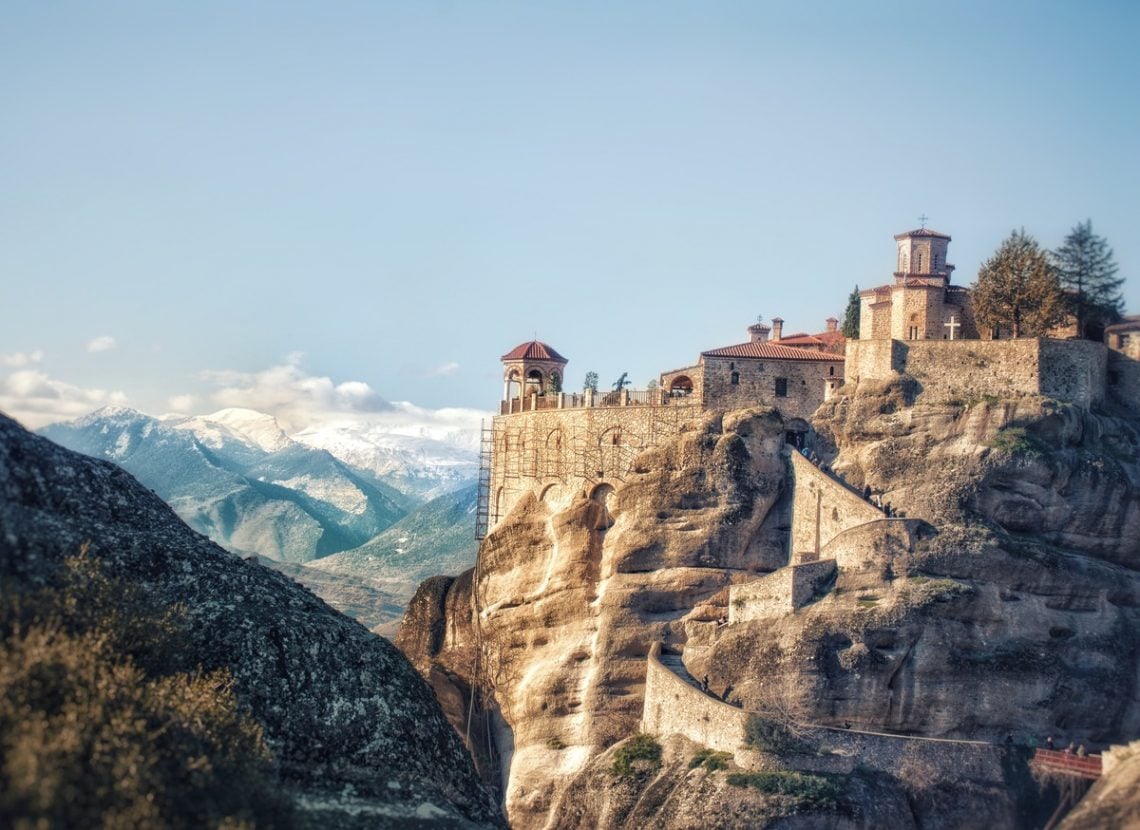
Meteora, Greece: One of Europe’s most fascinating locations

Greece is home to many breathtaking natural sites, from the volcanic island of Santorini to the pink beaches of Elafonissi, Crete. There is no wonder, then, that the myths of its ancient civilisation are so heady, as being blessed with such natural wonders would be enough to make anyone believe that this was indeed the centre of the world. Whilst the list of fantastical locations in Greece is nearly endless, one of the most breathtaking is Meteora, a setting that denotes not only the gods of the ancients but also the scientific history of the world.
A stunning rock formation in central Greece, Meteora is located on the verdant Plain of Thessaly, close to the Pineios River and the Pindus Mountains. As well as being naturally captivating, it is coveted as one of the centres of Eastern Orthodoxy, second only to the world-famous Mount Athos.
Meteora houses a sprawling but steeply built religious complex, hosting six of what were originally 24 active monasteries built on natural pillars and hill-like boulders that are found throughout the locale. Meteora’s name is taken from the word meteor, meaning “elevated”, and unsurprisingly, it is featured on UNESCO’s World Heritage list.
Interestingly, the rock formations of Meteora have proved difficult to explain. They are composed of a mixture of conglomerate and sandstone and are not volcanic plugs of hard igneous rock as can be found throughout the world in other areas. The rocks are 60 million years old, and when earth movements pushed the seabed upwards, it created a high plateau and fault lines in a thick sandstone layer, with the imposing rock pillars formed by weathering. Although this process has happened worldwide, the uniformity of Meteora’s aesthetic has caused it to become so renowned and mysterious.
Another fascinating aspect of Meteora’s tale is that it is not mentioned in the famous Greek myths or Ancient Greek literature, despite Radiocarbon dating suggesting human presence in the area for 50,000 years. The first people documented to inhabit the rocks were a group of hermit monks who moved up to the pinnacle in the ninth century AD, living in the fissures and hollows of the rock towers.
It is claimed that the monasteries were not constructed until the 14th century, when the monks needed refuge from the increasing number of Byzantine attacks on the area as they sought control over the fertile plain of Thessaly. Meteroa was perfect for this, as access to the top could be denied through removable ladders or windlass. Thankfully, these days, accessibility is easier than it was back then, as steps were carved into the rocks in the 1920s.
Before then, access to the monasteries had been notoriously difficult for centuries, requiring ladders latched together or large needs to haul people and goods to the top. UNESCO’s bio of this reads: “The net in which intrepid pilgrims were hoisted up vertically alongside the 373 metres (1,224 ft) cliff where the Varlaam monastery dominates the valley symbolises the fragility of a traditional way of life that is threatened with extinction.”
The monasteries are so connected to the story of Eastern Orthodoxy that after Theophanes built the Monastery of Varlaam, it is claimed that it once harboured the finger of St. John and the shoulder blade of St. Andrew, two of the most revered relics in the history of Christianity.
Meteora is one of the most impressive sites you’re likely to see and is a must-visit for those interested in the natural and human history of the world.
