


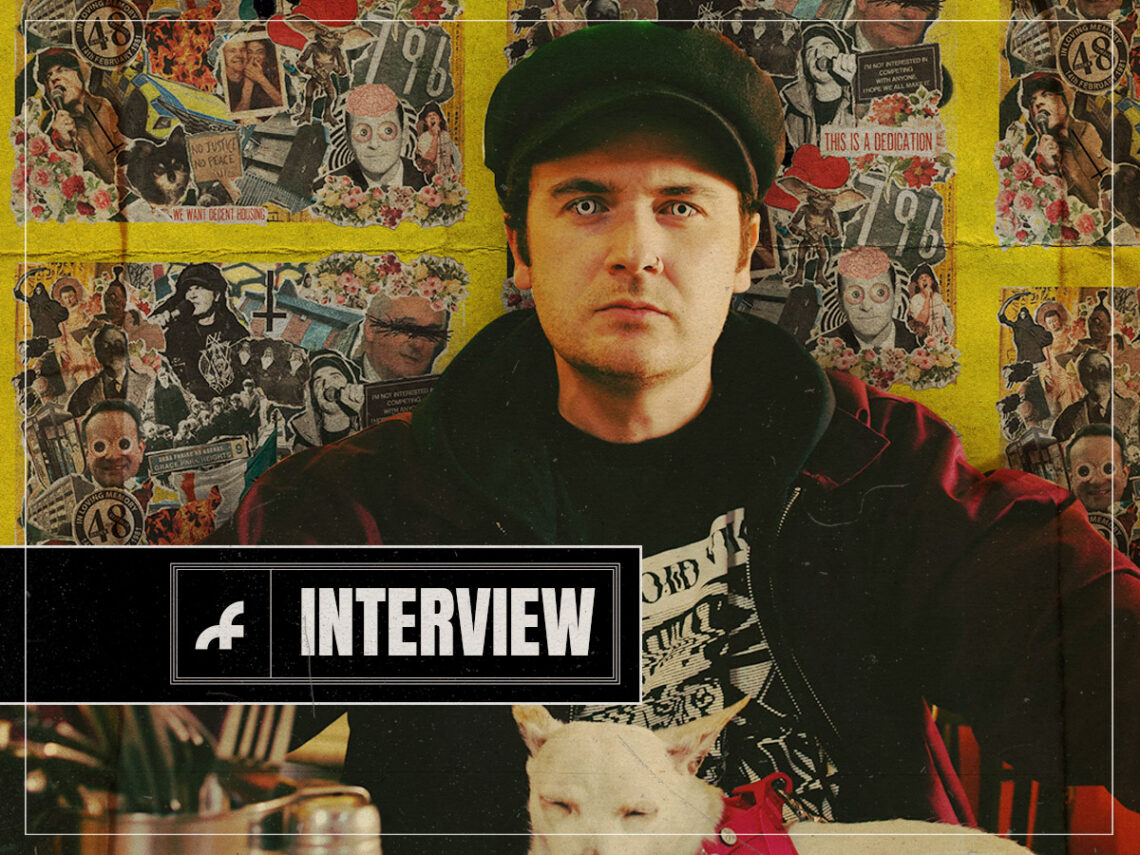
“We’re all fighting for the same fucking thing”: Meryl Streek on ‘Songs for the Deceased’ and a rotten political class

“First of all, what should I call you?” is not the kind of opening question that I’m usually used to asking artists. Yet, mystery is very much part of the package for Dublin‘s Meryl Streek. “Meryl,” he says straight up. “I don’t even like it, man, but I have to stick with it now, you know?” he laughs warmly, humanising the man behind the political outrage and ghoulish contact lenses.
On October 24th, Streek released his second album, Songs for the Deceased. The record is an all-encompassing body of work. Building on the fusion of heady electronic textures and punk that his first album, 2022’s 796, instituted, featuring his distinctive, vitriolic delivery, it sees the artist refine his sound, expand his sonic scope, and make his lyrics more hard-hitting than ever. He’s still holding power to account and doing it in the best way possible: by making the listener think.
As the title suggests, it’s comprised of songs concerning real-life tales of death, from the personal to the political, such as the passing of his Uncle Paddy – the namesake of ‘Paddy’ – the 1981 fire at the Stardust nightclub that killed 48, and the murky 2005 death of Terence Wheelock at the Store Street Garda Station in Dublin. Providing snapshots of reality through this lens is highly compelling.
I was never going to ask for Streek’s real name, but I did wonder about the pun on the famous Hollywood star, a figure whose acting career has seldom explored such substantial matters. Perhaps wrongly, I presumed Meryl Streek wasn’t his birth name.
“No, no, I wish it was, but it’s not,” he clarifies before explaining the choice behind the nom de guerre. “Basically, because I’m hitting some serious topics in Ireland and I live my mam, I want to keep the house safe. That was always the idea, even though everyone in Ireland knows who the fuck I am. It was a safety precaution.”

Streek also explains that he loves bands with pun names like Elvis Depressedly. “I just smoked a lot of weed, and I came up with that name, and I just stuck with it,” he admits with a smile, a lighthearted point for a project so principled.
The difference between the somewhat lighthearted name and the contents of Streek’s albums is incredible and highly effective. As a lifelong adherent of anarcho-punk and bands like Crass toying with the audience, this was all part of the plan. He even notes that Chumbawamba, the band best remembered for 1997’s ‘Tubthumping’, an ostensible footy anthem, are an anarcho-punk outfit.
“I wanted to trick the radio DJs… Like Chumbawamba, man. Back in the day, those lads were so fucking ahead of their time. They were singing proper anarchistic lyrics with really poppy music,” he says. This led to his idea to put punk vocals on top of melodic textures and “see if the DJs are stupid enough to play me on the radio”. He admits that he didn’t think he’d still be doing it two years later.
I qualified my praise of Songs for the Deceased by maintaining that I am not one of the “brown-nosing music journalists” Streek eviscerates in ‘The Industry’, his takedown of the entire music charade. “I’m so sorry, right. If I hadn’t been so lucky to be where I am right now, speaking to you and all that, if I didn’t have the support from the PR crowd, that’s where I’m singing that song from,” he explains. “The music industry is such a difficult place. I just think it comes down to people’s mannerisms and people thinking they’re too cool.”
After all, he’s been a drummer for 15 years, regularly encountering that kind of ego-massaging, exhibitionist behaviour, so he thought it was high time for a stab at the industry that encourages it, particularly in an age of nepotism and friends gifting friends high-paid jobs, an affront to the meritocracy we’re told we live in. “Most of these people that are telling you your album’s not good enough are fucking people that have never played music in their life,” he adds, decrying their lack of passion.
While Songs for the Deceased sees Streek increase his musical scope, featuring textural guitar work from A Place to Bury Strangers leader Oliver Ackermann on ‘Murder’, vocals from The Chisel’s Cal Graham on ‘Dogs’ and some fine poetry from Benefits frontman Kingsley Hall on ‘Interlude’, the throughline remains his rigorous societal autopsy. It might not have been, though.
Streek has been working nonstop for the past two years. He admits that his second effort was pieced together after 796 arrived, doing it in parts as he didn’t really have an opportunity to sit down and approach it in the usual way. This made it difficult initially, as he felt he lacked direction. However, after he realised every song on the album was about different situations and cases in Ireland and “needed highlighting”, the title Songs for the Deceased materialised, and it started to make sense as a body of work, “I felt like I’d made an anthology of FBI files where people are learning stuff from these songs about cases.”
Once he understood this angle, he rolled with it and asked musicians he admired to help him bring it to life. They immediately signed on, adding more fuel to the artistic flames whipping up inside him once more: “That’s how it started, man, and that’s kind of where it ended as well.”
It was interesting that Streek should draw upon the talent of Teeside’s Benefits. Despite the musical differences, their 2023 debut, Nails, feels like a British spiritual counterpart to his work. It touches on very real socio-economic and political issues they live and breathe in their local area, which also applies to Britain and the rest of the world. It’s vital work that both acts do, and the way they pull it off by conjuring challenging sonics and messaging, employing words that are not ramming it down your throat in a phoney way, but instead highlighting what they see, is refreshing, to say the least.

“Many of the messages I got after the first album was, ‘Wow, you’ve just written exactly how I feel.’ But it’s just natural, man,” Streek says before gesturing to the poster-covered room he was in, with the broader picture coming into view. “Look, this is my box bedroom in my Ma’s house, and I’ll be here for a fucking while longer. We’ve all been snookered out of owning a home, and it’s quite sad. I just want the younger generation in Ireland, the UK and fucking wherever else around the world to realise that we’ve been snookered here. If that album can just give you a little fucking thinking on some of these situations, then that’s all I’ve ever wanted to do.”
Streek is part of a loose, new wave of artists featuring himself, Benefits, Bob Vylan and High Vis, who are saying things as they are and not doing them in what he calls a “fashionable, fake sense.” Of groups that have made a name for themselves in the past with political messaging that has later been decried as fraudulent, he says: “My influences came from all those bands, but I knew I could take it a step further and be more real and just tell my stories. And that’s what I’ve done with this; it’s all true, you know?”The topic-specific line from 796‘s ‘False Apologies’, “I’m just saying what needs to be said”, applies to his general edge.
What’s interesting about the record is that its distinctly Irish topics are still applicable to the rest of us, not from within its borders. Just take the song ‘Bertie’, for instance. Streek condemns Bertie Ahern, the highly controversial Fianna Fáil politician who served as Taoiseach from 1997 to 2008, a man many blame for Ireland’s extensive economic plight since the recession. Yet, his thoughts can be applied to so many others, whether it be David Cameron, Boris Johnson, or Donald Trump.
As you might imagine from an artist who wrote a song so enraged about Bertie returning to politics in 2023, he does not mince his words: “That piece of shit, man, resigned because he screwed this country out of so much money, and now he actually thinks he’s coming back to be President in the next year. That man is the pinnacle of Irish society and politics; he’s just a fucking piece of shit. He’s still praised over here because he’s a face of politics. It’s just mad, isn’t it?” He adds: “Fucking hell, let the younger generation in, fuck these old pricks that have cycled us around the same shit.”
Streek thinks it’s hard to say whether Ireland has lurched to the right like other countries have, but he says the media are playing the traditional left and right against each other, with the main political parties pandering to whatever issue is popular with the masses, as they clamour to cling on to power. The ruling politicians are charlatans, and it is they who have created the crippling housing crisis in their country. The worst part of it in Ireland is that they shouldn’t have one; 180,000 derelict houses stand untouched there. The sad part for Streek and everyone affected is that this reality has occurred because of greed. Again, the housing crisis and avarice of the ruling class aren’t just specific to Ireland.
“So, left and right, I don’t really know,” he expresses. “I just wish that people would see that there’s no left and right. We’re all fighting for the same fucking thing, and we should be in the same place, doing that together.”
While it can often feel like a bleak picture Streek paints, it’s reality and one we must face up to. He’s not going to stop, either, with his brain always looking forward. He’s already nine songs into the next album. He hopes to have it finished by Christmas.

Never Miss A Beat
The Far Out Punk Newsletter
All the latest Punk content from the independent voice of culture.
Straight to your inbox.