


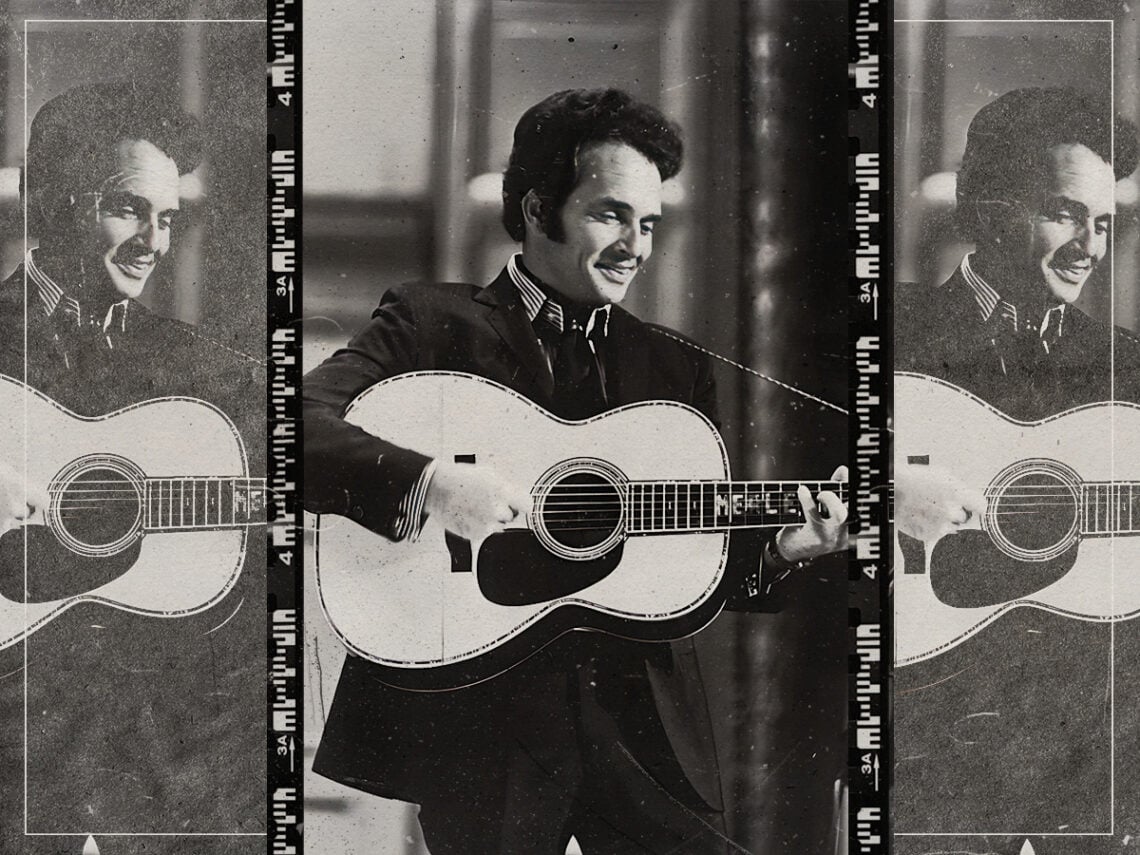
Merle Haggard: the country star who escaped jail 17 times

There might be no better evidence of Merle Haggard’s outlaw lifestyle than a conversation he once had with fellow country raconteur Johnny Cash, who was reminiscing about one of his first performances at the San Quentin State Prison. Haggard thought he was brilliant, flipping off the guards and chewing gum with the assured swagger of a bonafide star. But Cash didn’t remember Haggard being on the bill. “I was in the audience, Johnny,” was the simple reply.
Haggard, whose surname alone evoked a sense of hard living, was famously said to have escaped jail 17 times during his youth. He ricocheted around various juvenile detention centres, none of which had the desired effect of scaring him straight. Haggard, who was well accustomed to hitchhiking and hopping freight trains, seemed to have a real knack for escaping them. After a series of arrests for theft and one too many escapes, he was sent to the high-security Preston School of Industry.
After his eventual release, he and a friend went to see country singer Lefty Frizzell. Sat backstage, Haggard sang along, drunk on freedom and the sounds of honky-tonk. Frizzell heard his voice and refused to continue unless Haggard went out first. He did and was warmly received by the country crowd, soon setting out on a path to pursue music.
Talented as he was, his early endeavours were not lucrative. He tried playing it straight by singing in bars at night and working in the day but eventually concluded it might be quicker all round to rob a Bakersfield roadhouse. It was after this incident he was sent to San Quentin. “I wasn’t really that bad a guy,” he protested in a 2010 interview. “They just couldn’t hold me anywhere else. I escaped 17 different times, so they sent me there because I was an escape risk.”
Sure enough, not long into his sentence, he started hatching an escape plan with a fellow convict known only as “Rabbit”. Fate intervened on that one because Haggard was sent to solitary for a week for getting drunk after starting a brewing racket. In the week he spent in solitary, Rabbit did indeed escape but shot a police officer and was sent back to the prison for execution.
Rabbit’s death and Cash’s performance marked a turning point for him. “It set a fire under me that hadn’t been there before,” he later said of Cash’s performance. After being released in 1960, he went on to become a huge country star, even performing alongside the man he once watched when he was prisoner number A45200.
Reflecting on his unprecedented success and the possibility of a biopic, Haggard said: “When you look at my police record, you’d have to have more than one hour to tell the story.”
