


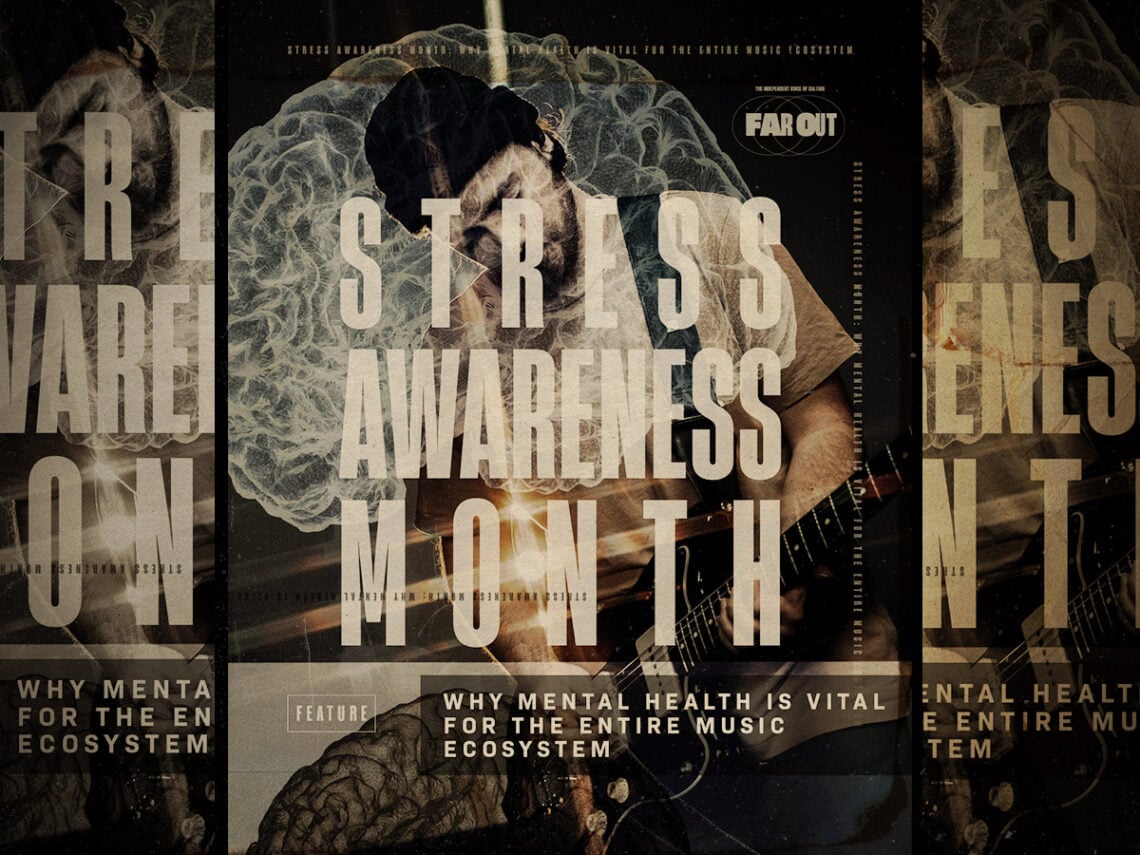
Stress Awareness Month: Why mental health is vital for the entire music ecosystem

So far this year, several musicians have used their platforms to voice concerns about where the industry is falling short. Some of these moments took place during awards season, with artists like Myles Smith and The Last Dinner Party calling on the government to revisit opportunities for emerging talent. Others, like Chappell Roan, have pushed for better access to healthcare. But underlying all of these conversations is a deeper issue the industry still hasn’t fully addressed: mental health.
In the music industry, the topic of mental health is everywhere. Even at its most implicit, it lingers in the music itself, lurking in the lyrics that give glimpses of the personal experiences of those it falls from. It shows up in interviews beneath the surface of the “bad time” artists mention going through to create their art, amplified by the emotional paradox of making something beautiful that doesn’t always feel that way.
For a long while, musicians have fought to destigmatise conversations around mental health to push for the greater freedom to explore it, normalise it, and identify where support is needed and when. For them, this makes sense; with different challenges varying from potential media scrutiny, lack of privacy, overworked hours, exploitation, discrimination, and more that make up a seemingly endless list, mental health can be difficult to nurture, let alone stabilise during times of struggle.
But what about the rest of the ecosystem? Musicians verbalising the concept is one thing, but the industry is made up of more than just those who stand at the front for all to see. It also encompasses managers, PRs, producers, engineers, label and crew teams, A&Rs, and countless others working behind the scenes to make the magic happen, many of whom experience similar challenges, often without the means of addressing them or identifying the right support.
While the industry has come a long way in recent years, there’s still an undeniable need for mental health support to grow, especially if the aim is to support everybody, no matter their position or status in the industry. And, while the focus on musicians when it comes to this topic is crucial, we mustn’t allow attention to fall solely on the tip of the iceberg when those below can often be just as vulnerable.

“They’re real individuals struggling silently”
In 2024, Music Minds Matter helped over 3,000 people in the UK music industry with mental health support. However, the need to continue this trajectory is more important now than ever, particularly after recent initiatives continued to push the one-dimensional view that musicians are the only ones who need support when it comes to mental health. According to Grace Meadows, Head of Music Minds Matter, the reasoning is simple.
“Artists have a platform which some use to talk about their mental health, but there are so many other roles in music where people don’t have the same platform,” states Meadows. “They, therefore, can’t talk out in the same way about their mental health or can’t be heard in the same way an artist might.” Regarding specific challenges, many of these follow similar patterns to those musicians may face, leading to uncertainty about where to turn to.
“Recent media reports have been a stark reminder of the profound pressures that can be faced by music professionals,” says Meadows. “These stories are more than statistics; they’re real individuals struggling silently, often unsure where to find help or how to navigate their challenges.” Clarifying some of the struggles, she claims “late nights, financial precarity, uncertain nature of freelancing, resilience and the impact of working hours on relationships and lifestyle” as some of the main ones, adding, “These are just some of the issues faced not only by musicians but from professionals working in a variety of roles across music.”
One of the most glaring obstacles to overcome when it comes to providing better mental health support in the music industry is an overwhelming inability to detect where it’s needed, which can incidentally result in many “background” teams becoming an afterthought in the haze of busy days and the rush to meet deadlines. As with all jobs, mental health is important, but when the focus starts to falter where it matters, that’s when it can exacerbate somewhere down the line.
According to Meadows, understanding and supporting in a holistic sense is key. The challenges that people face in the music industry will always be unique to the person, but, in her view, addressing the support more holistically means considering “the breadth of challenges” rather than “treating mental health as solely an individual responsibility”. Instead of leaving many by the wayside, therefore, support in this way can “help to transform music into an industry that champions sustainable career and wellbeing, potentially reducing burnout and turnover.”
The only way for this to be possible is to acknowledge and consider all job roles and the diversity of the challenges that arise. “By working across the sector, we can support everyone experiencing current challenges,” Meadows argues, “whether that’s the financial stresses that continue to impact post-Covid, managing the changes that are happening through AI, or the financial insecurity that is being felt because of shrinking revenues.”

“It is vital we keep everyone in mind”
While it’s important to expand focus rather than shift it solely from musicians needing mental health support, it’s also crucial to acknowledge that addressing the issue holistically takes a group effort. And, rather than deprioritising other facets that also need support just as much, it’s also about understanding that every role in the industry comes with its own unique pressures. According to Meadows, in order to do this, we need to “keep everyone in mind”.
“Many of the other roles in music are roles that aren’t visible to the audience, they’re the roles where people are working backstage, side of stage, away from the stage where no one is looking,” she says. “It’s these roles that help to make the music happen: The producer, the mixing engineer, the songwriter, the publisher, the promoter, the venue manager, the artist manager, the tour manager, the agent, the crew, and many more.”
To move forward, Meadows also draws attention to the many misconceptions regarding mental health in the music industry, like the idea of it being a “luxury” or only a “performer’s struggle” or even”an individual problem”, not a structural one—all of these make destigmatisation more challenging, preventing people from “seeking help for fear of appearing unprofessional or unreliable”. A lot of this aim is, of course, easier said than done, which is why the next step is to establish how exactly the industry can create long-term support systems.
Several of Music Minds Matter’s programmes aim to destigmatise conversations around mental health, with additional resources and psychosocial support expanding to explore structural changes that can create healthier, more open environments that also focus on prevention. The underlying charge is to encourage people to speak up when support is needed and to educate them on what support is out there if any struggles should arise. All of this is, of course, open to anybody in the industry.
Last year, they also invested over £1million in mental health support for people working in music. This culminates in a handful of impressive stats, like delivering over 15,000 counselling sessions since 2022 and supporting 8,000 people in music. While it’s difficult to derive specific impact from stats when so few organisations focus on such issues, at least not holistically, they offer a promising glimpse into what genuine and targeted support can achieve.
And, while there rarely is any “silver bullet” that can improve mental health support for all across the industry, the crux of it concerns fostering healthy cultures on a fundamental but educated level, resulting in greater well-being for anybody and everybody. With professionals in all corners facing their own specific challenges, it’s more important now than ever to create dynamic environments where everybody is supported, backed up on a human level, and encouraged to establish personal boundaries.
