


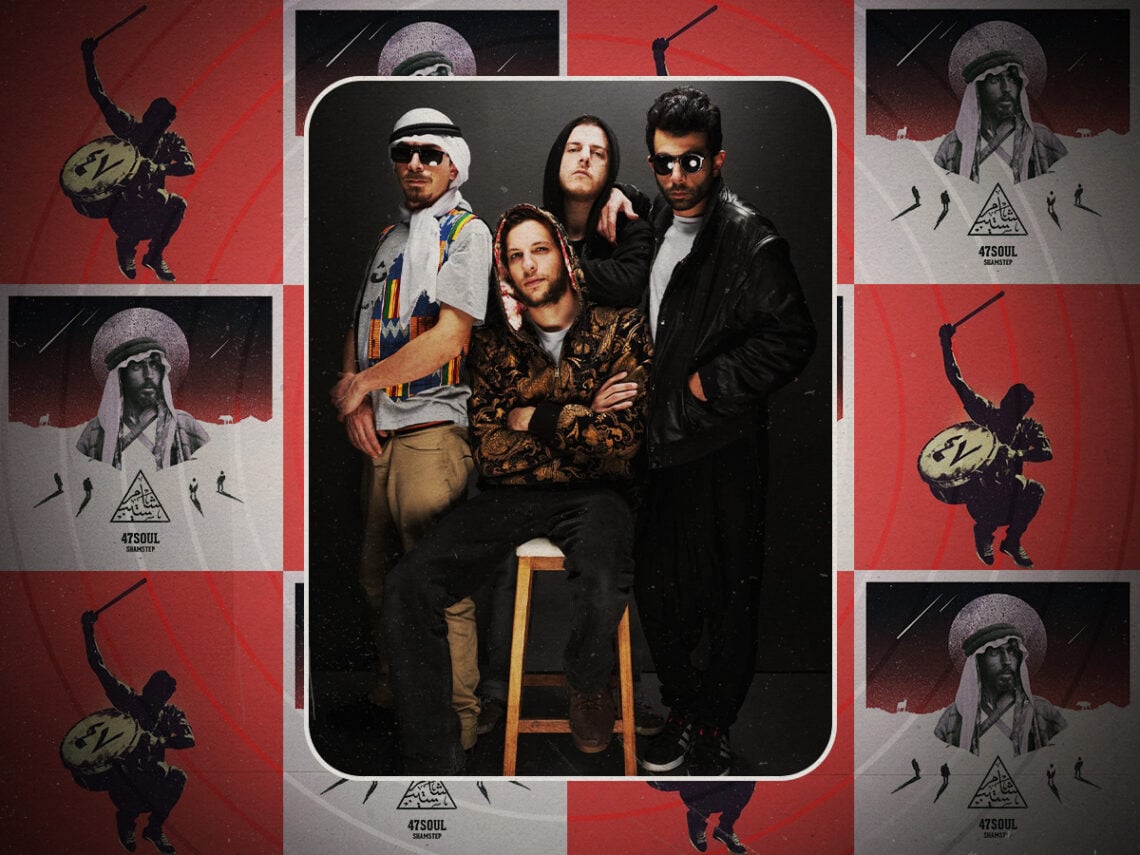
47Soul: Meet the Palestinian pioneers behind Shamstep

London-based Palestinian group 47Soul isn’t trying to shove a political message into anyone’s face, for their mission is simple: make the people dance, and they will defy.
The three-man crew brought the Shamstep movement to the streets, starting with a debut album that bears the genre’s name. The term ‘Shamstep’ is a portmanteau of dubstep, an undeniable influence from the band’s newfound home in the UK, and Bilad al-Sham, the Arabic word for the region encompassing Lebanon, Syria, Palestine, Israel, and areas of Jordan, Iraq, and Turkey. It combines elements of electronic dance music with the prevalent dabke, the region’s front-running folk dance performed in the Levant’s traditional festivities.
But 47Soul’s music isn’t just that. With a heavy focus on keyboard and synthesisers, their sound spells out where they’re from, while carving out a whole lot more. From an Arabic take on Jamaican dancehall to hip-hop, their projects have painted struggles beyond the oppression of Palestinians, notably inviting a Latina rapper to collaborate in solidarity on their track ‘Border Ctrl’.
Their work is as relevant as ever, and as the group told Forbes, they will keep “talking about us as globally-displaced people saying what our unity is in culture”.
By harnessing the traditional mouthpiece of dabke, the group is setting the record straight: Palestinians might have to leave their land, but their culture is here to stay. “It’s almost like we have another narrative of history between us and the West,” their singer Tareq Abu Kwaik, stage name El Far3i, told Owen Jones in 2025. He spoke of their message as “the relationship between the diaspora and the land. Although our role is to get attention on the continuous ethnic cleansing and what’s happening in Palestine”, their impressive body of sentimental work also explores themes of family, tradition, and identity.
The group, who make its music deliberately more accessible by mixing English and Arabic languages, started off as a collective in 2013. Their name derives from the year 1947, which was the last before the first Nakba, the Arabic word for ‘catastrophe’, during which an estimated 750,000 to one million Palestinians were forcibly removed from their land, to the point where none of the bandmates, in fact, have ever resided in any Palestinian territory.
Although Shamstep became an increasingly important part of Arabic street culture from Jordan to Syria, the music was always more than just an infectious addition to any dance floor.
“Musically, it was about bringing our sounds from our culture, almost trying to translate how we hear those sounds from other modern productions from you name it, from dub to hip hop to rock,” they told Jones. But how that plays out in real life includes venues consistently asking the group to confirm that Israel has the right to exist, and constant travel bans making any serious touring full of logistical complications.
The first part of their last album, Dualism Pt 1, was written to highlight the heroic efforts of Palestinian journalists who are still defying all odds to report on the horrors witnessed by the people of Gaza. Their latest work stays true to its title, embarking on a journey of ambivalence between the grief of losing one’s homeland and the hope that remains for staging a return. As a sign of the times, there’s less excitement present than can be found in their previous work.
