


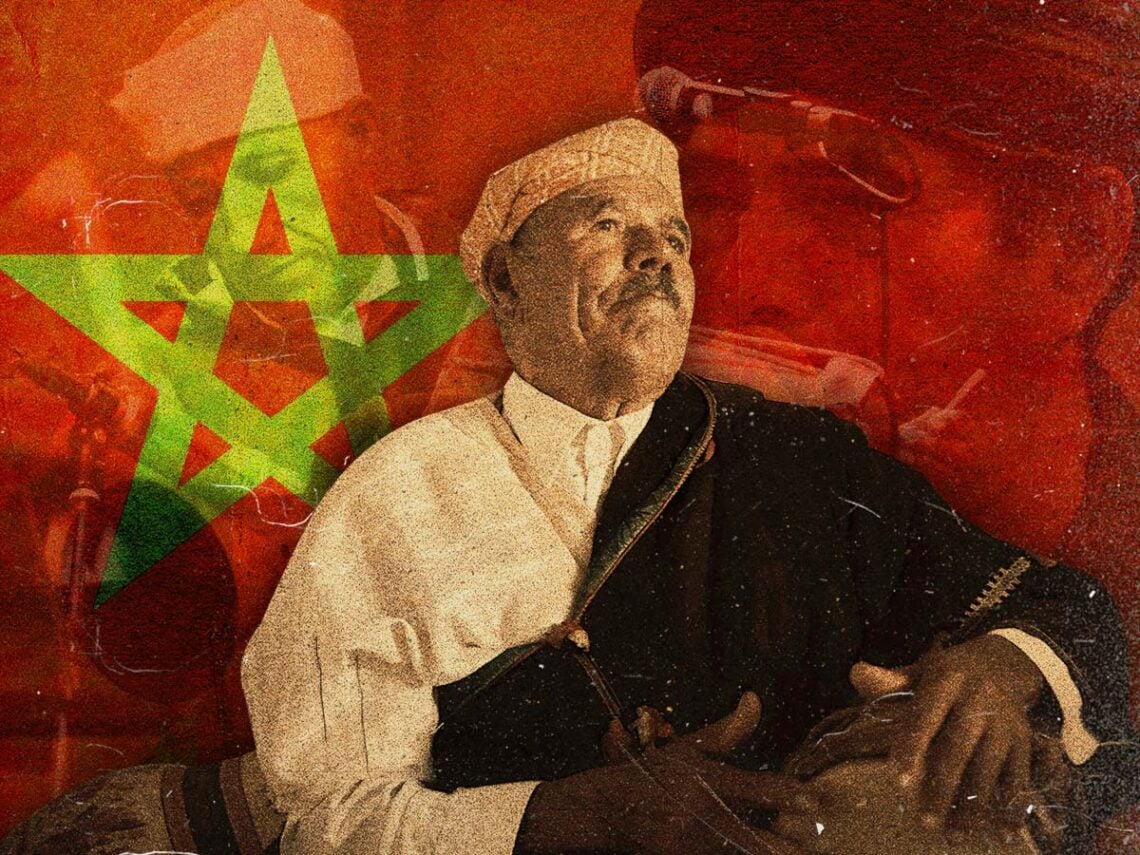
Meet Morrocco’s “4,000 year-old rock band”: the Master Musicians of Jajouka

Described by jazz musician Ornette Coleman as “a 4,000 year-old rock band,” the Master Musicians of Jajouka make some of the oldest music on the planet. While the lineage of the Attar family stretches back a thousand years or more, their music has only been known in the west since 1950, when British artist and writer Brion Gysin witnessed what he would later describe as “a pre-Islamic festival in a sacred grove not far from the Cave of Hercules.” Since then, countless musicians have travelled to Jajouka, a small Morrocan village in the foothills of the Rif Mountains, and found themselves reborn.
The music of Jajouka is very old indeed. Unique to a small village outside Tangiers, this blend of Jbala Sufi trance has been passed down the generations for a thousand years. The all-male Master Musicians of Jajouka belong to the Attar family, who were relieved from agricultural duties by the Morrocan Royal Family and given permission to dedicate themselves to the mastery of their instruments.
To this day, the Attar are responsible for preserving what is believed to be one of the oldest musical traditions on the planet. Honing the highly complex polyrhythms and intricate melodies of this music takes a lifetime, and the musicians of Jajouka begin learning as children from their fathers. In time they will become Malimin or Masters. Only then will they be ready to pass their skills on to the next generation.
Artists in exile were especially fascinated with the music of the Attars. In 1950s, American writer Paul Bowles and British artist Brion Gysin had the pleasure of attending a festival in Sidi-Kacem, where they were invited to hear the music in person by Morrocan painter and folklorist Mohammad Hamri. “That’s the music I want to hear for the rest of my life,” Gysin wrote of the experience [quotes via Songlines]. A year later, he returned with his friend Brian Jones, who made one of the earliest recordings of the collective. The festival, which involves dressing a young boy in the skin of a freshly slaughtered goat, reminded the Stones guitarist of the Roman fertility festival of Lupercalia, hence why he decided to name the album The Pipes of Pan.
What he’d, in fact, witnessed was Boujeloudia, the rights of the “father of skins”, which is performed in the village during the week-long festival of Aïd el–Kebir. If The Pipes of Pan was intended as a snapshot of the Attar, then Jones succeeded only in placing himself centre frame, removing the original titles of songs and replacing them with groovy-sounding translations like ‘Your Eyes Are Like a Cup of Tea’. He may well have heard ‘Hamza oua Hamzine’, the oldest and most complicated piece in the Jajouka Masters’ repertoire, and one that was performed for the Sultans of the Alawi dynasty across the centuries.
In the 1990s, economic pressures split the Master Musicians into two factions. The first, led by Ahmed Attar, kept the name The Master Musicians of Joujouka, while Bachir Attar, whose father had led the group during the hippie era, formed the Master Musicians of Jajouka led by Bachir Attar and embarked on tours of the West. Today, both groups remain committed to preserving the music of their ancestors in its purest form. Listen below.
