


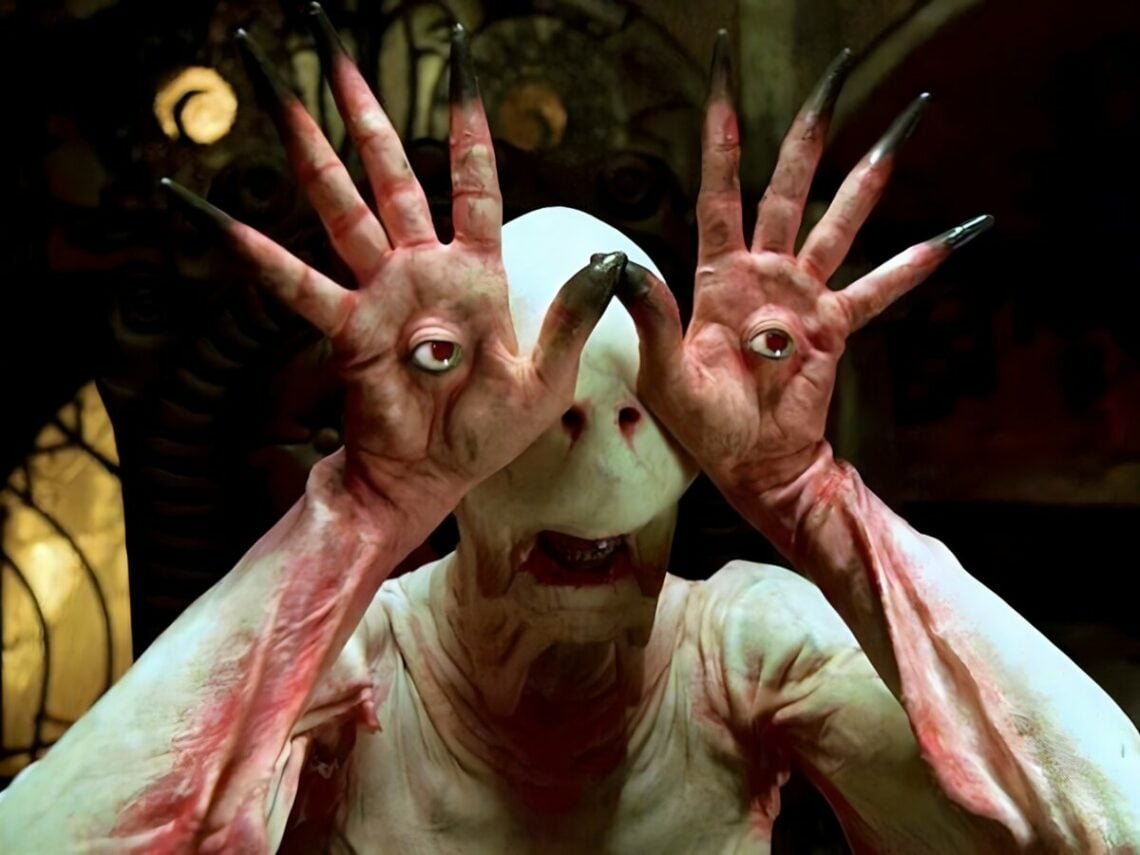
The meaning behind the Pale Man in ‘Pan’s Labyrinth’

No matter how much anybody loves monsters, there’s no chance they love them more than Guillermo del Toro. The filmmaker has spent his entire career dealing with creatures of all shapes and sizes, not all of which are non-human.
His three-time Academy Award-winning fantasy drama Pan’s Labyrinth showcases both sides of del Toro’s approach to what a monstrosity can be, with the physical manifestation coming through the form of Doug Jones’ unsettling, unnerving, and altogether terrifying Pale Man.
The story unfolds in 1944, towards the end of World War II. The sadistic brutality of Sergi López’s military officer, Captain Vidal, as he captures, tortures, and kills those standing in political opposition to his Falangist beliefs has such an effect on Ivana Baquero’s Ofelia that she retreats deeper and deeper into the titular world.
A borderline translucent and fleshy humanoid beast with eyeballs on the palms of its hand, the Pale Man makes for a striking presence. Thanks to regular del Toro collaborator Jones’ experience playing otherworldly entities, the long-time friends and creative partners join forces to create one of cinema’s most unforgettable and spine-tingling beasts.
Pan’s Labyrinth presents a subversive fairy tale that uses mythology as a means to shine a light on underlying themes that are as resonant now as they were during the period in which it’s set. Within that context, the Pale Man is only a small part of that design.
The dichotomy between choice and obedience, rules and order, and oppression and freedom are all key, as well as the gender dynamics of a patriarchal society. Vidal attempts to exert the same kind of influence on his wife and stepdaughter that he does on those who serve under him, and any sense of disobedience or backlash will be swiftly dealt with either personally or professionally.
It should hopefully go without saying, but eating children is a bad thing, although the Pale Man carries more importance than that. Much in the same way Vidal uses his reputation and position of power to terrorise the people in his orbit both at home and at work, the Pale Man exists as the manifestation of the patriarchy.
Del Toro spelt it out himself, explaining how the creature “represents all institutional evil fitting on the helpless”. Vidal might have his peepers in the right place, but at the end of the day, both characters fulfil a very similar remit. It sounds glaringly obvious, but that’s the way the director wanted it to be because, in his own words, “it’s not accidental that he’s a: pale, and b: a man”.
Symbolism doesn’t have to be subtle to be effective, with the Pale Man’s victims being reduced to little more than crude imagery and piles of abandoned shoes, which is hardly dissimilar from the way atrocities committed by men at the highest levels of power have reduced countless victims to nothing but statistics.
