


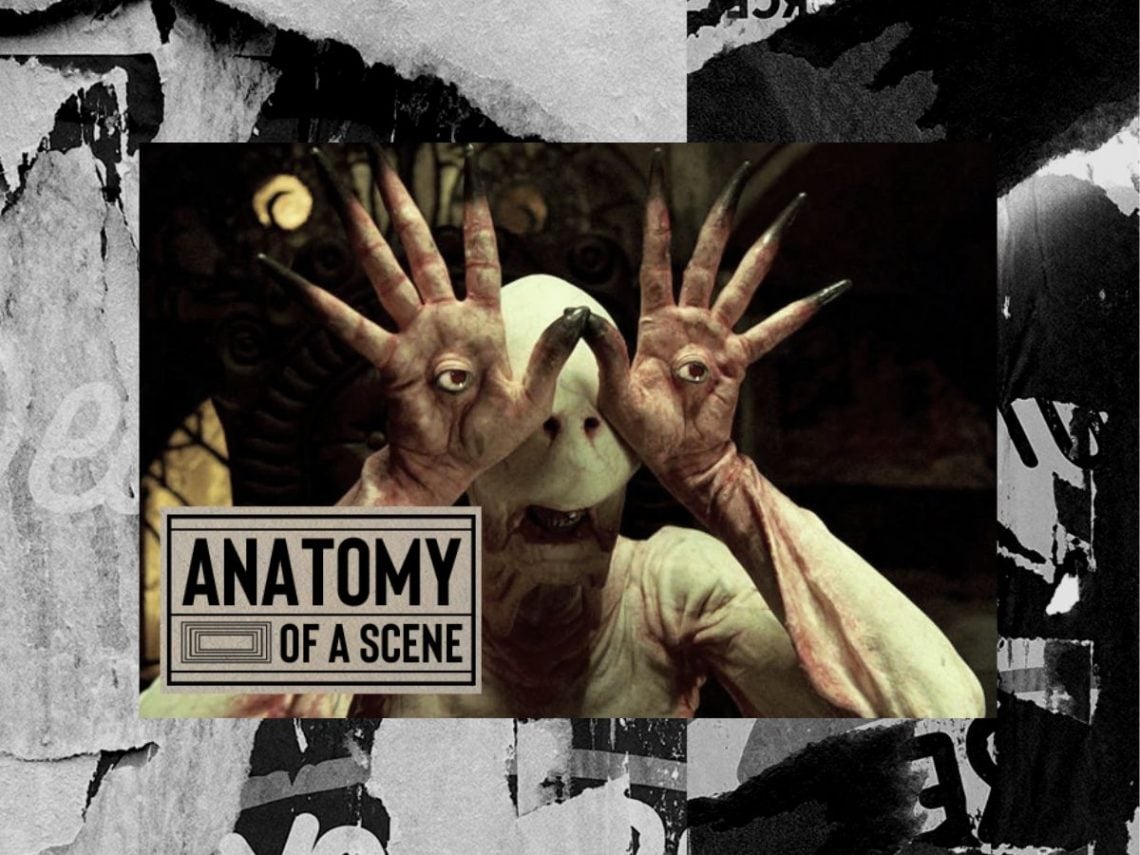
Anatomy of a Scene: ‘The Pale Man wakes, ‘Pan’s Labyrinth’

Released in 2006, Pan’s Labyrinth by Guillermo del Toro is undoubtedly one of the most transcendent dramas of the 2000s. Half dark fantasy, half wartime drama, the Academy Award-winner manages to capture the brutality of the Spanish Civil War while celebrating the power of the human imagination. Jaw-droppingly beautiful and frequently harrowing, this is no children’s fable. In this series, we look at key scenes from beloved films and examine what makes them so effective. This week, we’ll examine del Toro’s terrifying Pale Man scene.
Set five years after the end of the Spanish Civil War, Pan’s Labyrinth tells the story of 11-year-old Ofelia. Uprooted along with her pregnant mother, she is sent to the countryside to live alongside her new stepfather, a merciless General in Franco’s army. With republican fighters fighting a guerilla war and the General determined to quash support from ordinary folk, Ofelia escapes into an elaborate fantasy. Boasting del Toro’s trademark gothic style, Pan’s Labyrinth follows Ofelia as she undertakes a mythical journey under the guidance of a sinister but seemingly benevolent faun.
After meeting Pan under the light of a milkwhite moon, Ofelia is given three tasks by the faun. The first of these involves fetching a key from the belly of a giant toad, which she fails. Pan returns under the cover of darkness to deliver the second task, providing Ofelia with a piece of magic chalk, a book of instructions and three fairy guides. After using the chalk to trace a door, she travels into an eerie Underland where a faceless monster dwells. The magic chalk is not only a brilliant narrative device, allowing for an effortless transition into Pan’s magical realm; it also beautifully captures how children’s imaginations work. The ordinary human world is not wholly distinct from Pan’s sphere. Rather, the two realms sit alongside one another and can be accessed at any point through portals and doors, a common feature of both children’s games and children’s fantasy literature.
In the way that Alice’s adventures in Wonderland begin with her tumbling down a hole, Ofelia’s chalk allows her access into a subterranean realm where nothing is as it should be. Del Toro emphasises the contrast between the two worlds through a combination of set design, colour and lighting. While the bedroom Ofelia has left behind is shrouded in midnight blue, the Pale Man’s hall is lit with a sickly shade of red. Contrasts such as these are found throughout the scene. Consider the Pale Man’s feasting table, for example, which is laden with succulent grapes, puddings and slabs of roasted meat. It’s the dinner of every child’s dreams. Of course, at the head of the table sits every child’s worst nightmare – a grotesque humanoid figure with his eyeballs on a silver plate.
There’s a sense that Ofelia doesn’t understand the danger she’s in. It’s only when she looks up onto the ceiling, where the creature is depicted feasting on children, that she begins to sense his malice. At this point, the Pale Man is as docile as a sleeping grandparent. That all changes after she gives into temptation and eats a grape from his table, still unaware that such a decision puts her in grave danger. Even when the Pale Man begins to wake up, Ofelia is the last to know, the camera panning past her and settling on the now-animated figure slowly rising from his seat.
Sergio Sandoval’s designs are the main source of terror from here on out. Evoking the pallid madness of Francisco Goya’s Saturn (Goya’s Saturn Devouring His Son) is referenced when the Pale Man bites off the head of a fairy), the creature was brought to life through a combination of full-body makeup “going down from the head to the belt” and “marionette legs” placed above the actor’s legs. This allowed Doug Jones to bring a level of realism to the character’s movements that wouldn’t have been possible with CGI. Indeed, as the Pale Man chases Ofelia down the hallway, his hands outstretched, we feel a unique kind of horror – one bred from the sense that this creature was once human and now feasts on human flesh.
You can revisit the Pale Man Scene below.
