


Maud Wagner: the first Western tattoo artist

If you were to travel back to the 19th century, you would be very unlikely to see anyone in the Western world with tattoos like you do today. Tattooing has become incredibly normalised, despite the odd conservative person’s disapproval, but it has been a fairly recent practice in the West.
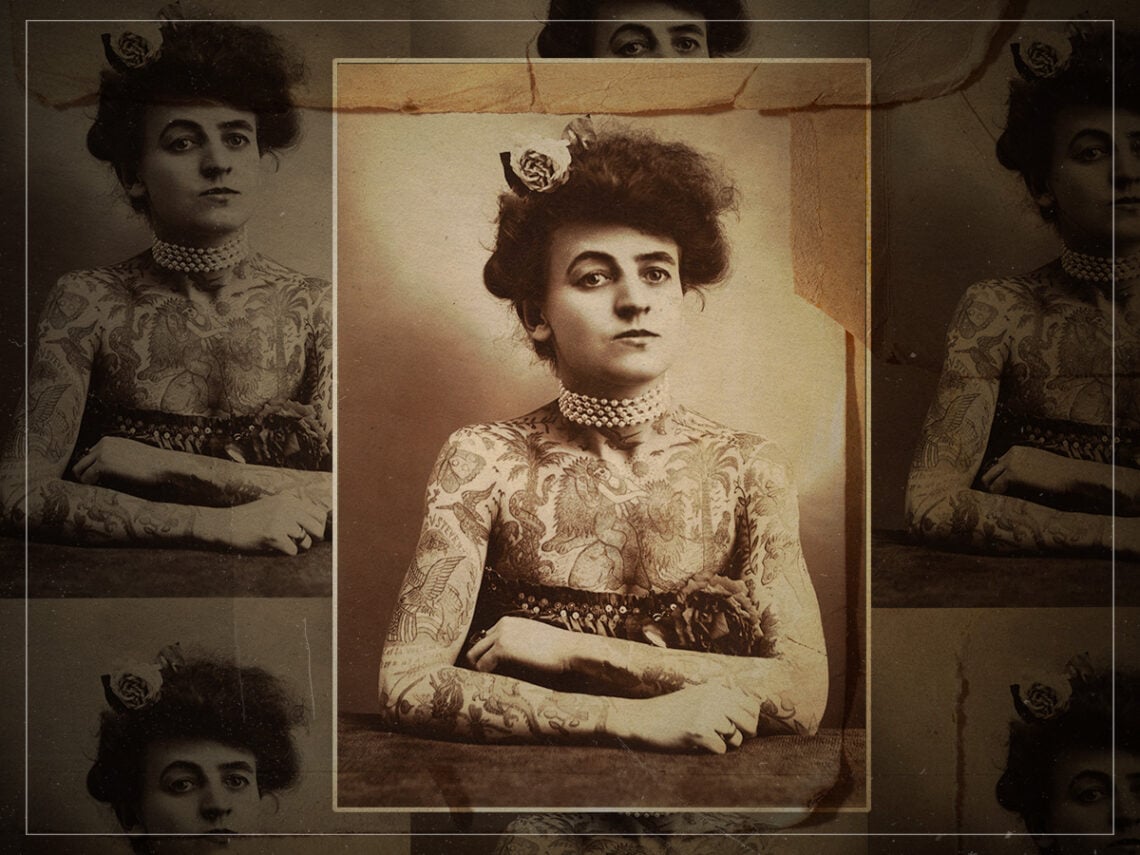
However, there was one woman in America who broke social norms and became a controversial yet pioneering figure in the tattooing community. Maud Wagner is considered the first female tattoo artist in the West. The most iconic photo of her is a black-and-white image of a woman in typical Edwardian fashion; however, her arms and chest are completely covered in tattoos. This image is shocking and powerful as she seems more like a woman of the 21st century.
Born in Kansas, Wagner lived a pretty ordinary life as a farm girl on her family’s ranch. She then joined the circus as a contortionist at the turn of the century, debuting at the St Louis World Fair in 1904. This is where she met the tattoo artist Gus Wagner, who, you might be able to guess, became her husband. Gus Wagner was a merchant seaman and had travelled around the world, witnessing the different non-Western tattoo techniques in places like the Pacific Islands and Asia. He had accumulated 250 tattoos of his own and claimed to be “the most artistically marked-up man in America”.
Initially curious about the practice of tattooing, Wagner was persuaded to go on a date with Gus in exchange for some tattooing lessons. They immediately hit it off and began tattooing each other, establishing a new love language of sorts. As an apprentice of her husband, Wagner learned how to give ‘hokey-pokey’ tattoos, our modern-day stick-and-poke. Shortly after meeting, they got married and continued their wild lives, frolicking about as circus performers and tattoo artists. However, the pair were greatly ridiculed by society at the time—women were barely allowed to be seen without their gloves off, let alone covered in tattoos.
Not only was tattooing associated with the tribal practices of native peoples across the world, which were already looked down upon by the West, but it was also an intrinsically male practice indulged in by sailors and delinquents. Nonetheless, no matter the scrutiny, the couple wanted to break these strict social codes outright and differentiate themselves as rugged outsiders belonging to a separate subculture.
In fact, Maud wore this new label with honour, as was evident in her central tattoo on her chest, which depicts a woman sitting on a lion surrounded by palm trees. This tattoo demonstrates just how fearless, authoritative and free-spirited she was in defying any labels assigned to her. The couple had a daughter named Lotteva, who started tattooing at age nine; it ran in the family, I guess. However, unlike her parents, she was forbidden from tattooing herself but continued her parent’s legacy after their deaths.
Wagner died in 1961, the same year that tattooing became illegal in New York City due to a hepatitis outbreak. Today she is remembered as a visual model and hero for women with tattoos, becoming a walking art form. Although alive decades ago, she continues to embody someone we can relate to and aspire to.
