


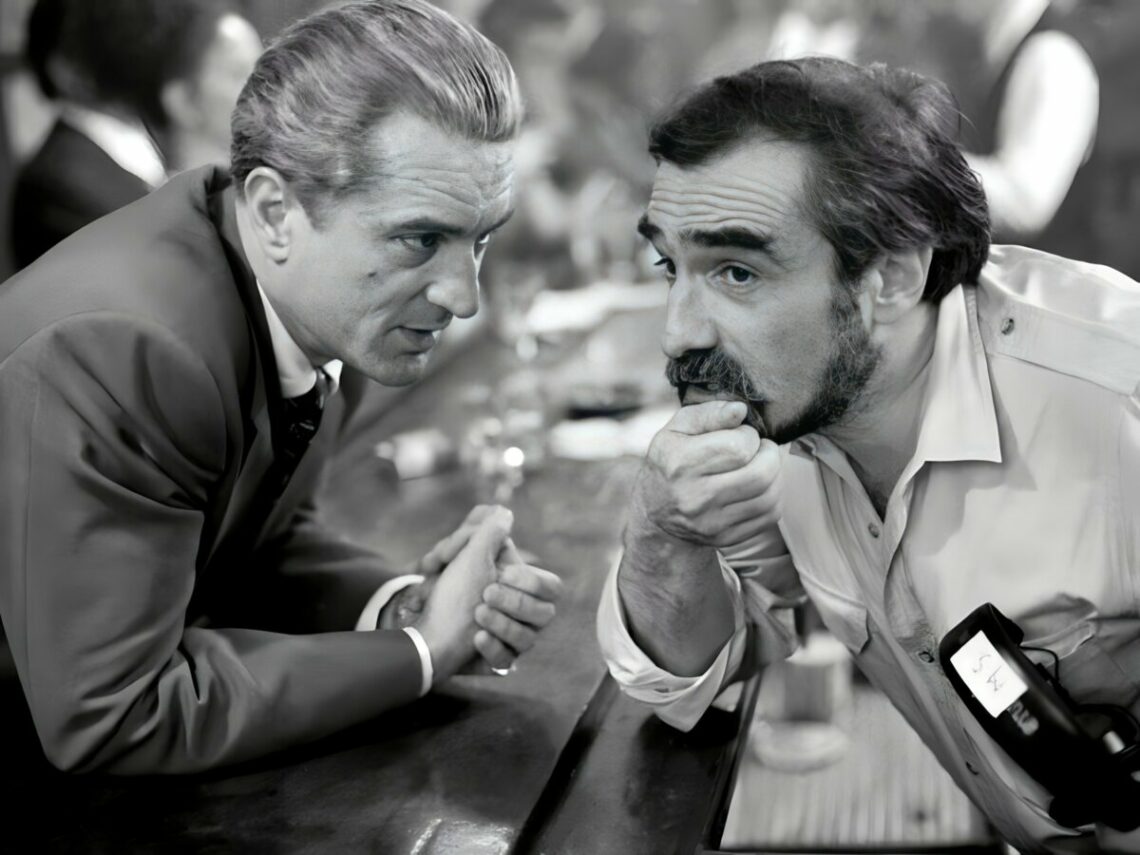
Martin Scorsese and Robert De Niro: the “barbarians” of cinema?

In the annals of modern cinema, perhaps no actor-director relationship is as enduring and canonised as that of Robert De Niro and Martin Scorsese. Last year’s Killers of the Flower Moon marks ten films together in 50 years, but in a way, it goes even further back than that.
Speaking at a Q&A at a Moroccan film school during the 2013 Marrakech Film Festival, Scorsese opened up about how the time and place he and De Niro were from formed the stories they told – and how the two share the singular gift of knowing the streets of Little Italy in the 1940s and ’50s.
“The reality is De Niro, in 1959 or 1960, he was in the neighbourhood, the streets that I was on. We knew each other,” Scorsese said. “We weren’t friends then, but he’s the only one alive working in cinema, in this business, who knows who I am and where I come from. That’s it. He’ll just look at me and… We know.”
Despite knowing each other briefly during their teenage years, the Scorsese and De Niro team-up only began in earnest in 1973 with Mean Streets and its gritty portrayal of life in an immigrant neighbourhood in mid-century New York. Scorsese has talked about the stand-offs and degeneracy of Mean Streets as a depiction of the things he saw regularly growing up – things he says De Niro alone can understand out of anybody in the industry.
“We were able to work together on a series of films where we mined some very deep emotions and psychological issues,” he said. “It wasn’t always pleasant. It was all based on trust.”
Mining real life for stories meant dealing with the kind of shady characters and dirty dealings Scorsese and De Niro’s work would become known for in the ensuing decades – larger-than-life characters like Taxi Driver’s Travis Bickle, Raging Bull’s Jake LaMotta and most recently the insidious William King Hale in Killers of the Flower Moon.
The way Scorsese tells it, it wasn’t in the pair to start cribbing from Shakespeare – they had to tell the stories he had seen and felt themselves. “It wasn’t the issue of De Niro going, ‘Marty, we should do A Midsummer Night’s Dream next, or we should do Richard The III‘, (which I like). But that’s not what we do. We are from here, and this is what we know. We never even had to say that [to each other]. We would just gravitate to these stories. We knew we were barbarians in that sense.”
It’s a sentiment that holds up throughout the early section of Scorsese’s career, but one has to wonder how films like Kundun (detailing the life of the Dalai Lama) or Paris-set family fable Hugo fit into this. Nevertheless, the De Niro and Scorsese partnership has always had a strong taste for grounded and bloody stories of the American Dream gone wrong.
“There was no pretension in him in that way because we dealt with what we knew. We were attracted to the same stories, the same characters, the same risks,” Scorsese said.
With both men now in their 80s, there’s a very real question over whether there will be any more instalments in the decades-long Scorsese-De Niro love affair. The director’s next film is expected to be an adaptation of The Wager: A Tale of Shipwreck, Mutiny and Murder, a true-to-life naval thriller in the style of the Aubrey-Maturin novels. Whether De Niro has a place as a grizzled ship’s captain or first mate has yet to be discovered.
