


How Martin Scorsese inspired a classic ‘Pulp Fiction’ scene

A countless number of modern filmmakers have been inspired by the work of American auteur Martin Scorsese over the years, with the likes of Christopher Nolan, Denis Villeneuve, Paul Thomas Anderson, and the Safdie brothers each showing shades of the 20th-century icon in their own movies. Working closely with Robert De Niro, Leonardo DiCaprio and Daniel Day-Lewis, over the course of his career, Scorsese is known for his magnetising presence in the industry.
Penning the scripts for many of his own movies, including Mean Streets, Goodfellas and Casino, Scorsese is also known for his close collaborations with screenwriter Paul Schrader, who has worked with the filmmaker on such releases as Taxi Driver, Raging Bull and The Last Temptation of Christ. As a result, Scorsese is largely considered one of the great 20th-century auteurs, alongside another contemporary great.
Emerging in the 1990s, Quentin Tarantino exploded onto the scene with Reservoir Dogs, a crime movie inspired by the hard-hitting dramas of Scorsese’s filmography, starring Tim Roth, Harvey Keitel, Steve Buscemi and Michael Madsen. A pastiche on such movies spiked with a post-modern edge, Tarantino’s indie classic would allow him to flourish in the twilight of the 20th century.
Even to this very day, Tarantino’s follow-up film, Pulp Fiction, is considered to be his magnum opus, with the filmmaker picking up an Oscar at the 1995 Academy Awards and a Palme d’Or at the Cannes Film Festival. A frenetic combination of comedy, crime and action, Pulp Fiction is an electric caper that takes inspiration from some of cinema’s greatest minds, from Jean-Luc Godard to Martin Scorsese.
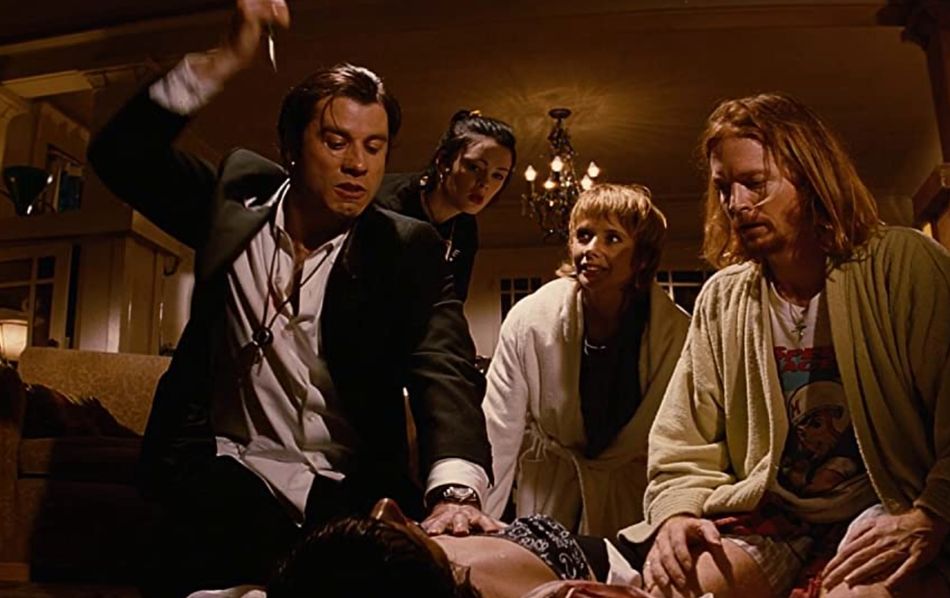
Whilst many believe Scorsese to be a mere general influence, however, the Goodfellas director actually had a pretty direct influence on one of the film’s most iconic scenes. When Mia (Uma Thurman) mistakenly overdoses on heroin at the start of the film, mistaking the substance for cocaine, Vincent (John Travolta) rushes her to safety, where she is given an injection of adrenaline into her heart.
The shocking, and somewhat wince-inducing scene, was inspired by a story told by actor Steven Prince in Scorsese’s 1978 documentary American Boy. The documentary, which tells the wild story of the actor who appears in a minor role in Scorsese’s Taxi Driver, features a similar story, though whereas we know the fate of Mia in Tarantino’s movie, Prince does not state whether the shot worked in real life.
The blinding odyssey of American violence, crime and style would help to catapult Tarantino to almost instant cultural prominence, with Pulp Fiction telling the story of several eccentric characters, each hunting down a mythical briefcase.
Glowing gold, the contents of the suitcases has long gone unknown, with the filmmaker refusing to answer the question, explaining, “It’s whatever the viewer wants it to be”. This has led to several fan theories behind the classic movie, ranging from the bizarre to the highly plausible, as film enthusiasts from around the world attempt to work out what’s really in the Pulp Fiction briefcase.

Never Miss A Take
The Far Out Quentin Tarantino Newsletter
All the latest Quentin Tarantino content from the independent voice of culture.
Straight to your inbox.