


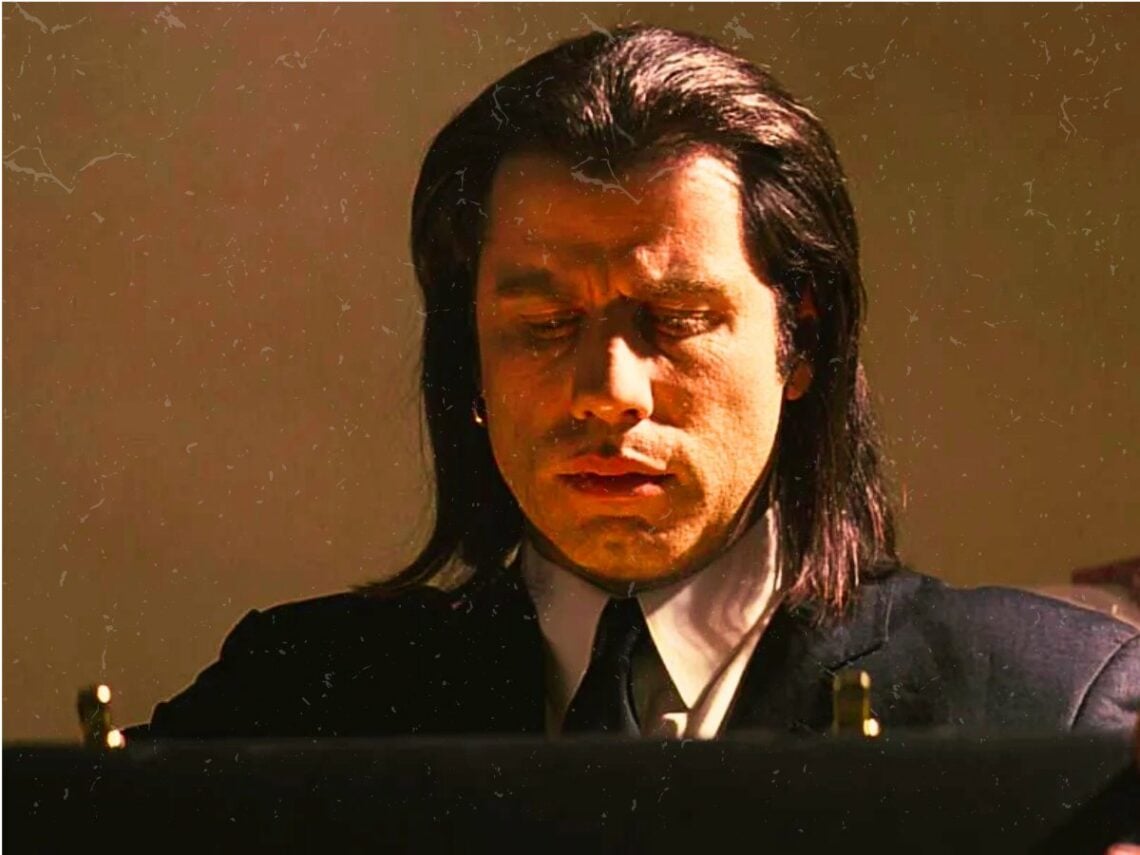
What is really in the ‘Pulp Fiction’ briefcase?

Few objects in contemporary cinema have sparked as much fevered speculation as the glowing briefcase in Quentin Tarantino’s Pulp Fiction. Its contents are never revealed, never explained, and yet it now dominates the narrative like a golden ghost sprinkled by the director with an intentional touch. It’s a classic MacGuffin – a plot device with no intrinsic value – but in Tarantino’s hands, it becomes something more: a mirror for obsession, a vessel for meaning, a pop culture riddle that refuses to be solved.
As one of modern cinema’s most deliberate auteurs, Tarantino is well known for obsessing over the tiniest details – a needle drop, a camera tilt, the contents of a fast food order. He writes, directs, curates and controls his feature films with an obsessive accuracy. So when something as central as the Pulp Fiction briefcase remains unexplained, it’s no accident.
Released in 1994, Pulp Fiction cemented Tarantino as a generational force. A non-linear crime epic bursting with razor-sharp dialogue, sudden violence and cool detachment, the film stitched together the stories of low-level gangsters, washed-up boxers and dancefloor dreamers with unmatched confidence. John Travolta, Uma Thurman, Bruce Willis and Samuel L Jackson all orbit around the film’s one great unknown…the suitcase with the golden glow.
What’s inside? Is it money? Drugs? Marsellus Wallace’s soul? Over the years, Tarantino has stayed cagey on the topic. “It’s whatever the viewer wants it to be,” he once said, leaving the door wide open for mythology to creep in. And creep in it has, across forums, fan blogs, and Reddit threads, all trying to crack one of modern cinema’s most famous unanswered questions.
Of course, the glow itself is part of the seduction. It’s never clear what characters are looking at when it opens, but whatever it is, it’s beautiful enough to halt Vincent Vega mid-sentence and make Pumpkin reconsider armed robbery. That’s the real trick. Tarantino doesn’t show you what’s in there because he knows it’s more powerful when you fill in the blanks yourself.
Some say it’s Marsellus Wallace’s soul, citing the band-aid on the back of his neck and the case’s 666 combination as evidence. Others argue it’s just a stash of gold or an Oscar-shaped jab at Hollywood. But maybe the point is that we’re still talking about it nearly 30 years later…but we can all have a guess at what it might be, eh?
So, what’s really in the Pulp Fiction briefcase?
Marsellus Wallace’s soul

This is certainly the most plausible of the briefcase fan theories, with the basis for the argument relating to the prediction that the mysterious suitcase contains the soul of Marsellus Wallace, played in the film by Ving Rhames. Intricate in its explanation, the fan theory points to the plaster on the back of the character’s head, along with the combination code to unlock the case being ‘666’, as major pieces of evidence.
Of course, in biblical references, the devil takes one’s soul through the back of their head, so this certainly stacks up with the theory that goes on to suggest that Marsellus was trying to repurchase the soul.
Diamonds

Eager to create his own cinematic universe, Tarantino initially wanted the diamonds from the Reservoir Dogs heist to be in the suitcase. The extended fan theory suggests that Marsellus Wallace orchestrated the heist and led the ‘Dogs’ to retrieve the case. Regardless, this theory still holds up, with diamonds being a worthy item of desire for many of the characters in Pulp Fiction.
This idea of diamonds or gold bars being in the case was thought to be floated around when Quentin Tarantino and Roger Avary wrote the script for the Palme d’Or winner.
An homage

Bypassing film school to immerse himself in the world of filmmaking, Tarantino educated himself on the world of cinema and is proud of his encyclopaedic knowledge of the silver screen. As a result, the glowing gold case of Pulp Fiction could be an homage to the 1955 film Kiss Me Deadly by Robert Aldrich, which also contains the search for a glowing case of radioactive material.
This wouldn’t be surprising, particularly since Tarantino has become known for borrowing multiple ideas from the history of cinema, inspired by filmmakers such as Akira Kurosawa, Sergio Leone, and John Carpenter.
Elvis’ gold suit

Loving to contextualise his films within the history of cinema as well as popular culture, one fan theory points to the possibility that Elvis Presley’s iconic gold suit could be tucked away in the suitcase. What makes this theory all the more possible is that just one year before the release of Pulp Fiction, Tarantino collaborated with Tony Scott for True Romance, a film that featured a prominent gold suit.
Still, the theory doesn’t go far enough to explain why so many people are after the suitcase, apart from its monetary value, as well as Wallace wishing to give the suit to his wife, a regular at the 1950s-themed diner Jack Rabbit Slim’s.
An Oscar

So, this may be the most outlandish of the theories, though it is also the most playful, suggesting that the mysterious item within the glowing case is an Oscar statuette. Having not yet won an Academy Award by the time Pulp Fiction was released, this may have been Tarantino’s way of hinting that he thought he deserved an Oscar for his efforts on the film. In addition, the theory also works its way into the story, with Wallace eager for the statuette to give to his showbiz-obsessed wife.
No matter his intention, Tarantino would scoop himself an Academy Award for the film after all, sharing an Oscar for ‘Best Original Screenplay’ with his writing partner, Roger Avary.

Never Miss A Take
The Far Out Quentin Tarantino Newsletter
All the latest Quentin Tarantino content from the independent voice of culture.
Straight to your inbox.