


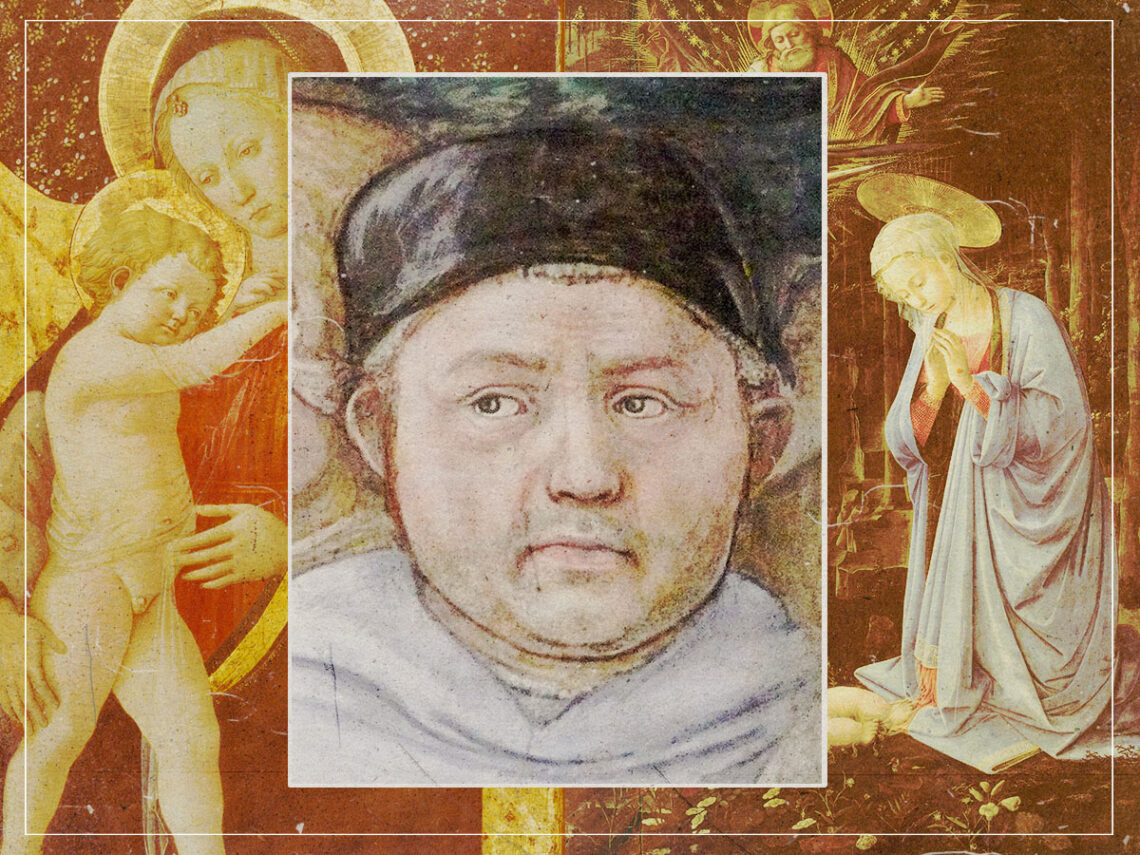
The many escapades of Filippo Lippi

In quite a feat for a Renaissance master out of the 15th century, Filippo Lippi lived a life so gossip-worthy that retrospective looks at his work are often preoccupied with the scandal of it all rather than the art itself. His well-established cultural imprint had previously driven Robert Browning to write a poem, Fra Lippo Lippi, about his connections to art and the church, and seen his work hung in museums around the globe. In his lifetime alone, career highs included commissions of cathedral frescoes, and the most egregious lows ranged from multiple abductions and a potential poisoning incident. Lippi’s wild times have piqued curiosity for centuries, appealing to fans of naturalist religious painting and chaotic biographies alike.
Born in Florence, Lippi was orphaned at only two years old. His aunt initially took him in but gave him to a Carmelite convent when his upkeep became too expensive. It was here his most profound links to religion were formed, and he was quickly admitted into the community of Carmelite friars while he studied. Before establishing himself as an artist, he was ordained as a priest but watched Masaccio painting in the Carmine church and felt that’s what he’d be better off doing.
After witnessing Masaccio’s handiwork, he began sketching rather than studying. While the church was initially supportive – the prior even gave him the chance to learn painting – when he quit the monastery in 1432, things somewhat soured. He found himself suddenly outside of the church but not released from his vows. Charged with the “maintenance” of six nieces, he declared himself the “poorest friar of Florence” in a letter from the time.
However, although largely dependent on perspective, his bold decision to pursue art did come in handy when he was kidnapped by Barbary pirates in Naples. He showed real promise when it came to portraits, and although there’s little evidence that this was the defining factor in his freedom, it’s certainly a nice idea. However, it could be symptomatic of Lippi’s quasi-celebrity because the Catholic Encyclopedia referred to this, and other contentious instances, as “nothing but romance”.
When Lippi returned to Florence, the shock of the kidnapping gave way to newfound popularity. Absence made the heart grow fonder amongst the art crowd, and he was handed commissions for The Annunciation and the Seven Saints. The only snag was that Cosimo de’ Medici, the effective ruler of Florence during the Italian Renaissance, had to imprison him to get the work done.
Even with the impetus of being locked indoors, Lippi refused to paint and chose to escape after fashioning a rope made from his sheets. Alarmingly, he even made time in between painting The Madonna and Child Enthroned to carry out his own kidnapping, abducting Lucrezia Buti and forcing nuns to intervene. While his artwork is breathtaking, his rap sheet, which includes several instances of forgery, deceit and consequent lawsuits, is equally impressive.
Even his death is shrouded in mystery, and it remains unknown if he died naturally or was poisoned by Buti’s relatives.
