


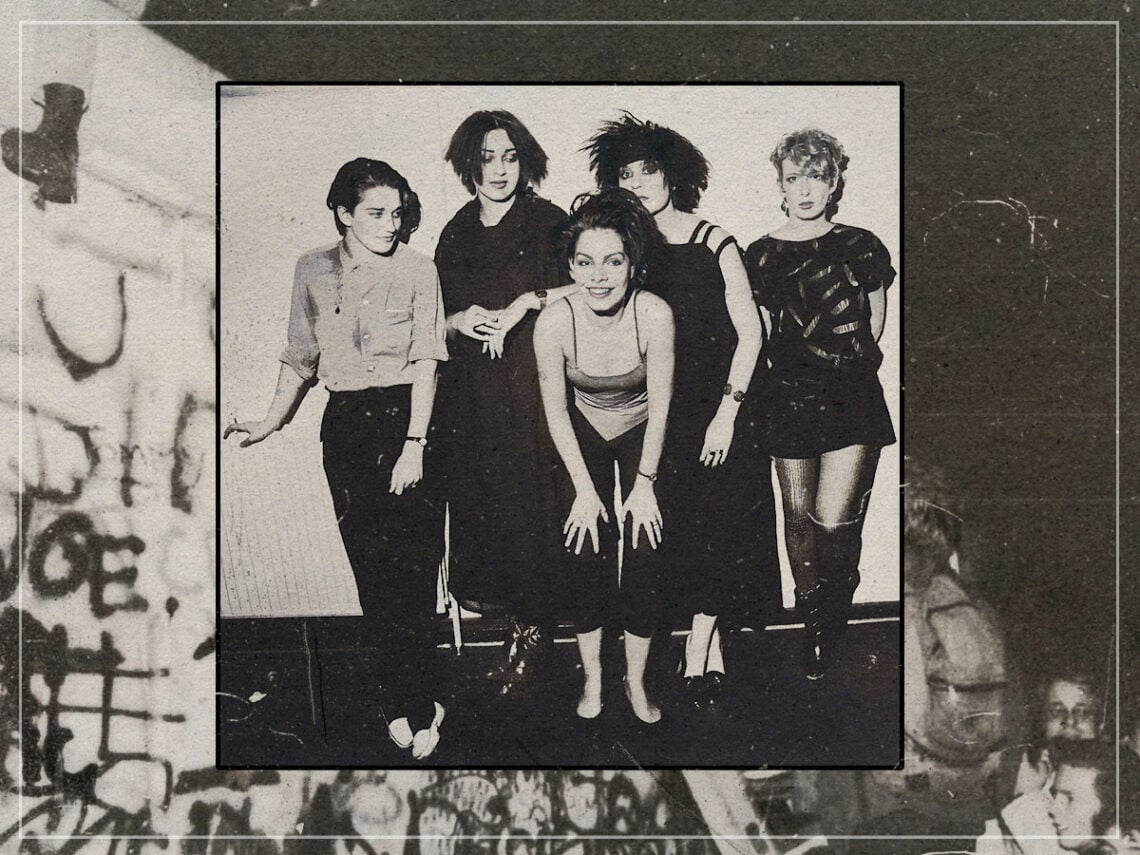
Malaria!: The forgotten “queens of noise” who survived the fall of the Berlin Wall

Post-punk bands left such a lasting impression that they remain a topic of discussion even today. The downside of the post-punk era, however, is that numerous bands have gone unnoticed, lost in the currents of time, and ultimately forgotten. Malaria! is one such group — an all-women post-punk band that emerged from the cultural divide of West Berlin.
Coming across any Malaria! footage is a rarity, but the Super 8 film that accompanied their song ‘Your Turn to Run’ provides an evocative glimpse into the band and their foreboding milieu. Against a backdrop of eerie saxophone and guitar melodies that send shivers down your spine, the band takes centre stage amid the remnants of a burnt-out car.
The video oscillates between androgynous, entranced figures adorned with striking red lips, pale faces, and upturned collars, their black attire sharply contrasting with the red satin and the scorched vehicle. In this setting, a fusion of auditory and visual elements coalesces to craft a disconcerting ambience infused with a dark sense of thrill, a hallmark of the early 1980s Berlin.
In the middle of Cold War-era West Berlin, the city’s unique status as an enclave within East Germany led to a distinct cultural and artistic scene. Residents of West Berlin were exempt from military service, attracting those on the fringes of society. This environment fostered a surge of artistic expression and experimentation often associated with Malaria! and the German underground in the early 1980s.
Emerging from experiments conducted in art schools, this cultural movement boldly pushed the limits of creativity in the face of looming nuclear dangers. It was defined by the incorporation of Super 8 films, fanzines, affordable synthesisers, and non-traditional instruments, embodying the avant-garde ethos of Berlin.
Another label associated with this period, New German Wave, reinterpreted British Punk and New Wave by incorporating a stark German vocal style and electronic elements. With time, this movement shifted towards a more commercial direction. The atmosphere of constant change also fostered an environment where creativity thrived, as musicians frequently swapped roles within various bands and shared spaces, such as the Malaria! rehearsal room.
At Eisengrau, a concept shop launched by Gudrun Gut and her friend Bettina Köster, the two crossed paths with Beate Bartel. Gut and Bartel briefly joined Einstürzende Neubauten, Blixa Bargeld’s experimental industrial group. Then, in May 1979, Gut, Köster, and Bartel, along with Eva-Maria Gößling and Karin Luner, formed Mania D, an all-women underground band with a penchant for half-improvisation. Merging elements of free jazz with New Wave, Mania D was resourceful and visually striking. John Peel praised them as the “queens of noise” in 1981, but the group disbanded soon after.
Bartel went on to create Liaisons Dangereuses, a pioneering electronic group, while Köster and Gut reformed as Malaria! The band aimed to rebel against the overproduced music prevalent on the radio, breaking the rules of music and playing instruments they were not formally trained for. Their resulting sound was a cold wave cacophony, characterised by icy guitar work, rhythmic percussive beats, and lyrics suited to Köster’s deep vocals.
Malaria! sang about capitalism, love, and sex in both German and English. Their first self-titled 12″ EP marked their entry into the music scene, supporting acts like New Order, Siouxsie and the Banshees, and The Slits. Their 1982 release, New York Passage, achieved international recognition, which led to a remarkable American tour, including performances at iconic venues like The Mudd Club, sharing stages with The Birthday Party, John Cale, and Nina Hagen at Studio 54.
In 1984, despite releasing three new titles, Malaria! took a hiatus, potentially due to their disruptive and tumultuous musical style or the frustration of not being taken seriously as an all-women group in a male-dominated industry. At the same time, being part of an all-women band was also significant as it allowed them to break away from established patterns in punk music and explore uniquely women-centric aspects.
The Berlin music scene started to shift in 1984, with a new wave of bands embracing the more stereotypical “eighties sound” as the music industry in Germany expanded. Köster relocated to New York, while Gut and fellow band member Manon P. Duursma formed Matador with Bartel. Malaria! then regrouped after the fall of the Berlin Wall, recording the Elation EP in the swamplands of New Orleans and later releasing an album titled Cheerio in Berlin, completing a full circle.
Although the punk scene infiltrated all of Germany, Malaria!’s legacy in the West endured in the urgent and unconventional nature of their songs, composed decades ago. However, the most significant legacy lies in the individual paths of Malaria!’s members, particularly Gut, who founded Monika Enterprise, a record label exclusively featuring women artists. She aimed to elevate women to an equal status with their male counterparts, ensuring they were not overlooked, and this ethos reflects Malaria!’s status as Germany’s most successful and distinguished alternative all-women band.
