


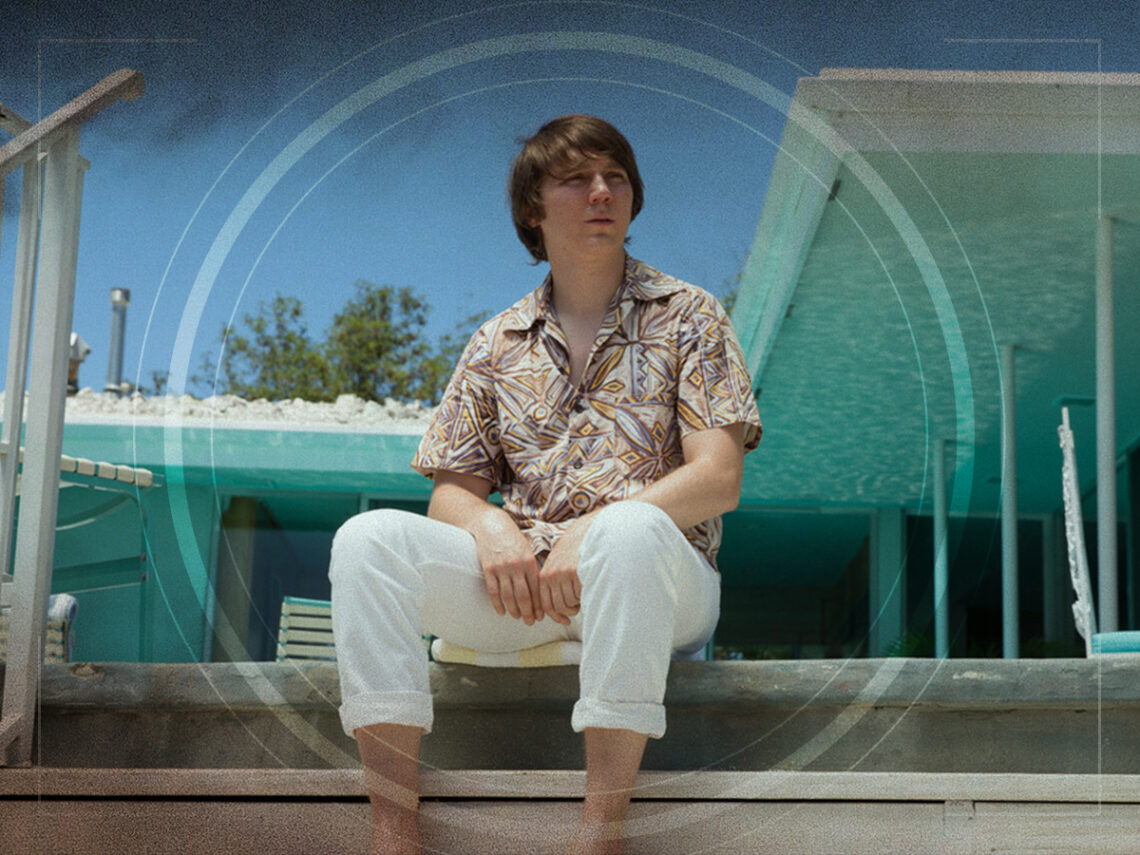
If you haven’t seen ‘Love and Mercy’, you haven’t seen a true music biopic

You know that moment in nearly every music biopic when the musician in question, be it Mozart or Elton John, sits down at their desk or piano and ‘composes’ their greatest hit out of thin air without a single note missing? Partway through Love and Mercy, Bill Pohlad’s 2014 biopic of the late Brian Wilson, the young musician (played by Paul Dano) sits at a piano and plays ‘God Only Knows’ in a halting but otherwise flawless rendition.
At first, it seems as though Pohlad is going along with all the other biopics, but then, Wilson turns around and looks at his father, glowering at him in a bathrobe from across the room. The young musician has been working on the song for a while, and he’s finally ready to play it for the person who dictated every part of his early career.
It’s one of the first indications that this film will be different. The narrative is split between two periods in Wilson’s tumultuous life. The first begins in the 1960s when Wilson steps back from touring with the Beach Boys to focus on making Pet Sounds. The second takes place in the ‘80s when Wilson (played in this period by John Cusack) meets his future wife, Melinda (Elizabeth Banks), while he’s suffering under the abusive conservatorship of since-disbarred therapist Eugene Landy (Paul Giamatti).
While this latter part delves deep into the harrowing personal battle that Wilson faced in his forties, it’s the earlier timeline that really offers a new gold standard for what a music biopic can be. Determined to move beyond the Beach Boys’ peppy surfer façade and make an album to rival the Beatles, the baby-faced Wilson shuts himself away in a sound studio in California while the band goes on tour to Japan and starts workshopping new sounds.
We see him bring in session musicians who have been toiling away in obscurity for years despite playing with some of the greatest musical acts of all time. He flits from musician to musician, demonstrating what he’s looking for, seizing upon flourishes they add by accident, and deftly changing tack over a single note or beat. He isn’t sure what he’s looking for, but he knows he’ll find it through experimentation.
He uses hairpins to pluck piano strings, brings his dogs to the studio to bark into the microphones, and asks if they can fit a horse in the cramped space. He reassures the musicians that he did, in fact, intend to write two baselines in two different keys and that the layering of five vocalists would make it all work, somehow.
Pohlad achieved the period accuracy not only by combing through books and recordings but also through the guidance of Mark Linett, a producer who worked extensively with Wilson and who acted as a consultant on the film. Darian Sahanaja, who played with Wilson for the last two decades of his career and helped finally bring Smile to fruition, served as the film’s supervising musical consultant. Dano, who was already a musician, worked with Sahanaja for months to capture Wilson’s phrasing and intonation, though Sahanaja didn’t want him to receive any formal training because Wilson never had any.
Watching Love and Mercy, it’s hard to avoid wondering why all music biopics aren’t like this. More often than not, they approach their subjects as celebrities rather than artists. We watch their rise to fame and usually their fall. We see them playing their music in front of their wanting public, but we rarely see them in the throes of the creative process. The closest we get are those scenes when they accidentally compose their greatest hit, only to have some clueless manager or bandmate gasp in horror and instantly pronounce it a flop.
But isn’t the artistry the reason we fall in love with these musicians in the first place? We might build a parasocial relationship with them and follow their lives in the tabloids, but none of that would happen without the music. The sad reality is that while highly dramatised, shallow biopics like Bohemian Rhapsody get showered with Oscars, Love and Mercy didn’t receive a single nomination. And yet, for those who watch it, it’s hard not to feel completely captivated by those recording session scenes. In the lead-up to Sam Mendes’ four-film Beatles biopic, we can only hope that he’ll fall down the rabbit hole of the music and its creation rather than personal melodrama.
