


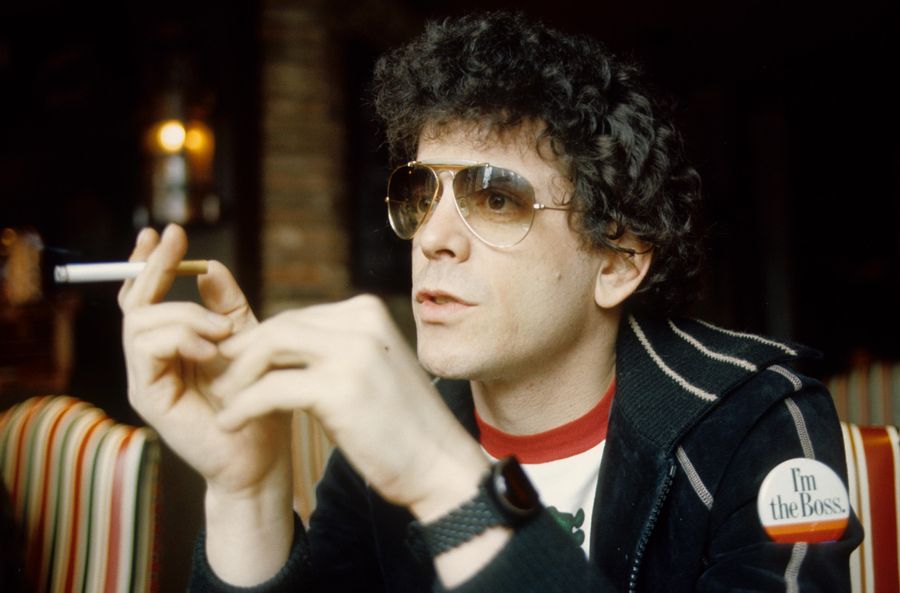
How literature infiltrated Lou Reed’s songwriting

Lou Reed was born in the bohemian world of New York City. As a boy, he shut out the world and sunk into the art around him by means of salvation from the endless panic attacks he suffered through. Albeit Reed was dyslexic, books were an appealing escape for him, as were the grand libraries where they were held. As a teen in the late 1950s, this invariably meant Jack Kerouac and the beat literature craze.
Suddenly, the star wasn’t leafing through old tales from the tomes of literature’s evergreen past but delving into a lucid technicolour future. This new literary revolution was, in part, a response to the rise of pop culture. Books had lost the top spot of cultural prominence owing to music and movies’ ability to capture culture on the wing and offer up something with vital immediacy.
Thus, Kerouac, William S. Burroughs, Delmore Schwartz and the likes responded by reciting prose rife with the here-and-now, only they sharpened further by telling the tales that the radio couldn’t play, and movies couldn’t screen. With expressionist poetry, they rendered the grit of the everyday with a poetic lustre. Reed thought that rock ‘n’ roll should do the same.
As David Bowie would later proclaim when he first hear the Velvet Underground: “I thought Lou was doing that were unavoidably right for both the times and where music was going. One of them was the use of cacophony as background noise and to create an ambience that had been unknown in rock I think.”
Adding: “The other thing was the nature of his lyric writing which for me just smacked of things like Hubert Selby Jr, The Last Exit from Brooklyn and also John Rechy’s book City of the Night. Both books of which have made a huge impact on me and Lou’s writing was right in that ballpark. It was Dylan who brought a new kind of intelligence to pop songwriting but then it was Lou who had taken it even further and into the avant-garde.” He even borrowed Leopold von Sacher-Masoch’s Venus in Furs for a wild new type of anthem, rooted firmly in the timeless past.
The Lou Reed masterpiece ‘Street Hassle’ has more depth, near-tangible imagery and character than most novels can achieve in half a tree’s worth of pages. In many ways, the song was the realisation of a goal Reed always held in his songwriting: “To bring the sensitivities of the novel to rock music.”
His literary ways defined him as a truly original songwriter, and as the cliché goes, one who was perhaps too far ahead of his time. Despite his love for the written word, he once told Elvis Costello that a slight bit of dyslexia meant he always struggled with long chunks of text, thus the madcap machinegun bursts of the poet Delmore Schwartz were a huge early influence.
Without craving long reeds, it was magic snippets that he searched for. Kerouac and the beats offered up the ones that turned his own world into poetry. It is Kerouac, in fact, who illuminates a very similar pastiche to Lou Reed’s opening ‘Berlin’ stanza when he wrote: “A pain stabbed my heart, as it did every time I saw a girl I love who was going the opposite direction in this too-big world.” On both counts, we have, of course, a self-absorbed fantasy.
The mix of punchy power and woven worlds was something Reed thought rock ‘n’ roll was made for, but all too often he was left wanting. in a 1987 interview with Joe Smith, Reed stated: “You don’t want to actually listen to the lyrics of a rock ‘n’ roll record. I mean, for what? It’s not like when you read a book and you come across a great line, it would be great if you got that in a song I thought.”
The concision of a line that cuts through the trance of melody is something that Reed sought. He had a sage on this front. Schwartz became a mentor of Lou Reed’s during his days at Syracuse University, turning him on to other seminal authors and nurturing his own malicious creative intent.
When this spark of inspiration burst into flame and launched his rock ‘n’ roll career, Lou Reed eventually met his other idol, Burroughs, in 1979. At that fateful meeting, he asked, “Can a pupil ever do better work than his teacher?” To which Burroughs humbly replied, “In this case, I believe so,” according to Transformer: The Lou Reed Story by Victor Bockris.
In short, the written word not only inspired Lou Reed throughout his career, but it was essentially what he strived for in his work – to couple prose with the visceral edge of rock ‘n’ roll.
