


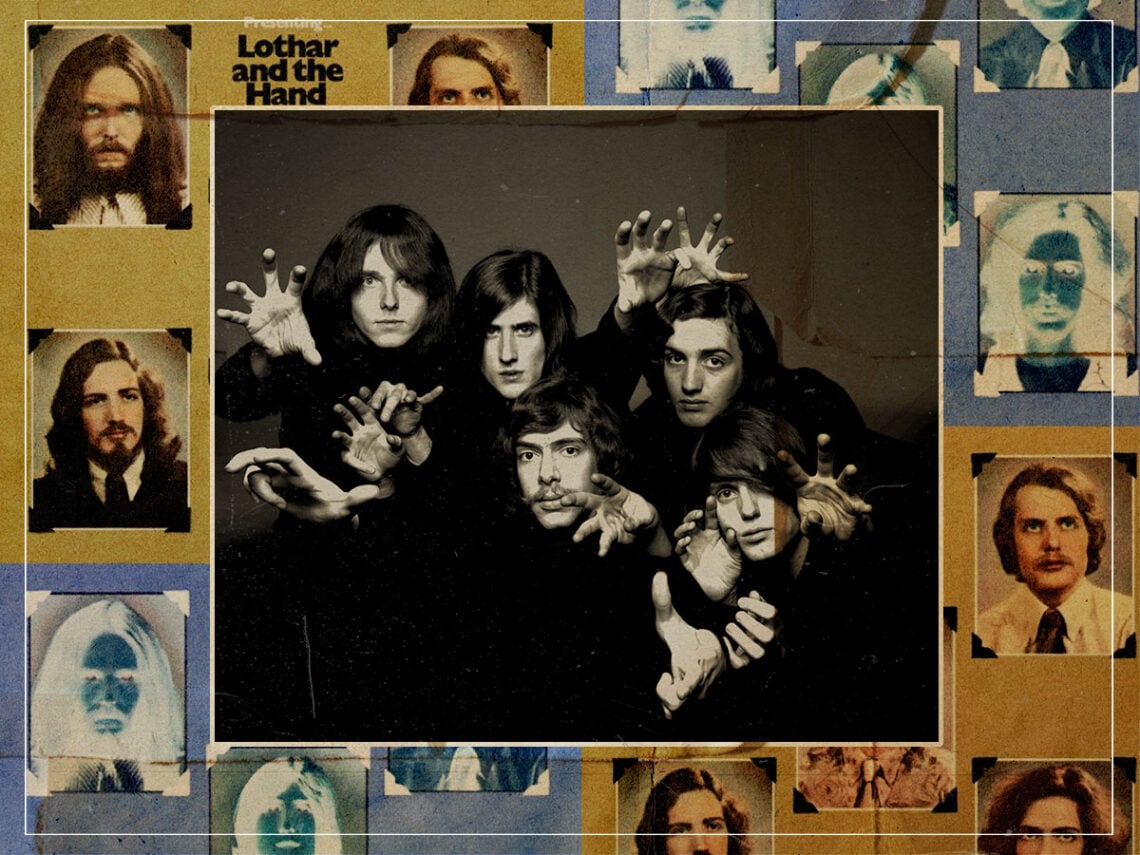
Lothar and the Hand People: The bizarre tale of the world’s first electronica band

Some moments in musical history seem to pass by in a flash, to the point where they are acknowledged for being important, but only for a split second. Moments like Jimi Hendrix setting his guitar on fire, Jimmy Page playing the double-neck for ‘Stairway to Heaven’ and The Beatles performing on The Ed Sullivan Show are recognised for their monumental contribution to music history; however, other instances, such as the first band to bring electronic music to a live setting, are glanced past.
How much something is recorded in music history almost seems to come down to luck. The majority of bands today, regardless of their music genre, have some electronic element to their sound, whether that’s as simple as an occasional synth or something more in-depth and complex. As such, music owes a lot to Lothar and the Hand People, one of the world’s first electronica bands, yet the majority have never even heard of them.
“The engineer was adamant that we would not use a fuzz foot pedal on Kim’s guitar because it distorted the sound,” recalled Paul Conly, discussing the clashing of heads between the band and officials when experimenting with an unfinished sound. “Mr Weissman did the best job he could under the circumstances. He is a great musician in his own right, but he didn’t feel that our experimentation would be commercially successful. Well, he was right about that.”
When the band moved to New York, they looked forward to embracing the more experimental side of their music. Having travelled from Denver, where the music scene felt suffocating and one-note, they had a no-rules approach towards songwriting. This naturally led to a clash of heads as label execs and band members had different priorities. One of the band’s biggest steps in the direction they wanted to move was when they incorporated the theremin into their performances.
“John Emelin had bought the theremin from Dr Robert Moog in 1965, or perhaps earlier […] It was such a shock and mesmerising experience for the crowd that we knew we had to add theremin to our show every night,” recalled Conly, “Soon, it seemed obvious to name the theremin Lothar, because the name of the band was Lothar and the Hand People, and yet, nobody among us humans were named Lothar. So the Moog theremin was the best one to get the name of Lothar.”
This makes complete sense now, given the band championed electronica in their sets, so to have the band be named after a pivotal piece of equipment seems like a good idea. Championing a sound that Conly referred to as “experimental electro-rock”, Lothar and the Hand People were tapping into a sound punters weren’t sure what to do with.
They embraced the futuristic element of their sound wholeheartedly. On their album, Space Hymn, they took the idea of astronauts and made an album that doubled up as a homage to them but also a metaphor for the tribulations faced by people here on Earth. “Confounding the journey into outer space with the journeys made into the inner space of the human mind and spirit,” said Conly, “We considered the mixture of ‘organic’ musical instruments with electronic instruments as representative of the dual journeys.”
The band were happy with the electronic side of their music, to the point that they began to view Lothar as its very own frontman. “In 1971, I figured that in 50 years we could communicate in both directions with Lothar, and in English,” said Conly before acknowledging that he wasn’t far off with his prediction, “It’s been nearly 50 years now and Alexa and Siri and I speak regularly. But Alexa is not Lothar.”
It was never meant to last, though. By the time the prospect of a third album came around, the band were short on ideas. The fact of the matter was that while playing electronica was fascinating, the technology wasn’t quite there to create sounds as dynamic as the rock bands in the ’70s would produce. They pioneered the mindset of taking electronic music to the stage, but they couldn’t go further than that. It sat on rocks for years but is now used in the majority of live music out there.
