


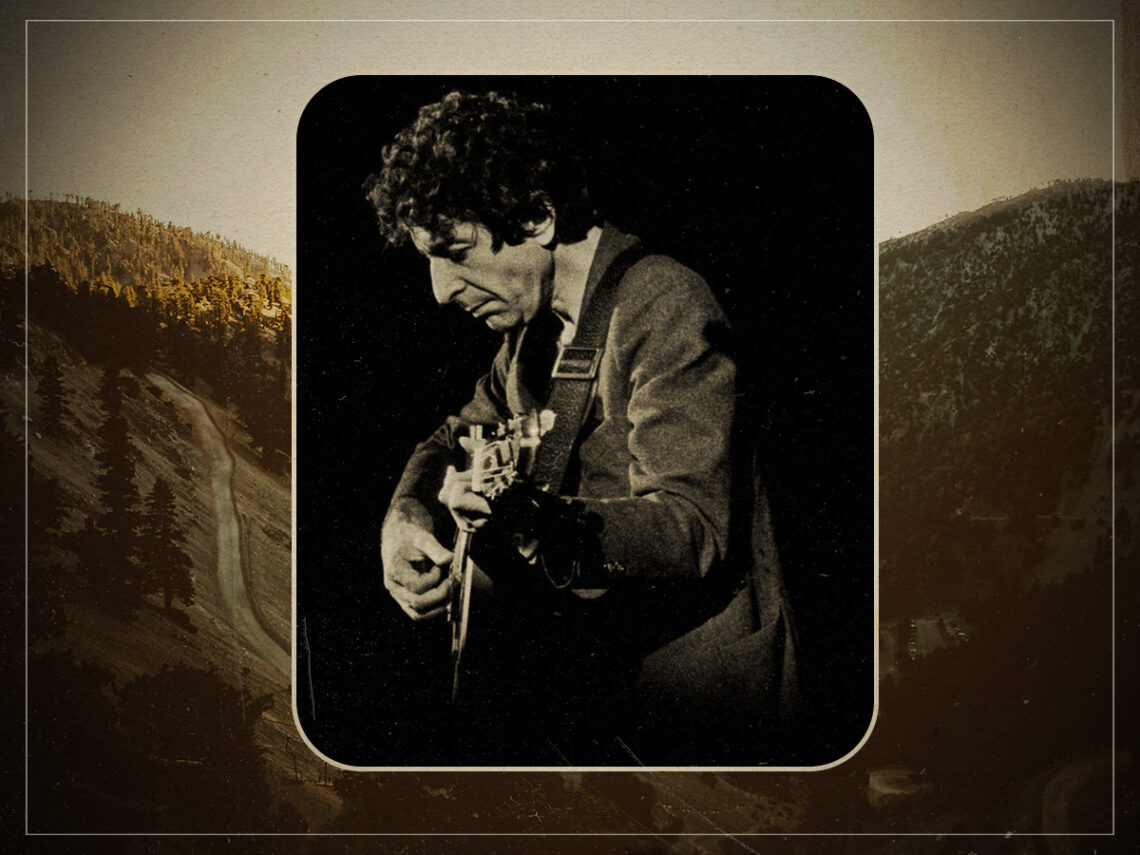
“How the light gets in”: the Los Angeles mountain that inspired Leonard Cohen’s ‘Anthem’

If there is one thing that defines Leonard Cohen’s entire life, it is surely an everlasting search. A search for purpose, a search for inspiration, a search for understanding. But overwhelmingly, Cohen’s life was one long search for enlightenment.
Born and raised in an Orthodox Jewish family in Montreal, Cohen’s youth went the way most young lives go after growing up in strict confines – he rebelled. He went against the more staunch religion of his youth to instead go all in on art, poetry, music and writing. He rebelled all the way to his town’s seedy underbelly to “watch the gangsters, pimps, and wrestlers dance around the night”, and from then on, the artistic course was set, taking him to New York, then to London, then to Hydra and then back to New York again.
Each step of the way seemed to form a new devotion. In New York, that devotion was always to art, whether it be as a student at first or later as a musician. In Hydra, the devotion was to love, both of writing and of Marianne Ilhen. But always along the way, alongside whatever was his current focus, a constant question of faith buzzed in the background.
It’s there in so many of his poems. In his first collection, Let Us Compare Mythologies, his work is haunted by the idea of God in whatever form, in words of prayer or merely the idea of prayer and calling to something above. But mostly, Cohen’s craving for spiritual understanding played out in his actual life.
When he landed back in New York, he even briefly dabbled in Scientology, looking for answers seemingly anywhere he could think. However, the most extreme example of his quest came in 1994, when he trekked up Mount Baldy in Los Angeles and entered the Zen Centre at the top, where he would end up staying for five years.

Cohen had been practising Buddhism since the 1970s by this point, but at the Mt Baldy Zen Centre in the San Gabriel Mountains near LA, he was ordained as a Rinzai Zen Buddhist monk – he abandoned his own identity and took the Dharma name Jikan, and as the most influential part of the experience, he studied closely under Kyozan Joshu Sasaki Roshi, serving as his personal assistant.
Arguably, there could be no better figure for Cohen to be complexly attached to and no better representative of this strange period. Just as Cohen’s own work forever dipped between the divine and the deviant, from words of spirituality to words of seduction, Roshi would later become a highly controversial figure as he was exposed for “coercing hundreds of [students] into having sexual contact with him”.
But overwhelmingly, if there was one thing Cohen learnt during his time up on Mount Baldy, it was that life is made of contradictions. In his various comments about the experience, he seemed to always zig-zag between seeing it as a period of profound learning and profound boredom. In ‘Winter On Mount Baldy’, he says straight up, “It’s cold and dark and dangerous / And slippery as a lie / Nobody wants to be here / And me, I’d rather die,” suggesting acute misery.
Yet elsewhere, his work from up on the mountain muses on the magic of contraction. In ‘Roshi At 89’, a portrait of his teacher, he writes “There’s no one going to Heaven, and there’s no one left in Hell,” as if the pinnacle of his religious learning was an acceptance that there is no one truth, no good and no bad.
In what is one of his most iconic songs, ‘Anthem’, Cohen put all of that succinctly when he sang – “There is a crack in everything, that’s how the light gets in.” It was written around the time that the artist was deciding to fully retreat to Mount Baldy, visiting the centre more and more as his hunt for understanding intensified. It also perfectly captures the naivety and hope of his enduring belief that he would, in fact, find answers. As he prepped to devote years of his life to finding them, it’s a more hopeful acceptance of the kind of hypocritical chaos he’d later live in up the mountain.
It hinted back then already that he knew what he’d find was more contradiction and few clear answers, and it’s mirrored perfectly by his closing thoughts on that period, writing in ‘Leaving Mount Baldy’, “I finally understood / I had no gift / for spiritual matters”.
