


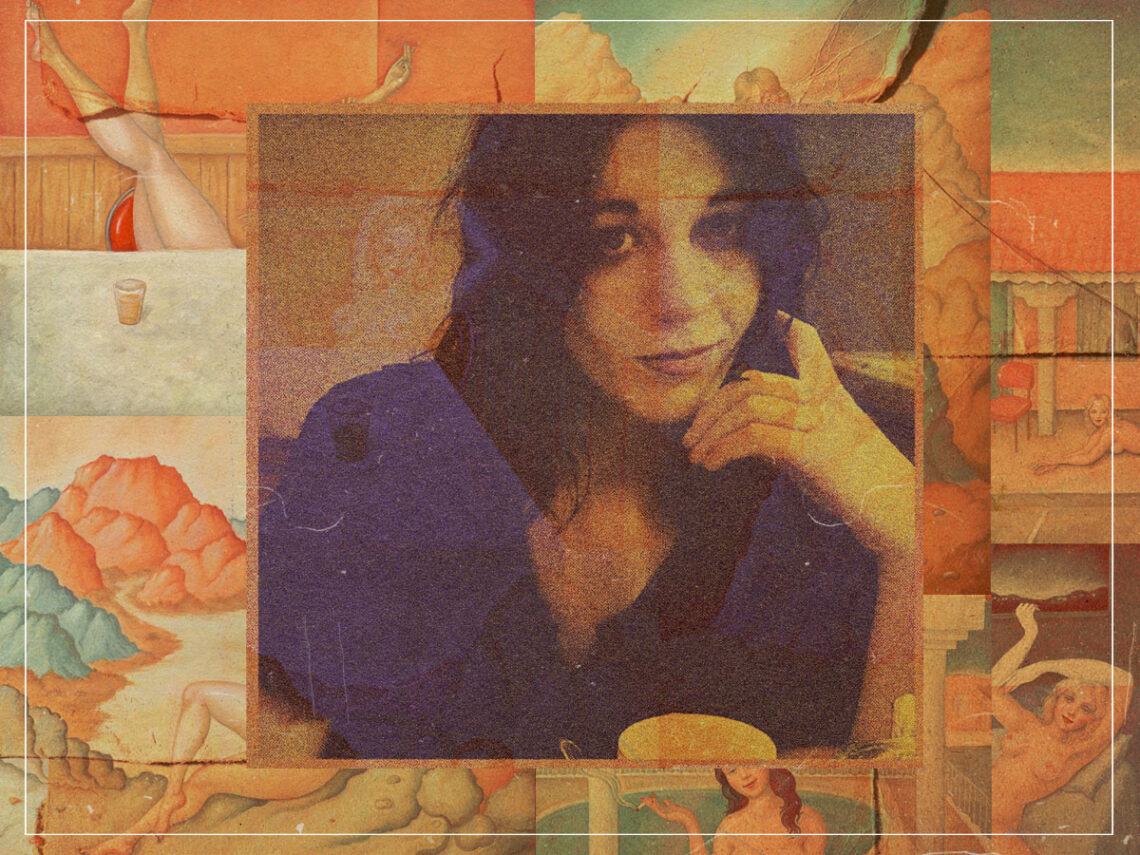
Lorena Lohr: Capturing feminine dialogue with the American south-west

In the bustling arteries of everyday life, there exists a world often overlooked, eclipsed by the volume of commodity fetishism. It takes a keen artistic eye to highlight certain aspects of beauty while commenting on humanity’s shortcomings and the overwhelming volume of modern life, and Lorena Lohr is one of the few who can do it with precision.
Although you could analyse Lohr’s work for weeks, embellishing her stories as reflections of your own romanticism, everything she creates could be pinned down to one moment of simple beauty. “I could say the photographs and paintings were born from the same moment,” Lohr tells Far Out. “Which was waking up in the Arizona desert for the first time on a Greyhound bus at dawn, the pink light spreading out to a powder blue haze.”
My initial interest centred around how Lohr transitioned from photography to painting, but the more she reveals, the more I realise her own adeptness at capturing certain aspects of humanity in places where dichotomies thrive. Setting the scene by detailing a three-day trip in which she travelled from the east to the west coast of the US, Lohr tells me about the significance of the surrounding landscape in the birth of her latest creation.
“Overnight, the landscape changed from midwestern factory smokestacks and north Texas dusty streets to this highly expansive landscape that I had never been able to imagine before,” she says before explaining her inherent interest in medieval and northern Renaissance paintings. Although she didn’t officially study these works, they were never far from her mind.
“For some reason, I decided to paint some kind of devotional painting backdropped by this desert setting that was supposedly barren but which immediately struck me as incredibly rich with life,” Lohr explains. The result, her collection Desert Nudes, hasn’t been officially shown until now, mostly due to Lohr’s desire to “put in years of work” to make sure they felt unquestionably complete.
Desert Nudes is an endearing and striking collection that seamlessly blends the desert’s rugged terrain with the feminine silhouette. Executed in a subdued twilight palette and rendered on a small scale with immense detail, these pieces evoke intimacy while serving as a homage to the landscape they find themselves within.

“I see them as being temporarily still in a landscape that has typically been associated with movement, transcience, and conflict, not necessarily interacting with the landscape with great purpose, but just existing in harmony with the natural surroundings,” Lohr explains. “The women have a certain calmness and dangerousness which I guess could be seen as subverting the stereotypical or archetypal images of Western machismo, or the outlaw or cowboy.”
Instead of emulating the northern Renaissance appeal, which often incorporated religious themes set in a similar landscape in the Middle East, Lohr was more interested in presenting the female figures in a more contemporary New Frontier setting, creating images that were devotional but without “overtly religious or mythological connotations”. As a result, the backdrop comments on the value of preserving stories through the landscapes that connect small towns.
Photographers could, of course, immortalise such settings by capturing pictures of them, but Lohr’s art reflects their unique auras, drawing from her own memories and feelings when stumbling across such inspiring places. “The compositions for the paintings have come about subconsciously,” she explains. “[They] are all from my head, starting with one mark on paper and seeing what comes next. It has always been important to me not to have any preconceived ideas. If you knew what something was going to look like before you finished it, then there wouldn’t be any point in doing it at all.”
As a result, Desert Nudes conceptualises the power of subjectivity in the human condition by reflecting Lohr’s personal musings about both the physical setting and the visceral nature of the female form. There is an obvious contrast in the two images depicted within the same concept, but this is precisely its power—what Lohr achieves with mundanity is an important commentary on existential expectation.
“There is a slight fantasy element to how these women luxuriate in suspended time, and I think that these compositions come from remembering or being in situations and wondering what it would be like to make the most out of them without restriction,” Lohr says, noting the importance of the somewhat tediousness of part of the spectacle. “Maybe it’s about a balance between everyday experiences and this kind of heightened feeling, where more is permitted than in life,” she adds.
When it comes down to specifics, the perception of the desert as both desolate and rich with life is best captured in the “wild detail in the layers of rocks and the lines and curves of the topography,” Lohr explains, highlighting the ways these details twist “every which way” and create “surfaces which, to some people, can look devoid of life or barren”.
Referring to artists of the Middle Ages, Lohr recalls being fascinated by the ways they “rendered everything with complete care and sacredness, from the figures themselves to the small details that are found in the front corners of the paintings” including “glistening pebbles, swirled weeds, a household ornament, or an odd piece of bone.”
As a result, Lohr’s presentation of the desert followed suit, incorporating each and every texture and facet that contributes to its complexity while simultaneously representing its stagnation.


