


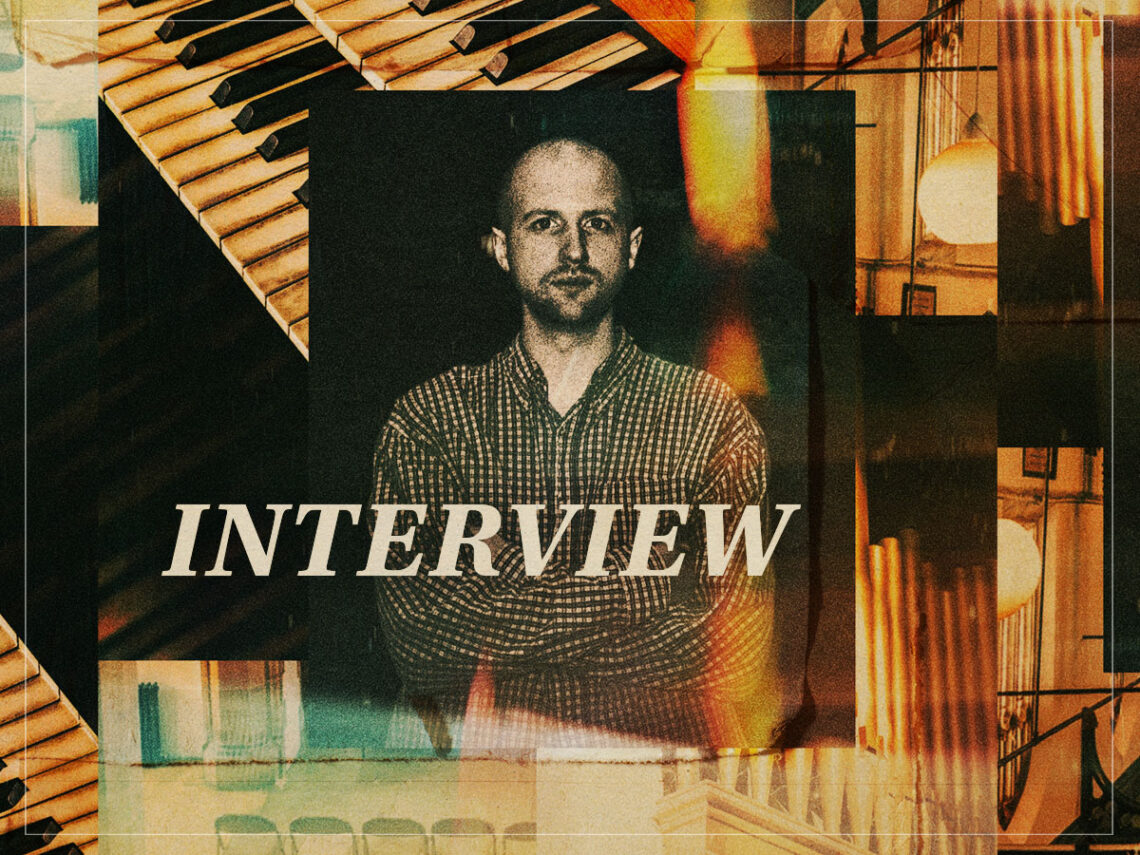
“It’s the original synthesizer”: Laurence Carden wants to liberate the organ

It could be said that classical music and instruments are back. The Last Dinner Party are incorporating flutes and mandolins into their rock show, Laufey is turning Gen-Z onto symphony orchestras and jazz, and countless artists are calling up string sections or adding horns onto their tracks for a more traditional edge to modern music. But in reality, and in the hallowed halls of churches, these traditional forms never left. Some sounds, however, have been neglected, and Laurence Carden is putting in a case for the organ to get a modern revival.
Ask any musicians, and they’ll likely put working with an orchestra on their bucket list. However, that dream never really includes an organ. “I think it’s quite underappreciated,” Laurence Carden says. While mostly found playing the drums in the indie outfit Pushpin, the musician has played the organ for quite some time. However, given that the average venue doesn’t tend to house a grand organ, no one would really know that. “They’re quite locked away in these churches,” he said, considering the inaccessibility as one of the reasons why the instrument doesn’t get the attention it perhaps deserves.
He added, “It’s actually very hard to play an organ, even if you want to play an organ.”
It is not exactly a portable instrument or one that would be all that easy to come by to teach yourself, but the organ has rarely made it out of the realm of the church. Kept isolated in a world that many modern musicians couldn’t access or wouldn’t know how to get into beyond taking a distinctly classical or religious root into music, it’s meant that the instrument has been neglected, with few modern players there to tackle the stereotypes connected. Think of an organ and most probably imagine something like the Phantom Of The Opera or a similar melodramatic, abrasive sound. We envision them being played by an ageing churchgoer rather than being an instrument mastered by talented musicians or making a real difference in the music world. But the organ is much more than that.
“It’s the original synthesizer, right?” Carden says, pointing out that synths are now commonplace in modern acts, for which many of their features derive from organs. The actual capabilities of the organ are also underappreciated as this is not a one-note instrument. “The organ is obviously loads of different sounds,” he explains, “You get flutey sounds or trumpet sounds. We get strings and all those sorts of things. Especially, like bigger organs, they are built to be orchestras.” Essentially, it allows an artist the chance to tick off that orchestral dream with only one additional instrument, and its capabilities feel like an untapped potential that has been left neglected simply because of its dusty, old associations.

But just as how the organ has gone undervalued, so too has the role tether churches and church sounds have to music. “If you go to church and someone’s playing the organ, lots of the hymns you sing, that were arranged around the turn of the 20th century, were taken from folk songs as well,” Carden says. Drawing a line between this instrument and its typical church home, out into the world of folk music, that’s where his idea came from.
Alongside a lineup of up-and-coming artists from the worlds of folk and indie, including Elanor Moss, Jemima Coulter, Oscar Browne, and Lilo, The Organ Collaborations Project will see Carden reimagining their songs on the organ and performing alongside them in a beautiful church setting. Combining old and new, the tradition of gothic church sounds with the tradition of more tender folk sounds, he’s hoping to prove that perhaps they’re not as contrasting as they appear. Or that the contrast can be truly beautiful.
“Folk songs, hymn tunes, the organ, all that stuff was always then they’ve always been friends,” he says, “it doesn’t feel like I’m trying to put a square peg in a round hole.”
However, while the organ isn’t as far from the world of modern music as people might realise, it does come along with its own difficulties. “There are obviously people who do really cool things with it, but I think one of the reasons it’s quite hard to bring it into normal music is because it can be quite challenging to work with,” Carden tells me. “The weird thing about the organ is that the notes are either off or on,” he says, “There’s only a small amount of dynamic control you can do.”
So, while strings can fade in and out, or a saxophone can slowly and subtly arrive in a song, there is nothing subtle about an organ; it’s either there or not.
But that’s precisely why Carden’s night is called The Organ Collaborations Project because it is exactly that, a project. As something new, testing out mixing two sounds and styles that have been kept separate, there is a level of experimentation involved on all ends. The artists are experimenting with allowing their own songs to be reworked to suit the instrument, Carden is experimenting with the ability of his instrument and the new places it can go, and even the audience is experimenting with trying to marry two worlds they’ve likely drawn a dividing line between.
Happening on January 18th in London at The Old Church in Stoke Newington, a former medieval and Tudor church turned community arts venue, the location that matches the energy of liberating old into new and daring to open up the doors of something previously stuffy and traditional into something more accessible.
Laying out his solo motivation for the entire idea, Carden says, “I just think the organ is an amazing instrument. It’s nice to liberate it a tiny bit”.
