


‘Fite Dem Back’: How Linton Kwesi Johnson used poetry as a “cultural weapon”

For as long as the written word has existed, poetry and prose have been used by various writers to challenge authority and injustice. Racism and prejudice permeated virtually every aspect of society during the 1970s in Britain, reflecting a rise in far-right hate groups and political parties around the same time. Hence, it was only a matter of time before a generation of radical new writers and musicians emerged to challenge these prejudices, with poets like Linton Kwesi Johnson pioneering styles of anti-fascist poetry.
Having relocated from his birthplace in Jamaica to Brixton as a young man in the 1960s, Johnson was able to witness the horrors of fascism and widespread racist attitudes in the UK firsthand. The nostalgic image of 1960s London suggests that the entire city was some kind of utopia, populated by modernists, Mini Coopers and exciting new art movements. The reality for many Black families, however, was one of poor working conditions, poor living conditions, race riots and intimidation by far-right hate groups.
Johnson witnessed this injustice and decided to take a stand against it. While at school, he joined the British Black Panther Movement, becoming increasingly radical and political. It was also during this time that Johnson began to compose his own art and poetry, which was often politically charged and pertinent to issues like institutionalised racism and hate crimes. Following his graduation from Goldsmiths College in 1973, the poet devoted himself tirelessly to poetry.
Finding a home for himself within the dub and reggae scene of London, Johnson began to perform his poetry to audiences, becoming an incredibly influential figure in the Black liberation movement in the process. Even before the self-styled cultural revolution of punk rock came to London in 1976, Johnson was already challenging the status quo of authority and British society through his compelling and groundbreaking poetry.
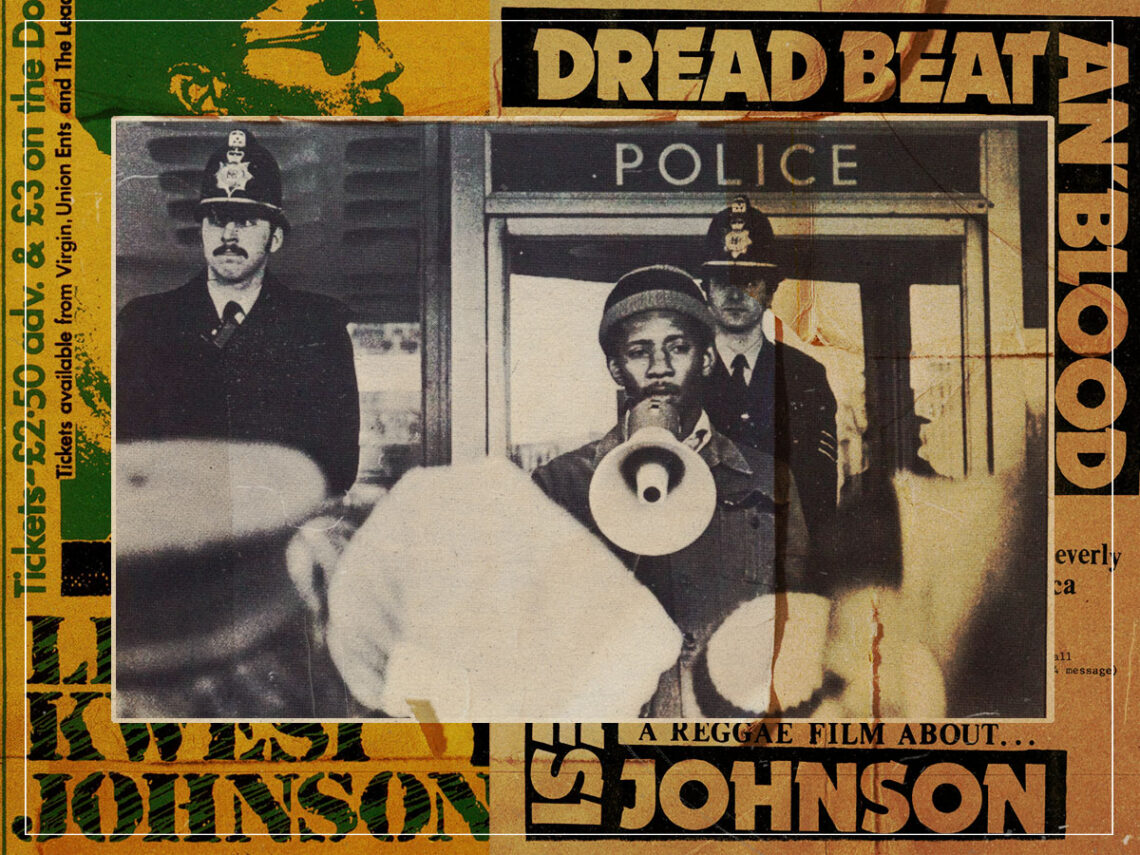
Quickly, though, Johnson realised that his poetry would reach a much larger audience when coupled with music, speaking to the anachronistic artistic vision of the poet. After recruiting legendary reggae producer Dennis Bovell, Johnson began to release his poetry into the wider world through incredible records like Dread Beat an’ Blood in 1978 and Forces of Victory a year later.
The poems on these records tackled issues of far-right nationalism and racist attitudes in an incredibly uncompromising nature. Johnson was tired of complacency and pacifism, calling for people to tackle fascism head-on in tracks like ‘Fite Dem Back’ – noted for the repeated lyrics “Smash their brains in” – referring to groups like the National Front. Speaking to The Guardian in 2008, Johnson explained these choices, saying, “Writing was a political act, and poetry was a cultural weapon”.
Johnson’s rebellion was certainly not superficial, bringing attention to various different social issues and cases. His 1978 poem ‘It Dread inna Inglan’, for instance, brought attention to the imprisonment of George Lindo, who was framed for robbery in Bradford and was an essential part of the campaign that eventually saw Lindo released.
Aside from its political content, Johnson’s work was also revolutionary in its construction. The world of poetry is often viewed as being quite archaic and elitist, but Johnson turned that reputation entirely on its head, writing in his own accent and dialect and using simple sentence structures to get his political message across. “My early writing was a load of rubbish really,” he later recalled, “I tended to use lots of ‘thees’ and ‘thous’, which is what I thought poetry needed”.
To this day, Johnson remains one of the most prolific, important and revolutionary writers that the United Kingdom has ever seen. His groundbreaking poetry held a mirror up to the ugly face of racism and far-right hatred in British society, calling on audiences to challenge these attitudes and this hatred wherever they might encounter it on a daily basis.
