


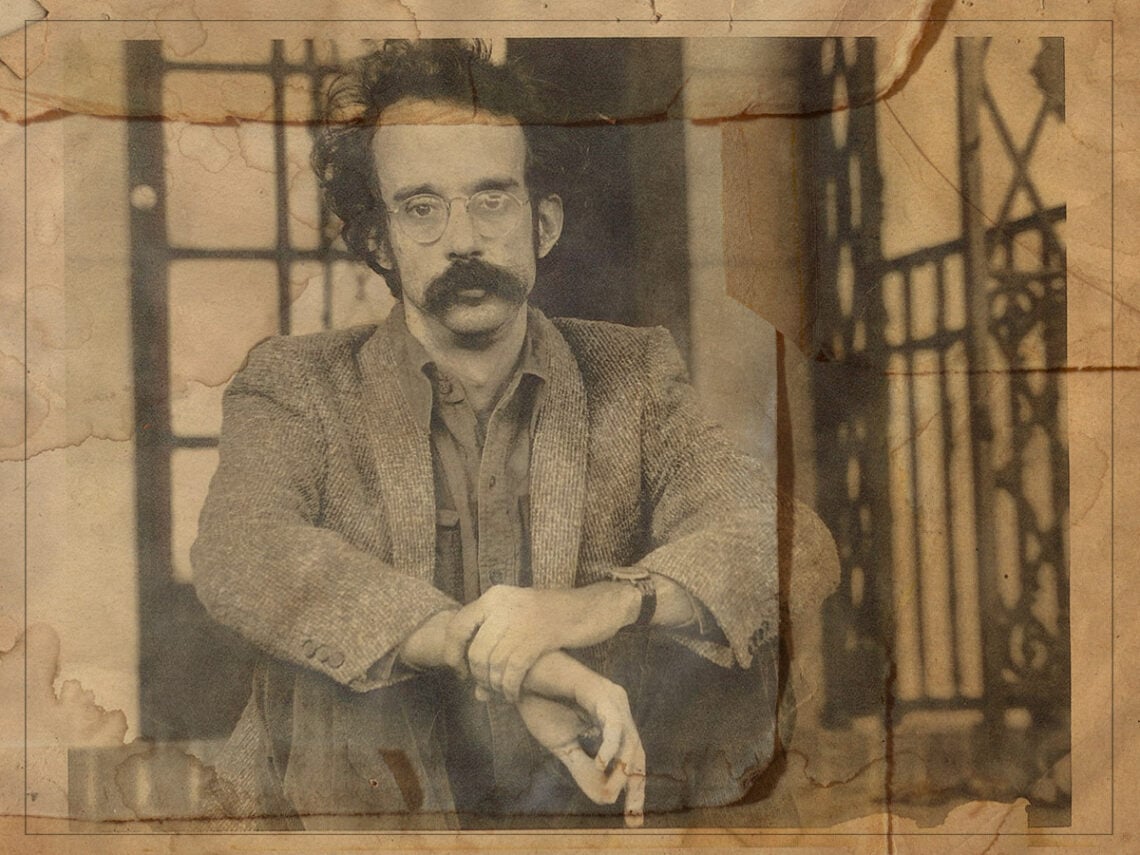
The life and times of Johnny Coley: an overlooked queer hero

Writing poetry and conjuring improvisational pieces for over 50 years, Alabama artist Johnny Coley has explored the American South’s psychogeography with a deeply surrealist authority. Armed with a lyrical gift for narrative hand-holding to guide the listener through his skewed musings on US heritage, everyday Birmingham eccentricity, and the warped edges of reality, Coley wraps his work in an inviting warmth which points to absurdity while ensuring your stay in his off-kilter world is a hospitable one.
Commanding this collage of half-lit characters and shadowy impressions is Coley’s distinctive vocal drawl, oozing close to the mic with every expressive plosive captured and imbued with a uniquely dual perception of a weathered observer organically rooted in the Southern landscape while also divorced like an alien outlier.
Born in 1950 in Alexander City, Coley inherited an American South hopelessly steeped in its ugly history. The great-grandson of a cotton farm owner laboured by slavery, the white supremacy of Alabama’s Jim Crow era proved an essential foundation for a life dedicated to left-wing values and criticism. “How many letters are there in Alabama?” he asked in 2024. “Seven letters—four of those letters should be Black people. You know what I mean? Alabama is something that happens coming out of white supremacy, this whole situation between Black and white people, which was not chosen by Black people.”
Drawn toward a different path away from his father’s credentialed academic career, Coley took a study year in France just as the country’s 1968 protests and civil unrest engulfed President Charles de Gaulle’s archaic state. Swept up in the students and militant organisers, he joined the university occupiers and exposed himself to the basics of Marxist theory, as much as his crude grasp of the French tongue could ascertain. Around this febrile and volatile time, an interest in writing first cast its spell on the young Coley.
Working odd manual jobs upon his return to the States sparked an intense bout of unrequited love. Mowing lawns for a friend’s father, his falling for his male pal accelerated the queer dimension to his identity, and thus his future creative work on the Suggests Nightfall short stories collection and novel Huron. Finding work in Tuscaloosa’s Department of Pensions and Securities, his welfare duties would require health visits to a host of the city’s many characters, a grounding experience that charged his humanism and warded off the ghosts of his heritage: “I did that for ten years, and it was very good for me—to lose that bourgeoise place”.
Gaining a reputation over the years as one of Birmingham’s key fringe poets, an excursion into experimental spoken-word music beckoned with Landscape Man and Antique Sadness. Swapping the latter’s buzzing country electronics with a more Lynchian fever dream skulk, Coley corralled backing group The Sweet Whisper Band—a composite of Sweet Wreath label associates—to record a smoky lounge swirl of fraught jazz all in one session. Taping Coley’s separate vocals directly from his assisted living facility, 2024’s Mister Sweet Whisper via New York’s Mississippi Records landed like a mysterious culmination of his overlooked life thus far.
Nebulously floating between his point of view and the prism of Birmingham’s myriad of down-and-outs, Mister Sweet Whisper documents a strange reportage of strip clubs, doughnut stores, endless highways, and the mysterious plains of the South. Exploring the many figures that pass through life’s side joints and pit-stops, Coley depicts life’s strange light that glows atop seeming normalcy, all tied together with his genteel and natural note of empathy and affinity for characters who’ve lived quietly tumultuous lives as he has.
Forming another intriguing thread of American country and folk’s rich and confounding history, Coley’s colourful life and the art it inspired will hopefully continue to draw new fans and a wider audience into the twilight of his life.
