


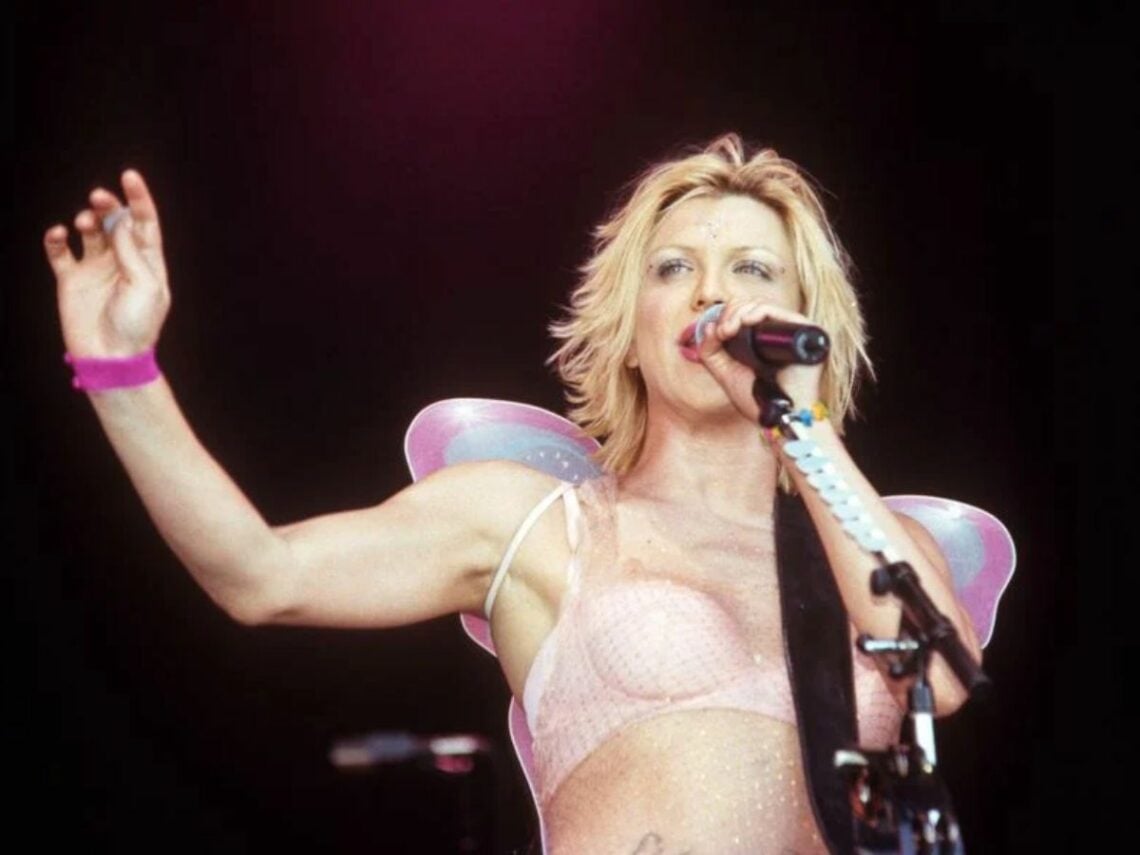
“Let’s just pretend it didn’t happen”: Courtney Love’s remarkable performance at Reading 1994

It’s the middle of the day, the weather is dry, and the crowd is made up of genuine fans and the unempathetically curious. Hole are set to take to the stage at Reading Festival, one of the most prestigious rock festivals of the day and the stomping ground where Nirvana delivered a legendary set that separated them from any other band only two years prior. Now, Courtney Love takes to the stage, gold dress and sunglasses on, “Oh yeah, I’m so goddam brave,” she says down the mic.
This gig was particularly big for Hole because it came at such a difficult time for all the band members. Love hadn’t made a public appearance for five months since her husband, Kurt Cobain, had passed away. On top of that, Hole bassist Kristen Pfaff had died of a heroin overdose just two days prior. The setting was notably lacking in surefootedness.
The crowd, much like the hounding tabloid press, stood curious to see what version of the grieving widow they would get. With a contractual agreement that would likely have seen her ina financial trough had she and the band cancelled, Love found herself in the impossible position that many women in music find themselves in.
If she showed no emotion, she would have been labelled a heartless industry plant; if she showed too much emotion, she would have been dubbed unstable and off the rails. During her performance, she displayed both ends of that spectrum and everything in between, as her soul was laid bare in the most authentic way possible.
“Yeah, sure. Let’s just pretend it didn’t happen. Let’s just pretend. Is that what you’re doing, pretending it didn’t happen? Great. Well, I’m not,” she said before the band went into their first track, ‘Plump’. The song has a chaotic element to it anyway, but it was emphasised even further by the band, who only just managed to keep hold of it and stop the track from slipping away entirely.
There are moments throughout the set where Love seems to get some kind of catharsis. For instance, on ‘Miss World,’ Love dives head first into the doom-laden lyricism, even ad-libbing a little so that she re-wrote the final line to deliver lyrics as subtle as an earthquake: “I’m the one who should have died.”
The reviews of the show were mixed. The tension in the air was what many people focused on, not being able to get over the fact that there was a barrier between Love and the audience, between Love and the entire world, the moment she stepped out onto the stage. “[They] teeter on the edge of chaos,” wrote John Peel, “Generating a tension which I cannot remember having felt before from any stage.”
Cathi Unsworth, on behalf of Melody Maker, showed a bit more sympathy towards Love. “This is both brave and upsetting…” She wrote, recounting the set, “It leaves her in that most unenviable of positions: everybody wants to know about her, but few would really want to know her.” But both of these accounts seem to miss the glaring point.
The truth is, what Love delivered that day is one of the most authentic and genuine performances by any artist in the history of music. There is no right way to grieve. If only the grieving process were linear, then at least you would see light at the end of the tunnel when you feel down about losing someone. Instead, grief is a swirling vortex, one that spins in the distance some days and tears everything you know apart on others.
As Love is in that cesspit of emotion, in an environment that brought it all out to the surface, people saw every single aspect of grief within a 40-minute performance. This meant apathy, devastation, anger, hopefulness, humour, and self-depreciation, all laid bare in the name of art.
That 1994 performance remains one of the most exemplary in human existence.
