


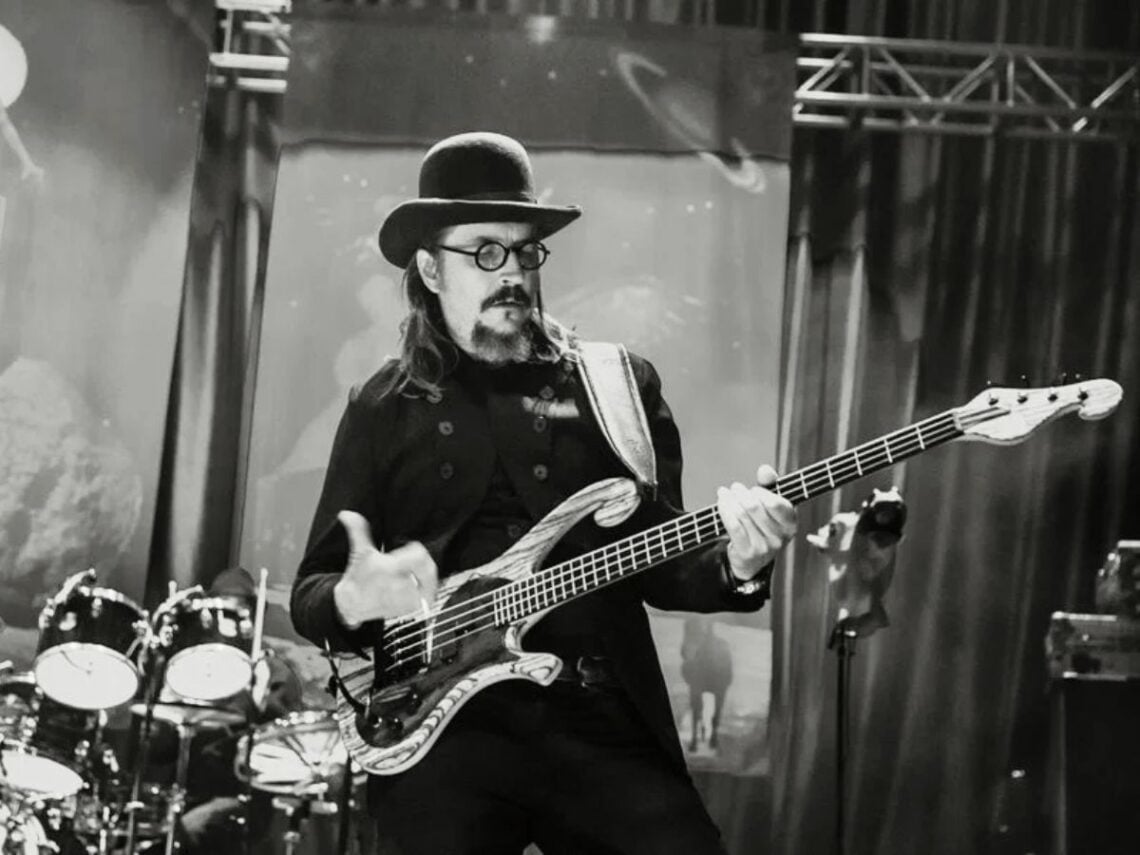
Les Claypool names the “hardest” rock and roll bassline of his era

For many suburban American kids gobbling up alternative MTV’s boilerplate soundtrack, Californian experimental funk trio Primus would have enjoyed heavy rotation along with Ween or early Beck a good few years before the South Park theme propelled them to mainstream attention.
Inspired by the thick slap of Louis Johnson and Sly and the Family Stone’s Larry Graham coupled with The Residents’ cartoon avant-garde, frontman and bassist Les Claypool existed on the eccentric end of the Lollapalooza spectrum, crafting a chunky slice of plastic-lacquered funk metal filled with the lyrical prowess of Hanna-Barbera characters on acid.
Primus goes back as far as 1984. Originally operating under the moniker Primates, Claypool and founding guitarist Todd Huth initially jammed with a LinnDrum machine before cycling through several drummers until the end of the decade. Establishing the classic lineup with Larry LaLonde on guitar and Tim ‘Herb’ Alexander on drums, Primus began picking up steam in San Francisco’s Bay Area and selling out the nearby cult Berkeley Square club.
Following the Suck on This live album profits, Primus recorded their first studio album proper with 1990’s Frizzle Fry, winning a dedicated fanbase. From then on, that would see them as one of the States’ beloved cult bands, winning junkyard blues elder statesmen like Tom Waits as a keen devotee and even Rush’s Geddy Lee proclaiming Claypool an influence.
Along with his love of soul and funk bassists, Claypool’s aggressive and dynamic style of playing was influenced by one of the UK’s biggest prog bands. Devouring Yes’ acclaimed run of albums, the young Claypool cut his bass teeth trying to emulate the complex playing style of Chris Squire, highlighting one cut in particular as the pinnacle of his playing: “I mean, ‘Roundabout’, that was like the hardest bassline at the time that I can remember, as far as rock.”
One of their most celebrated tracks, 1971’s opening cut from Fragile demonstrates Squire’s heavy style of playing, which would hover all over Primus’ future funk blasts. “I use heavy Herco picks and hold them so the pointed side is facing away from my bass, and the rounded side extends slightly past my thumb,” he told Bass Player in 1993. “When I play a downstroke, I hit the string with the side of my thumb. As a result, you hear the initial pick attack and, immediately afterwards, a rounder, smoother tone.”
For its hectic complexity, Squire played his parts with his signature Rickenbacker 4001 but overdubbed using guitarist Steve Howe’s Gibson ES-10. Coupled with newcomer Rick Wakeman‘s Minimoog and Mellotron wizardry, Yes had conjured one of their signature pieces long revered by their fanbase as a moment when the band were still on the right side of interesting before the later stodgy excesses to follow.
Squire has served as a bass hero for many beyond Claypool, with Rolling Stone ranking him as the 18th greatest bassist of all time. Rickenbacker even produced a limited-edition model bass in his honour—the 4001CS modelled on the RM1999 he had used since he was a teenager.
