


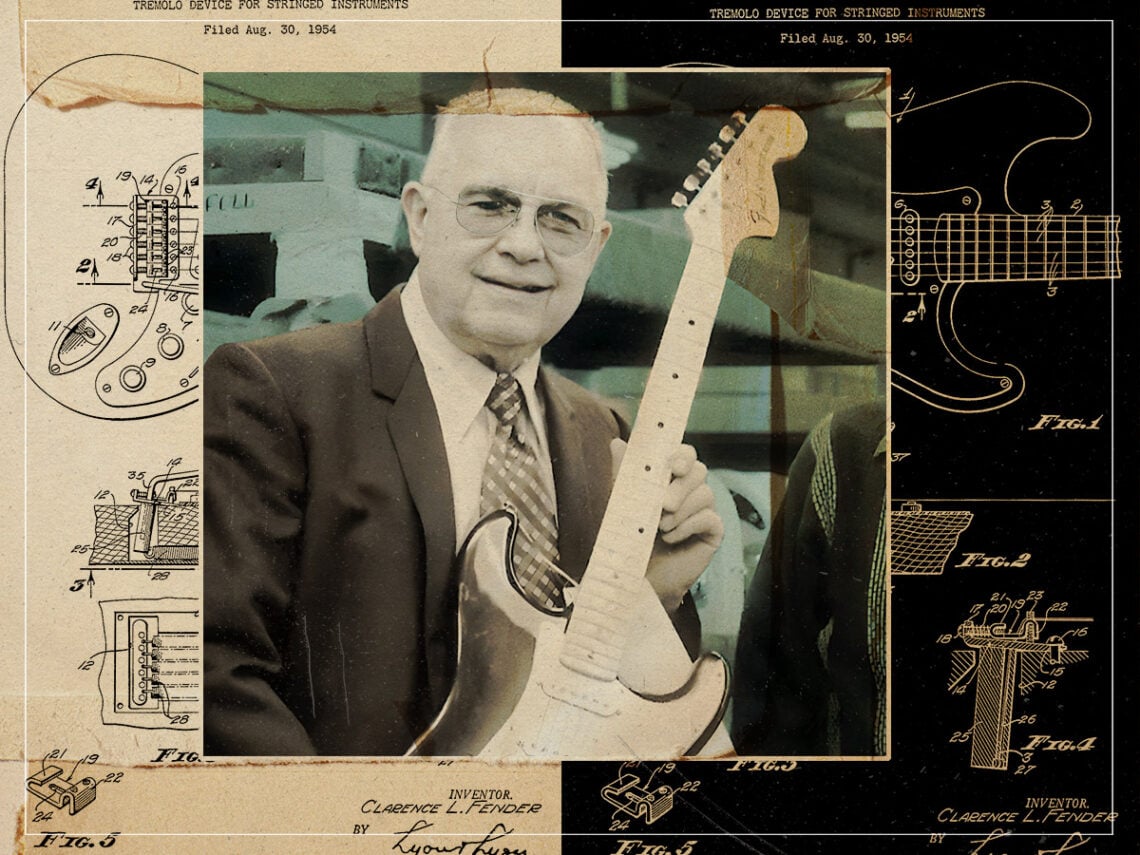
Leo Fender: the man who changed the guitar forever without being able to play a note

Ask anyone in music, and they’ll know the name Fender. Scratch that; ask most people in the world, or at least show them the logo, and they’ll probably recognise it, too. It’s a household name. A titan in the music world, sprawled across the guitar necks held by some of the best players in history. Fender is held up as the top class, with models like the Telecaster often imitated by never being beaten and never needing to be improved upon as the style and build endure as a favoured weapon for players throughout genres, decades, and countries. But yet the man behind it all, Leo Fender, never played a note.
It feels rather sad that Fender could never enjoy his creations fully. It would probably be expected that the man behind it all would be some kind of rock legend able to shred like no one else. That assumption lends itself to a creator who understands precisely what a great guitar needs or what innovations would help make playing easier or make the instrument sound its best. But for Fender, he approached it all from a very different angle, one that wasn’t musical at all.
Fender, instead, was interested in electronics. He grew up visiting his uncle’s automotive-electric shop and became especially interested in radios, which he began repairing. With this interest, he learned more about the mechanics of radios, speakers, amplifiers, and all the equipment needed to make, share, and effect noise. Soon, bands came to him to ask him for his services to make the equipment.
In 1945, after meeting Clayton Orr ‘Doc’ Kauffman, a guitar player who worked for Rickenbacker making steel lap, they started K&F Manufacturing Corporation. Together, they combined Kauffman’s knowledge of guitars with Fender’s electronic mind, having already patented his own custom pick-up.
It was perfect timing. Just as Fender was making these early custom pickups, the world of rock and roll was getting underway. More and more musicians were embracing the electric guitar to allow for bigger and louder sounds as well as more variety in tone.

However, the instrument, especially solid body guitars, was still considered a novelty, so it had yet to be perfected. While Fender wasn’t a guitar player and couldn’t understand from experience, his connections to musicians and his understanding of electronics had him convinced that he could make the ultimate instrument: one that was easy to hold, tune, and play, and one that could hit the perfect volume for a range of different venues from dance halls to stadiums. In 1950, he finally made it happen when he made the Telecaster.
The guitar became the most famous and popular electric guitar in history. Just like the company name of Fender, the Telecaster is a household name, too, with its iconic shape inspired by Spanish guitars. It has been played by Keith Richards, Bob Dylan, Eric Clapton, Jeff Buckley, David Gilmour, Chrissie Hynde, and more. In fact, it would probably be easier to list the iconic musicians who didn’t, at some point, play a Telecaster of one of Fender’s other inventions like the Stratocaster or the Precision Bass.
But it feels impossible that a man who couldn’t play the guitar could be responsible for the greatest guitars ever made. “Leo was a strange man in a way,” his partner Don Randall said. “He had a fetish for machinery,” he explained, talking about how Fender was obsessed with the idea that no expense or effort should be spared to make the best product on the market.
He added, “Nothing was done economically, necessarily. If you could do it on a big machine, well, let’s buy the big machine and use it.”
That determination and drive is echoed by his colleague George Fullerton, who said, “The ideas he had, you didn’t change him. If he had an idea to try something, the only way you’d ever change him would be to prove that what he had would not work.”
But overwhelmingly, Fender made the best instruments because he was the hardest-working innovator around. “Leo certainly was a hardworking person,” Fullerton told Guitar, “He was not pretentious. He was not the kind of person who wanted to be a big shot, if you want to call it that, and never was. Even up to the day he passed on, he was Leo.” It just so happened that Leo couldn’t play guitar, but he sure could build a mean one.
