


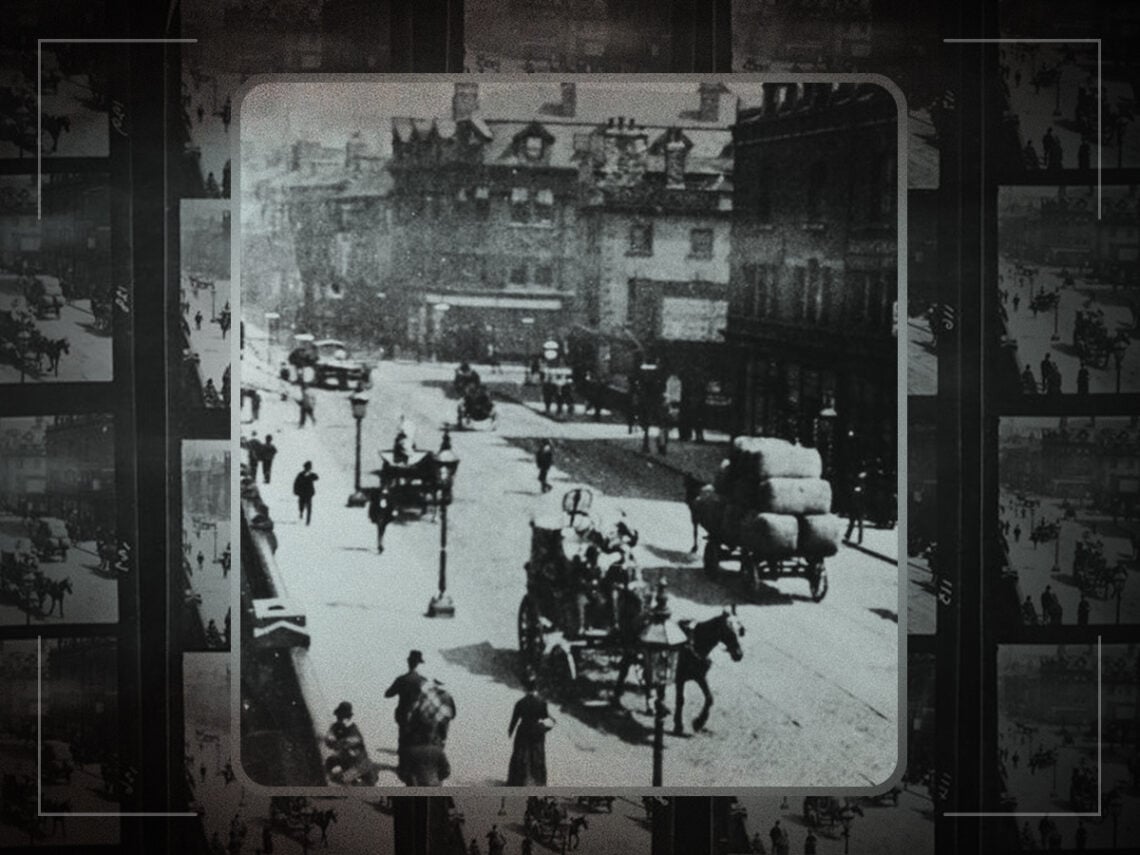
The Leeds bridge that became the subject of one of cinema’s first movies

Leeds is probably one of the last places you’d imagine to have a substantial cinematic history behind it, but the city actually played a key role in the development of the medium.
While it’s easy to see the city as nothing more than a place rammed with students, football fans, and Tetley’s drinkers, there has always been a vibrant creative charge pulsating through the city’s streets and red brick houses.
Many great bands have come from Leeds, and there’s a thriving scene that spreads across the city’s vast network of independent venues, currently going strong. Meanwhile, some incredible artists have called Leeds their home at some point or another, like John Atkinson Grimshaw and Barbara Hepworth, with the former often immortalising the city in his work.
Unfortunately, there aren’t many notable filmmakers from the city, which is a shame, really, because back in the late 1800s, cinema essentially began in the city, all thanks to French inventor Louis Le Prince, who, while studying science in his native country, met and befriended Englishman John Whitley.
When the latter asked Le Prince if he wanted to work for his company over in Leeds, he accepted the post, and soon he began a new life in the Yorkshire city, developing his interest in both art and science through the invention of a camera which could capture moving images, and he soon successfully made one of the world’s first motion-picture cameras. On the other end, he opened up an art school with his wife, which was located in Park Square, while his studio could be found on Woodhouse Lane.
These aren’t the only Leeds locations that possess cinematic history, though, because he would come to film several early experiments with motion pictures in the city, the first being Roundhay Garden Scene, which many believe to be the first ever film. Shot in 1888, it was filmed at Oakwood Grange in Roundhay, just a few miles from the city centre, and that same year, he took his camera out into the city, where he shot three seconds of footage on Leeds Bridge, which is located near the Calls and The Tetley. It’s a pretty unsuspecting bridge, but it was here that Traffic Crossing Leeds Bridge captured carriages and people walking on the river crossing, a documentation of a world that now seems so far removed.
Filmed in grainy black-and-white, it might not look like much when we consider what cinema is capable of today, but this was truly groundbreaking, posing these newfound possibilities to immortalise moving sequences on film, so the next time that you cross that bridge, remember that it was here that one of the earliest films was shot, even if it was only three seconds in length. Le Prince would call Leeds home for around 20 years, developing his cinematic inventions in the city until he eventually moved back to France, which is more commonly considered the birthplace of cinema.
Interestingly, he would disappear in 1890, just two years after his revolutionary film inventions, and his body has never been found, with theories proposed, from suicide to murder at the hands of his own brother, although the conspiracy that Le Prince was assassinated, possibly by Thomas Edison, due to the race to patent this new technology first, remains the most discussed.
What happened to Le Prince is still a mystery, but what we do know for certain is that his cinematic experiments changed everything, and who knows what film would’ve become if the French inventor hadn’t packed his bags and moved to Leeds?
