


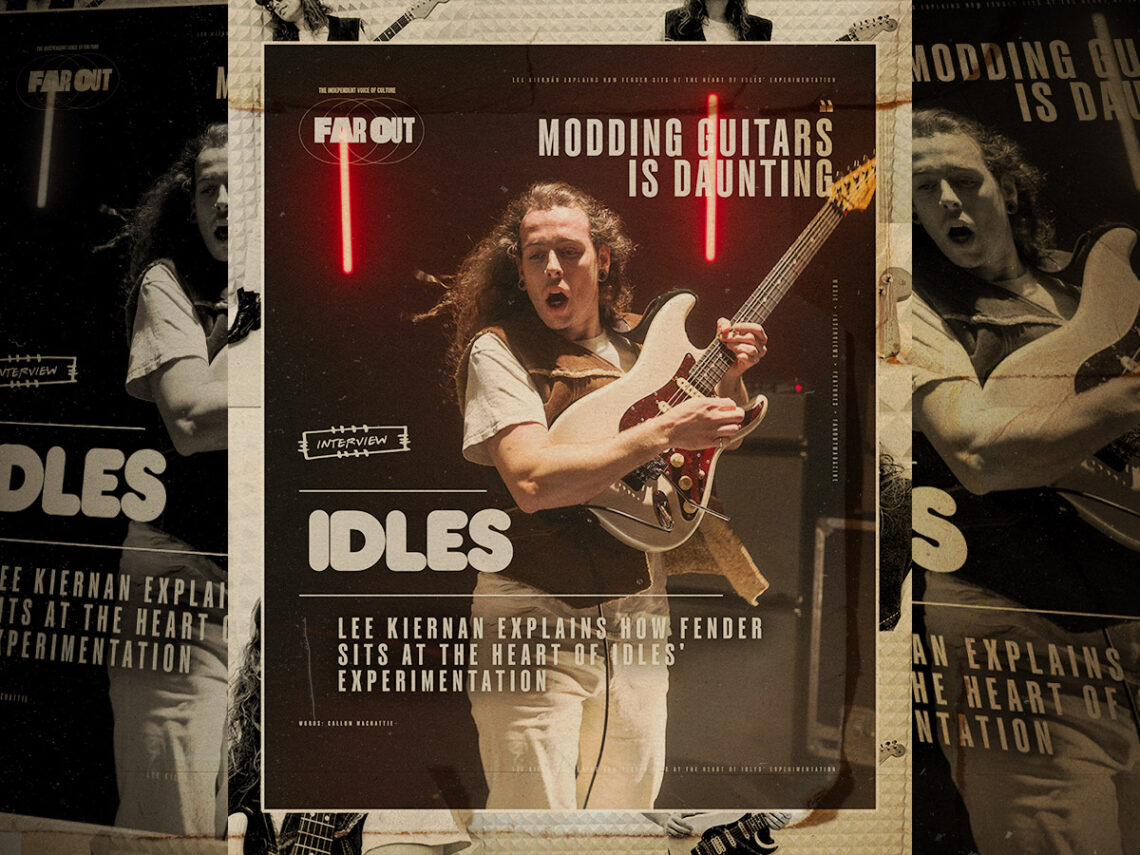
“Modding guitars is daunting”: Lee Kiernan explains how Fender sits at the heart of Idles’ experimentation

Guitar music is dead, or so they say. As the millennium turned and the megastars of music went from solo-playing juggernauts to electronic experimentalists, traditional fans panicked that the days of four-chord guitar glory were moving towards extinction. All nonsense, of course, but to suitably quash any irrational fears, a brave new band was needed to stake their flag into the dreary landscape of alternative rock and point us to the future. Thus, enter Idles.
Upon the release of their 2017 debut album, Brutalism, they ushered in a new brand of alternative music that eluded all of the conventional 21st-century subgenres. Welding up-tempo beats of their native Bristol with caustic punk sensibilities and finding a compelling orator in Joe Talbot, Idles tapped into something that rose above tired labels of ‘guitar music’.
“Like the sound of what we are is, is what we are. As much as we take influences from all of our favourite genres and artists, we’ve never really tried to follow anything that’s happening now. So we’ve always just done what pleases us. And that’s it,” guitarist Lee Kiernan told me with an honest sense of pride when I asked how the mixed influences of a diverse city helped cultivate their sound.
The core of the band’s halcyon days had a free spirit, as they weren’t consigned to the templates set out by any predecessors. They were operating in entirely new sonic territory, in a societal landscape desperately in need of both an honest and fresh interpretation.
It has been just over 15 years since they formed the band and set out to inject a healthy dose of nuance into an otherwise tired musical landscape. Now, they have been announced as ambassadors for Fender for the release of their upcoming Player II Modified guitar.

“I grew up playing Fenders, I started on Fenders,” said Kiernan, excitement evident. “I think every person that starts playing a Fender [and] dreams that one day they’ll have their own signature Fender, which is obviously just completely ridiculous. But it’s just fun, isn’t it, to think what you would have, what you would do. So to actually do this and be partnered with Fender now is incredible.”
It’s fitting that Kiernan and his axe-playing contemporary Mark Bowen will become inextricably linked with a campaign celebrating the art of modifying. Because the pair are no strangers to personalised modification. In fact, while Kiernan’s Mustang is a go-to instrument for the guitarist, readily available at a moment’s notice to provide an Idles song with their signature sound, it’s been through several transformations. A snapped neck wasn’t enough for Kiernan to part ways with a guitar that has had its pick-ups consistently modified to suit his self-confessed shoddy strumming style. But this understanding of style and consequent imperfections has helped forge a unique sound for the band.
“I mean for the majority of the time we’ve written songs to play them live because we are a live band and we love performing our music.”
Lee Kiernan
“Modding guitars is daunting,” Kiernan claims seriously, “like changing something on a guitar, but ultimately, if it’s not the feel in the end, you can put it back. You can, you can do anything you want to it. And not being afraid to do that is important because, then it means you can try new things. And honestly, you will, you will mod a guitar, and it will sound terrible, or it will play horrible, or it will be crap. But sometimes that crap will make a noise that you didn’t expect, and that will give you a new inspiration.”
I suppose my description of caustic is Kiernan’s crap. But that raw-boned identity within the band’s discography is where their artistic tenderness lies. Whether it’s showcased on a more raucous and frantic song like ‘War’ or a broodingly tender ‘MTT 420 RR’, Idles have a sonic ability to soften the shadows that none of their contemporaries come close to plagiarising. While that’s largely rooted in their exploration of creative ideas, once again, it’s Kiernan’s trusty Mustang that comes into play.
He admitted, “That guitar is, it’s a cutting guitar, so if there’s anything that needs like hard, angular, chords, aggressive playing, it’s that guitar. If there’s anything that needs feedback, I could go straight to that guitar. That’s the one for me; pretty much every single feedback take I’ve ever done on any of our records is with that guitar.”
Feedback has become somewhat of a signature style for Idles. It’s what Bowen describes as “top-end violence” in the band’s discography, but it has helped give their sound a sort of intangible potency. Back to the space Kiernan describes as potentially “crap”, it proves the band aren’t afraid to play in the shadows for as long as it takes to find that nugget of innovation yet unheard in contemporary music.
Of course, in the studio, you have time to explore such murky depths, whereas the live show is a different beast altogether. Time-limited and under the everpresent pressure of an onlooking audience, this myriad of playful ideas needs refining. So how is it achieved? With great difficulty.
“It’s just ridiculous. We have loads of amps and loads of guitars, and they all go around with us,” Kiernan explains before admitting that the sheer spectacle of their equipment-laden stage is inspiring in itself. “It’s amazing, it feels amazing, it looks amazing when you turn around and you see all these amps. I mean, for the majority of the time, we’ve written songs to play them live because we are a live band, and we love performing our music.”

But don’t mistake unbridled noise for unrefined skill. The very appeal of the Idles sound is their continued push at conventional norms and cramming as many emotional shifts into a song as possible. While the end result feels somewhat effortless—given its resonating power—there’s a high level of performative requirement underneath it. Something that becomes increasingly apparent as they hurtle towards ‘Grace’ on the setlist.
“There’s just moments like ‘Grace’ that has so many pedal changes in, they have to be bang on. Otherwise, they bleed into the next parts,” he says, before adding, “Because there’s so much going on, Bowen’s got loads going on with him, Jon with the drums, Joe’s got to be focussed on the singing in time with the drums which are a bit weird in the mix, so then if I fuck it as well, it’s just another noise that doesn’t need to be in a place where there’s already loads of noises; it’s just, it’s kind of a little bit stressful.”
So as they snap loose the band on their wrist that says ‘Glastonbury 2024 Other Stage Headliners’ and look to the future, where a seminal homecoming Bristol show awaits, you can’t help but wonder where a band who perennially straddle the line between art and noise will head next?
“We can write songs like Brutalism, Joy [as an Act of Resistance], Ultra Mono, Crawler and Tangk, but we want to write new things. And, you know, how that happens depends on what we have in our hands. Like it might be that a new guitar helps you make a new sound, or it might be that you need that old guitar to make the sounds that you’re used to on top of this new song. But we love exploring what is possible more than anything.”
At some point, the dust from Tangk’s atomic explosion will have to settle. And when it does, you’ll be sure to find Kiernan alongside his bandmates sifting through the remains, with one hand on the neck of his trusty but bruised Mustang and the other pointed towards the future.
