


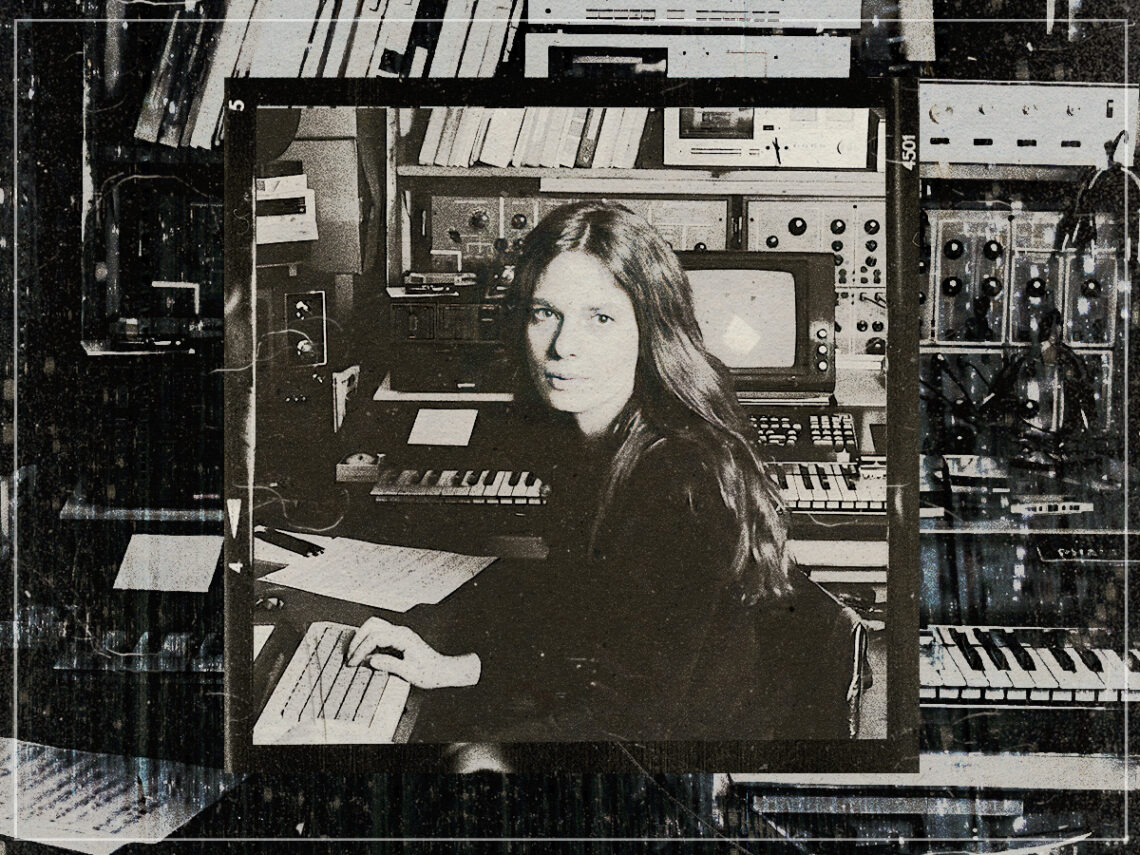
Laurie Spiegel: the forgotten musician who might become the first human heard by aliens

Electronic music has always been a genre pioneered and developed by women. While the first commercial synthesiser was created by a man, Robert Moog, it was avant-garde composer Wendy Carlos who was responsible for suggesting vital improvements to the instrument, which aided its efficiency. She subsequently popularised the synth with her album Switched on Bach, released in 1968.
Before that, women such as Delia Derbyshire and Daphne Oram made notable contributions to the BBC Radiophonic Workshop, with the former creating the Dr Who theme and the latter pioneering the Oramics technique. Thanks to these women, electronic music has been able to flourish, allowing it to become one of the most popular genres.
Sadly, due to the male-dominated nature of the music industry, many female electronic pioneers have failed to receive the attention or recognition they deserve. One of these women is Laurie Spiegel, who is not only a master of computer-based composition but also a skilled multi-instrumentalist and creator of Music Mouse, a popular composition software.
Despite her outstanding contributions to electronic music, Spiegel’s name has faded into relative obscurity, only enjoying somewhat of a resurgence in the past decade. Yet, Spiegel’s career has been long and momentous, beginning her musical journey as a child when she began playing the mandolin and the guitar. She ended up moving to England from the United States to attend Oxford University, eventually studying with the composer John W. Duarte in London.
When she was back in the States, she began working with synthesisers at Bell Laboratories. She told Crack, “I love electronics, I love electronic sounds, I love logical processes.” Spiegel imbues her computer-based music with warmth, “In my book, whether it’s conventional instruments or electronics, emotion is the essence of what music is for,” she explained.
The creation of Magic Mouse allowed it to be used on Macintosh, Amiga, and Atari computers, and it was widely available until 2021. Throughout the years, Spiegel has also released albums, such as 1980’s The Expanding Universe and 1991’s Unseen Worlds. However, back in 1977, Spiegel’s electronic interpretation of Johannes Kepler’s ‘Harmonices Mundi’ was placed as the opening piece on the Voyager’s Golden Record.
Discussing her work, Spiegel told Pitchfork: “I was sitting with some friends in Woodstock when a telephone call was forwarded to me from someone who claimed to be from NASA and who wanted to use a piece of my music to contact extraterrestrial life. I said, ‘C’mon, if you’re for real, you better send the request to me through the mail on official NASA letterhead!”
The gold record was sent into space with the intention of introducing extra-terrestrial lifeforms to humanity. Thus, the decision to include ‘Harmonices Mundi’ was not arbitrary; the piece is directly inspired by the planets. Of course, no aliens have discovered the golden disc just yet, but if they ever do, they’ll be greeted with one of Spiegel’s futuristic pieces before anything else.
Spiegel has continued to make music, electronic and otherwise, and soundtracked films and documentaries. Her piece ‘Sediment’ was even used in the 2012 dystopian movie The Hunger Games, partly aiding her newfound recognition. The multi-talented artist has paved the way for a legion of future electronic musicians, proving that computers can be imbued with an incredibly human essence when used correctly.
