


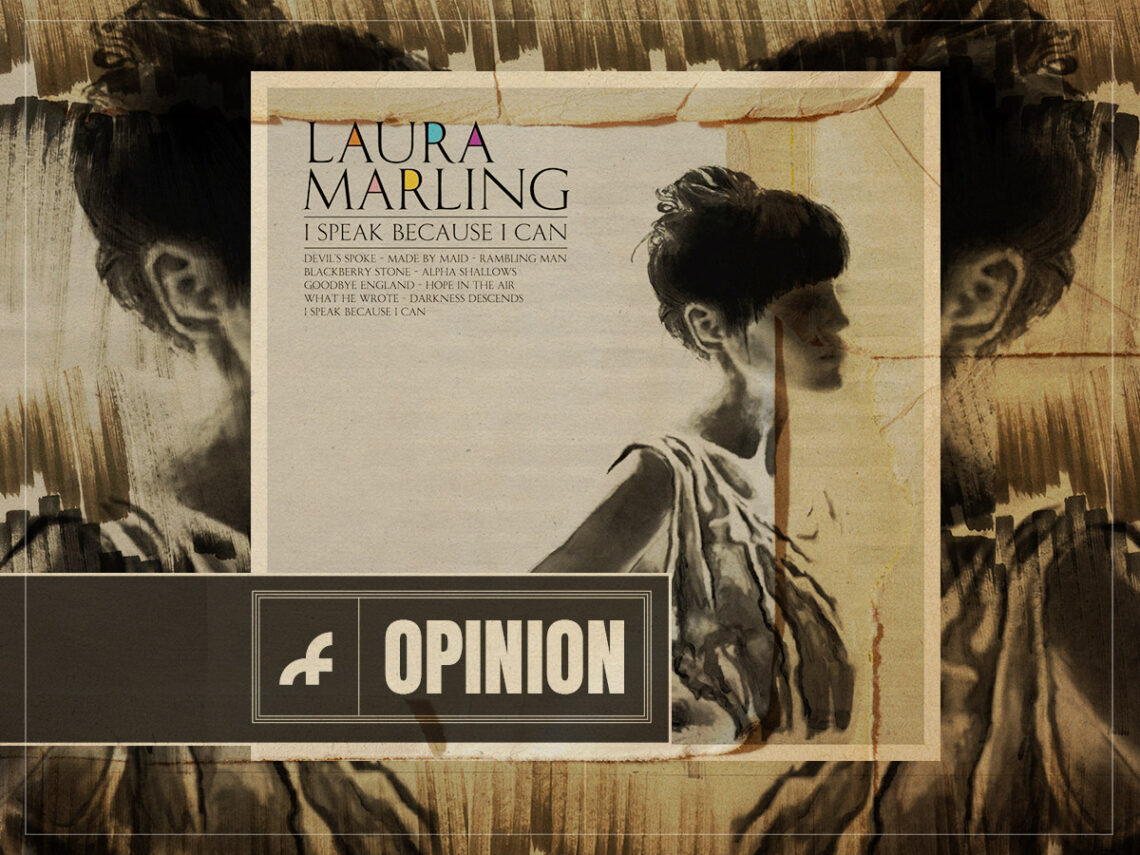
Hear Me Out: ‘I Speak Because I Can’ is still Laura Marling’s best album to date

Given the chance to create something truly classic at the age of 20, would you? Seriously, ask yourself that now. Because sure, at the time, you get the whole ‘prodigy’ treatment. You get to cause your peers paroxysms of existential horror when you drop into the conversation that ‘yeah, you were born in 2004’, and that’s always fun. What comes next, though? How the hell do you return to a bar that you yourself set so stratospherically high when you weren’t old enough to drink in the US? Do you appreciate the fact you’ve made it? Or do you curse the fact that now you’ve got to live up to it? In the case of Laura Marling, I would expect the latter.
Perhaps because with her debut album, 2008’s Alas, I Cannot Swim, she’d danced the whole ‘holy shit, this girl’s a literal child’ dance already and seemingly hated every moment of it. Alas is a good album. At points, it’s great, like the spellbinding centrepiece ‘My Manic And I’. Part of the record’s charm, though, is its precocity. At others, it really does feel like a teenager looking you right in the eye and, eloquently enough, demanding to be treated like an adult. Which is a one-way ticket to being patted on the head and told, “Yeah, OK, sweetie, off you pop now”.
Strangely, I’m reminded of another act who were around the same age, if not younger, when their debut album hit. The four members of Panic! At The Disco (yes, stay with me) were around 17 and 18 when their debut album, A Fever You Can’t Sweat Out, made a worldwide sensation of them. Their follow-up, 2008’s Pretty. Odd. seemed almost purposely built to dress them up in adult clothes, to say to the world, “Forget that kiddie shit from earlier. We’re real adults now, have you heard of The Beatles?”
It’s the same fate most young stars share when they want to quote-unquote ‘grow up’. They start playing the role of adults because as much as they want to shed the trappings of youth, they don’t know who they really are without youth on their side. Thus, they remain shackled to this image of the eternal teenager without ever really wanting to be one. Lack of identity was not an issue Marling faced moving from debut to second album. She moved into her own place, had an album written about breaking up with her (thank you very much, Charlie Fink), and began to embrace her image more as the campaign for her next album started picking up.
This isn’t just me being gross, either. During an interview with The Observer promoting the record, Marling talked about wearing make-up in promo photos for the first time. “I didn’t want to wear makeup then,” she explained, “Because I didn’t want to give in to that. It was all because I wasn’t at ease with myself.” In a separate interview with Uncut, looking back on ten years of I Speak…, Marling illustrates the leap she’d made when talking about the album’s producer, Ethan Johns. “He turned down the first record, but I tried again with the second one – he seemed to be more impressed with the songwriting.”

And what songwriting it is. Opener ‘Devil’s Spoke’ is a swirling, propulsive dervish that immediately throws the listener into a darker, more sensual place than her debut ever did. Marling sounds positively regal as she intones, “Eye to eye / nose to nose / ripping off each other’s clothes in the most peculiar way”. ‘Rambling Man’ proves that’s not a scale she can only reach with bluster, shaking the listener with a simple high harmony over a line as simply haunting as “It’s hard to accept yourself as someone you don’t desire / as someone you don’t want to be”.
Fittingly for an album concerned with the relationship between self-image and self-conception, the album also reckons with the places society sets aside for women and girls. On the one hand, a strange comfort can be occasionally found in being assigned a caregiver. We can hear this in ‘Made By Maid’s’ tumbling Nick Drake-isms: “So I walk into the fog, found a babe atop a log and all alone / Took him under, took him on / Taught him everything about the world I’d come to know”.
Despite acknowledging the few comforts that can be found in embracing your societally mandated position, this is an album that also radiates a quiet, composed fury at them. Its title track rails against the learned dependence women are encouraged to develop towards men and stomach the sacrifices they’ll never get credit for making: “My husband left me last night / Left me a poor and lonely wife / I cooked the meals and he got the life / And now I’m just out for the rest of my time.”
For all my hyperbole, it’s not perfect. Marling would later develop a cutting, sardonic sense of humour in her work that would have enlivened the album’s occasional monotone nature. ‘Darkness Descends’ is a slightly baffling bit of country fluff that, considering some of the tracks cut for the record should have been tucked away as a B-side. Then comes the elephant in the room. This album is 14 years old. Marling has made five records since. Seven counting her side-project Lump. What does it mean to say this album is her best to date?
The last thing I want to do with all this is undercut the music she’s made since. She’s taken an enviable position as one of our most intriguing and innovative songwriters, whose music will always be worth checking in with whenever new work comes out. To me, though, that cultural capital was built from I Speak Because I Can, which would be a masterpiece of self-discovery no matter the age of its creator
